Search results: cavity

Waves find order in the chaos of an oddly shaped cavity

Waves find order in the chaos of an oddly shaped cavity

Condensed matter • Materials • Nanotechnology • Physics

By Mapping Ignorance

When light or sound bounces around inside an oddly shaped room, its reflections can quickly become difficult to predict. But new research led by scientists at the Advanced Science Research Center at the CUNY Graduate Center (CUNY ASRC) shows that waves can behave very differently when they travel through a special class of materials. The […]
A photonic picocavity in action

A photonic picocavity in action

Nanotechnology • Quantum physics

By DIPC

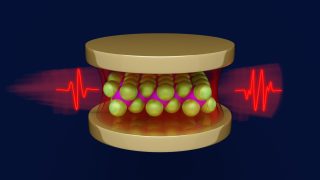
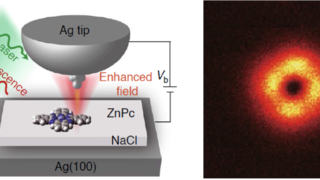
Light emission from emitters is a valuable piece of information in a variety of sensing and detection techniques, capable of labeling physical and biological processes which occur in the proximity of the emitter. Furthermore, quantum technologies are currently exploiting the statistics of single-emitters light emission aiming at turning particular emitters into fundamental units to sustain […]

Catching intramolecular vibrational redistribution in real time

Catching intramolecular vibrational redistribution in real time

Chemistry • Quantum chemistry

By DIPC

Molecules are never truly still. Even in apparently stable matter, atoms vibrate continuously, stretching and bending the chemical bonds that hold them together. These vibrations are not random noise: they determine how molecules absorb light, exchange energy, and undergo chemical reactions. One of the central challenges in chemistry is learning how to direct energy into […]

New Radio-Frequency Quadrupole design with symmetric direct transversal fields for efficient compact particle accelerators

New Radio-Frequency Quadrupole design with symmetric direct transversal fields for efficient compact particle accelerators

Particle physics • Physics

By Invited Researcher

A Radio-Frequency Quadrupole (RFQ) is a resonant cavity with a cylindrical symmetry divided in four lobes resembling a clover-like geometry and four vanes to focus and accelerate charged particles. This structure can accept a continuous flow of low-energy massive particles (such as protons or heavier ions) and accelerate them from the keV to the MeV […]

Optomechanical control of molecular motion

Optomechanical control of molecular motion

Physics

By DIPC

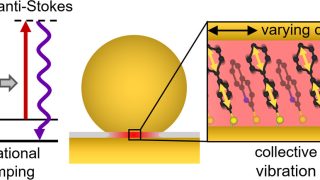
At first glance, molecules seem too small and too chaotic to be controlled with light. Their atoms jiggle ceaselessly, driven by thermal energy, and their vibrations—tiny oscillations of chemical bonds—usually remain hidden in the background. But recent work has shown that we can, in fact, use light not only to measure these vibrations but also […]

Vacuum fluctuations in optical cavities reveal hidden properties of embedded materials

Vacuum fluctuations in optical cavities reveal hidden properties of embedded materials

Quantum physics

By Mapping Ignorance

Researchers at the Max Planck Institute for the Structure and Dynamics of Matter (MPSD) have theoretically demonstrated that photons trapped inside an optical cavity carry detailed information about a material placed within it. By measuring the properties of the photons leaking out of the cavity, researchers can probe how an optical cavity modifies the properties […]

The effectiveness of the DNA origami method for placing molecules into plasmonic nanocavities

The effectiveness of the DNA origami method for placing molecules into plasmonic nanocavities

DIPC • DIPC Photonics

By DIPC

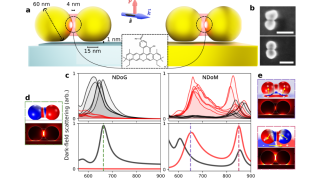
In the realm of modern technology, controlling light at the smallest scales is crucial for advancements in areas like medical imaging, environmental sensing, and the development of new computing technologies. A recent study explores innovative methods to manipulate light emission from individual molecules, paving the way for significant progress in these fields. The role of […]

Taste receptors: not only in the mouth, not only for taste

Taste receptors: not only in the mouth, not only for taste

Neurobiology

By José Ramón Alonso

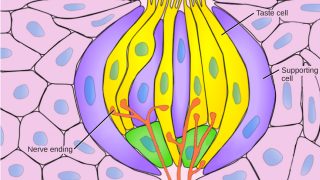
The perception of food occurs when food enters the oral cavity and depends on the action of three complementary sensory systems: somesthesia (a group that includes mechanoreception, thermal sensation and nociception), retronasal olfaction and taste. Taste is one of the five classical senses, along with smell, touch, hearing and sight. One of the most common […]

Parity-time symmetry for faster and stronger optical signal processing

Parity-time symmetry for faster and stronger optical signal processing

Condensed matter • Quantum physics

By César Tomé

In the era of big data, signal processing faces significant challenges in terms of capacity and energy consumption due to the torrent of data to process. With over 90% of data transmitted through light, optical signal processing may offer unprecedented speed and energy efficiency compared to its electronic counterparts, as it operates without the need […]