Search results: zigzag edge

Protection/deprotection strategy to zigzag edge segments of nanographenes

Protection/deprotection strategy to zigzag edge segments of nanographenes

DIPC Interfaces

By DIPC

In the last decades, a new synthetic approach has been developed, generally termed as “on-surface synthesis” that substantially departs from standard chemistry in solution. Instead of the three-dimensional space of solvents in the latter, the environment of the reactants in this new approach are well-defined two-dimensional solid surfaces that are typically held under vacuum conditions […]
Magnetic edges in graphene islands survive on a metal

Magnetic edges in graphene islands survive on a metal

Chemistry • Condensed matter • DIPC Advanced materials • Materials

By DIPC

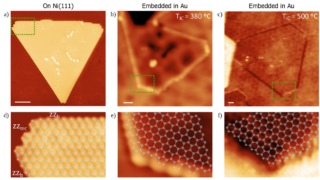
Graphene, a honeycomb sheet of carbon atoms just one atom thick, was first isolated in 2004 with adhesive tape and a lump of graphite, work that earned a Nobel Prize in 2010. Large sheets of graphene conduct electricity superbly, but they are not magnetic. Shrink a piece to a few nanometres, however, and its boundary […]

Graphene nanoribbons need to be protected from oxygen to remain functional

Graphene nanoribbons need to be protected from oxygen to remain functional

DIPC Interfaces

By DIPC

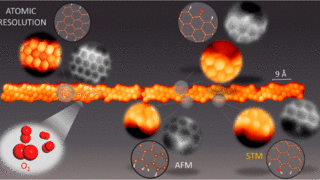
Real life is sometimes very different from laboratory settings. Take superconductivity, for example. In order to reach, it you either need extremely low temperatures, extremely high pressures or a combination of both; something that makes very difficult to conceive an everyday application out of a laboratory. Something similar happens with other new materials, but in […]

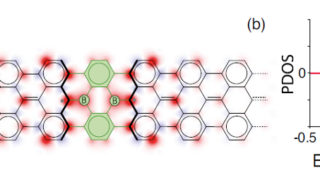
Magnetism in graphene nanoribbons induced by a pair of boron atoms

Magnetism in graphene nanoribbons induced by a pair of boron atoms

Condensed matter • DIPC Electronic Properties • Materials

By DIPC

Graphene nanoribbons (GNRs), are strips of graphene with ultra-thin width (<50 nm). Graphene ribbons, introduced as a theoretical model by Mitsutaka Fujita and coauthors to examine the edge and nanoscale size effect in graphene, have emerged as a promising material for nano electronics, as they combine many of the extraordinary properties of graphene with a […]

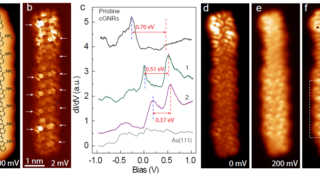
Quantum dots embedded in graphene nanoribbons

Quantum dots embedded in graphene nanoribbons

Chemistry • Condensed matter • Materials • Nanotechnology

By DIPC

Graphene nanoribbons (GNRs), are strips of graphene with ultra-thin width (<50 nm). Graphene ribbons were introduced as a theoretical model by Mitsutaka Fujita and coauthors to examine the edge and nanoscale size effect in graphene. GNRs are very interesting structures, partly due to their attractive electronic properties. Those properties vary dramatically with changes in the […]

Monolayers from aligned hexagonal islands

Monolayers from aligned hexagonal islands

Materials

By Mapping Ignorance

A method that can grow a useful insulating material into exceptionally high-quality films that are just one atom thick and are suitable for industrial-scale production has been developed. The material, called hexagonal boron nitride (hBN), is used in semiconductor devices and can also enhance the performance of other two-dimensional (2D) materials such as graphene and […]

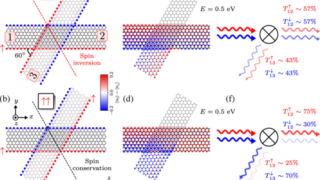
Crossed graphene nanoribbons as electron-beam splitter

Crossed graphene nanoribbons as electron-beam splitter

DIPC Electronic Properties

By DIPC

Graphene is an exceptional material with attractive properties to explore fundamental physics and for use in technological applications. While ideal graphene is non-magnetic, custom-shaped graphene nanostructures can be designed to exhibit complex magnetic phenomenology, with promising possibilities for a new generation of nanoscale spintronics devices. In fact, graphene π magnetism is more delocalized and isotropic […]

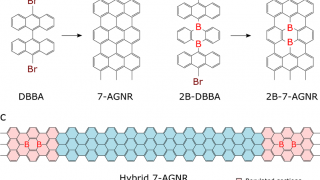
Engineering hybrid graphene nanoribbons with active electronic properties

Engineering hybrid graphene nanoribbons with active electronic properties

Condensed matter • Materials • Nanotechnology

By DIPC

Graphene nanoribbons (GNRs), are strips of graphene with ultra-thin width (<50 nm). Graphene ribbons, introduced as a theoretical model by Mitsutaka Fujita and coauthors to examine the edge and nanoscale size effect in graphene, have emerged as a promising material for nanoelectronics, as they combine many of the extraordinary properties of graphene with a high […]

Columbus and the shape of the Earth, a “Holywood” story

Columbus and the shape of the Earth, a “Holywood” story

History • Philosophy of science

By Jesús Zamora Bonilla

It is said that Washington Irving’s biography of Christopher Columbus, published in 1828, was the work that started the legend that the discoverer of America was the person that convinced the ‘nearly medieval’ Europeans of his time of the sphericity of the earth, a legend that has captured the popular imagination since then. Nothing could […]

Origami, the art of folding

Origami, the art of folding

Materials

By Silvia Román

Origami, the ancient art of creating intricate sculptures from a flat sheet of paper, is no longer just a Japanese curiosity, but a cutting-edge manufacturing technique. Just through bending and folding a given material, we can obtain complex 3D structures with applications in electronics, bioengineering or architecture, just to name a few that are currently […]