Search results: graphene nanoribbon

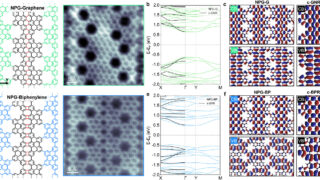
A new two-dimensional carbon allotrope combining graphene and nanoporous design

A new two-dimensional carbon allotrope combining graphene and nanoporous design

Chemistry • DIPC Advanced materials • DIPC Electronic Properties • Materials

By DIPC

Carbon is one of the most versatile elements in the periodic table. Beyond the familiar forms of graphite and diamond lies a rich family of carbon structures with surprising and useful properties. Among these, graphene, a single two-dimensional (2D) allotrope consisting in a layer of carbon atoms arranged in a perfect hexagonal lattice, has captivated […]
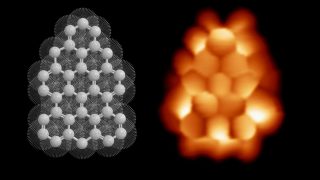
Twisting nanoporous graphene on graphene

Twisting nanoporous graphene on graphene

Condensed matter • DIPC Electronic Properties • Materials

By DIPC

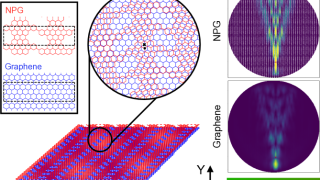
In a recent study, a team of researchers explores the intriguing electronic behaviours that emerge when two distinct forms of carbon-based materials—nanoporous graphene (NPG) and graphene—are layered together with a twist between them. Graphene is a single layer of carbon atoms arranged in a two-dimensional honeycomb lattice, renowned for its exceptional electrical conductivity, mechanical strength […]

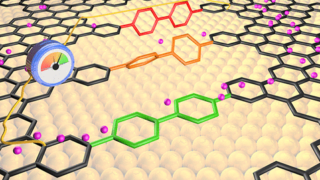
Molecular bridges as tools to engineer quantum transport in nanoporous graphene

Molecular bridges as tools to engineer quantum transport in nanoporous graphene

DIPC Electronic Properties • DIPC Quantum Systems

By DIPC

At the nanoscale, even the most basic quantum size effect, the induction of semiconducting gaps by electron confinement, requires ultimate precision. The case of graphene is a dramatic example, where deviations of a single atom in width can induce dramatic variations of the gap. As a consequence, local defects or variations in width can severely […]

Protection/deprotection strategy to zigzag edge segments of nanographenes

Protection/deprotection strategy to zigzag edge segments of nanographenes

DIPC Interfaces

By DIPC

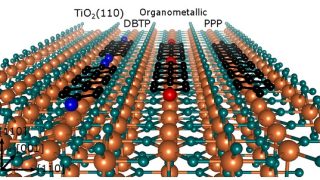
In the last decades, a new synthetic approach has been developed, generally termed as “on-surface synthesis” that substantially departs from standard chemistry in solution. Instead of the three-dimensional space of solvents in the latter, the environment of the reactants in this new approach are well-defined two-dimensional solid surfaces that are typically held under vacuum conditions […]

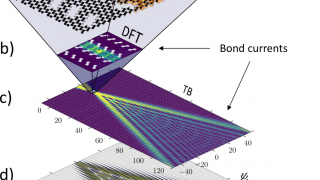
A Talbot carpet of electrons in nanoporous graphene

A Talbot carpet of electrons in nanoporous graphene

Condensed matter • Materials • Nanotechnology • Quantum physics • Theoretical physics

By DIPC

Controlling electron waves by harnessing phase-coherence and interference effects is a cornerstone for future nanoelectronics or quantum computing. To this end, design of platforms with well-defined, narrow, and low-loss propagation channels is essential. Nanoporous graphene (NPG) holds great potential for distributing and controlling currents on the nanoscale. But the effects derived from the wave nature […]

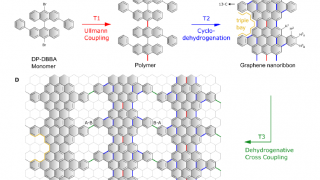
How to synthesize a nanoporous graphene that is both transistor and molecular sieve

How to synthesize a nanoporous graphene that is both transistor and molecular sieve

Chemistry • Condensed matter • Materials

By DIPC

Graphene is a two-dimensional allotrope of carbon made of hexagons. It is a zero-gap semimetal with a tiny overlap between valence and conductance bands. Since the isolation of graphene in 2004, considerable interest has been paid to exploring its applications in a variety of fields such as electronics, composites, sensors, catalysis and energy related systems […]

Graphene nanopore DNA sequencing

Graphene nanopore DNA sequencing

Biochemistry • Chemistry • Condensed matter • Molecular biology

By Francisco R. Villatoro

Nanopore DNA sequencing was one the ten scientific breakthroughs of 2016 highlighted by Science magazine. In principle, graphene is the perfect pore material for DNA sequencing . Its monoatomic thickness of 0.35 nm is similar to the DNA base spacing and graphene nanopores can be fabricated with a diameter of only 1.0 nm, about the […]

Charge transfer and symmetry affect π-magnetic nanostructures

Charge transfer and symmetry affect π-magnetic nanostructures

DIPC Electronic Properties • DIPC Interfaces

By DIPC

Whenever an electric current flows a magnetic field is produced; as the orbital motion and the spin of atomic electrons are equivalent to tiny current loops, individual atoms create magnetic fields around them, when their orbital electrons have a net magnetic moment as a result of their angular momentum. The magnetic moment of an atom […]

Efficient on-surface Ullmann-like reaction on poorly reactive surfaces

Efficient on-surface Ullmann-like reaction on poorly reactive surfaces

Chemistry • DIPC Electronic Properties • DIPC Interfaces

By DIPC

The way a particular reaction proceeds, described in terms of the steps involved, is called mechanism. The study of organic chemistry is, to a great extent, the study of reaction mechanisms and textbooks content both their description and their applications. But something has come to revolutionize the world of mechanisms: surface chemistry. On-surface synthesis is […]