Search results: moiré

Superconductivity in twisted graphene multilayers

Superconductivity in twisted graphene multilayers

DIPC Advanced materials • Materials

By DIPC

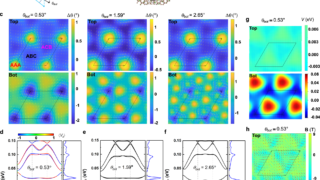
Superconductivity, the phenomenon where electrical current flows without resistance, has long captivated scientists and engineers. This unique state of matter holds promise for revolutionizing technologies, from power grids to magnetic levitation. A recent study delves into the intriguing world of graphene-based superconductors, shedding light on how twisting multiple layers of graphene can influence their superconducting […]

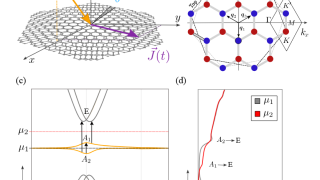
Photogalvanic effects in twisted bilayer graphene

Photogalvanic effects in twisted bilayer graphene

DIPC Quantum Systems

By DIPC

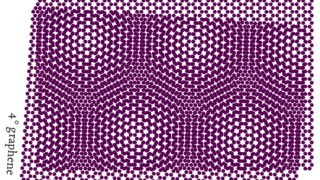
Twisted bilayer graphene (TBG) has garnered significant attention due to its unique electronic properties, especially when the two graphene layers are misaligned by a specific “magic” angle. This misalignment leads to the formation of moiré patterns, resulting in flat electronic bands that enhance electron interactions and give rise to phenomena such as superconductivity and insulating […]

Simple explanations for some complex patterns in twisted bilayer graphene

Simple explanations for some complex patterns in twisted bilayer graphene

DIPC Advanced materials • Materials

By DIPC

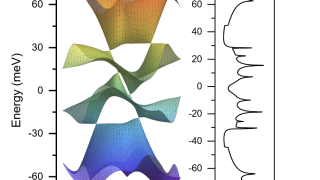
Twisted bilayer and multilayer systems represent two-dimensional materials, where atom-thick layers of the same or different materials are superimposed and rotated by an arbitrary twist angle. Twisted bilayer graphene (TBG) represents arguably the most prominent physical system of this kind, the bilayers of transition metal dichalcogenides (TMD) the other. The effect of twisting two periodic […]

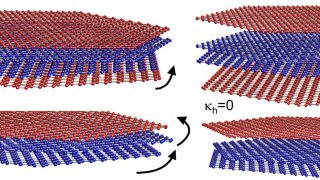
Engineering high Chern number materials

Engineering high Chern number materials

DIPC Advanced materials • Materials

By DIPC

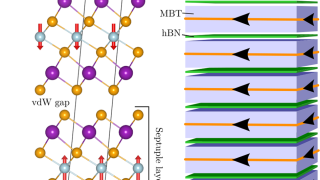
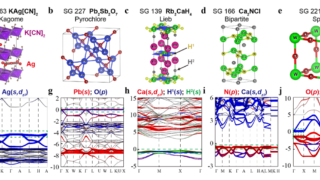
Some materials have special universal properties protected against perturbations. Such properties are theoretically described by topology, a branch of mathematics concerned with the properties of geometrical objects that are unchanged by continuous deformations. So-called topological insulators are electronic materials that have a bulk band gap like an ordinary insulator but have conducting states on their […]

How quantum geometry governs superconductivity in twisted multilayer systems

How quantum geometry governs superconductivity in twisted multilayer systems

DIPC Advanced materials

By DIPC

The band theory of metals has been experimentally tested many times and is now the accepted model of the behaviour of conductors and insulators. Electrical resistance is due to collisions of the electrons (whether treated as particles or waves) with impurities, imperfections, and especially the lattice vibrations of the metal crystal. The lattice vibrations of […]

An atomistic approach to twisted bilayer graphene-boron nitride heterostructures

An atomistic approach to twisted bilayer graphene-boron nitride heterostructures

DIPC Advanced materials

By DIPC

Twisted bilayer graphene (TBG) has taken the spotlight in the condensed matter community since the discovery of correlated phases. Now, a team of researchers studies heterostructures of TBG and hexagonal boron nitride (hBN) using an atomistic tight-binding model together with semi-classical molecular dynamics to consider relaxation effects. Isolated atomic planes, two-dimensional (2D) materials, like graphene […]

How the screened Coulomb interaction induces superconductivity in twisted bilayer graphene

How the screened Coulomb interaction induces superconductivity in twisted bilayer graphene

DIPC Advanced materials • Materials

By DIPC

Twistology could be the study of unexpected changes or developments in stories or situations, from coups d’état to the fatherhood of Darth Vader. In condensed matter physics there is something similar, although the preferred name is twistronics (from twist and electronics). It is understood as the study of how the angle (the twist) between layers […]