Delivering sound to a specific listener
Delivering sound to a specific listener
The kind of technology that can deliver sound to a single listener—like something out of a spy film—may soon become a reality. Researchers at Pohang University of Science and Technology (POSTECH) have developed a speaker system that can direct speech to a specific person. 1
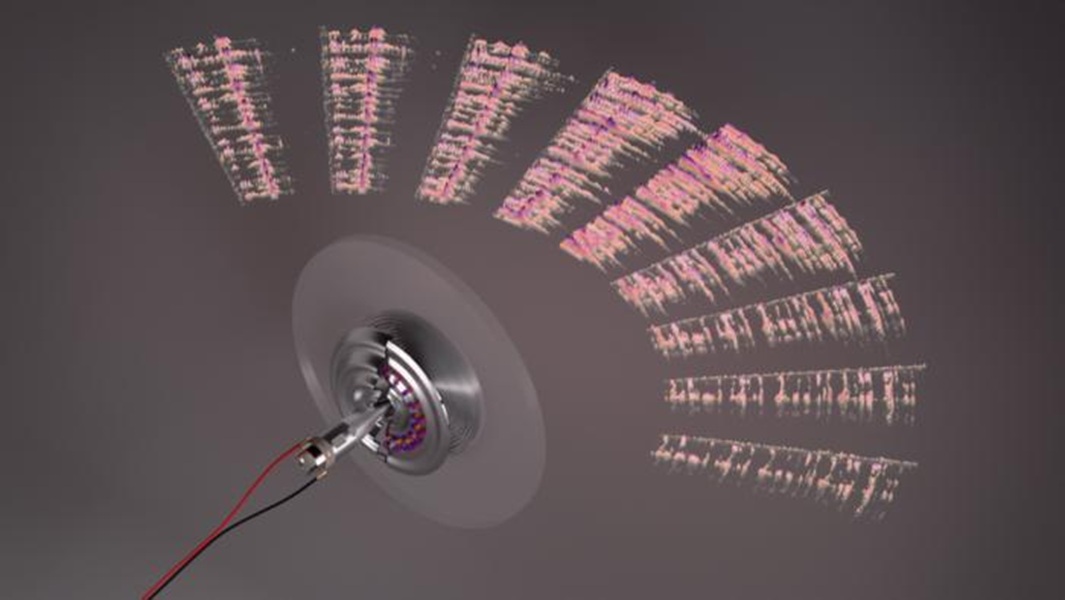
Light and sound behave differently. Light from a flashlight or laser travels in a straight line, whereas sound readily spreads in all directions—that is why voices can be heard over a wall. The question, “Could sound, like light, be sent only where we want it?” led to the team’s highly directional speaker, MiPAL. By modulating ultrasound with audible content, the system can deliver sound only within a targeted area. A representative technology is the parametric array loudspeaker (PAL), which uses the nonlinear interaction of two ultrasonic waves in air to generate and concentrate audible sound in a specific direction.
Compared with conventional speakers, PALs can confine sound to a much narrower region. Traditional systems, however, require tens to hundreds of ultrasonic emitters to be precisely arranged and individually controlled, making them expensive and structurally complex. More recent PAL designs have simplified the hardware, but the vibrating diaphragm can also excite unwanted vibration modes, allowing sound to leak sideways and undermining directivity.
The team addressed this problem by integrating two types of metamaterials into a single ultrasonic transducer. An acoustic metasurface was mounted at the front. Acting like a lens for sound, it reshapes the irregular ultrasonic wavefronts radiated by the diaphragm into a straight, narrow beam, much like a laser. Elastic meta-units were placed at the rear. Acting more like a sound barrier, they suppress unwanted vibrations at selected frequencies and keep sound from leaking to the sides. In effect, the design uses a double safeguard: it focuses the sound at the front and blocks parasitic noise at the back.
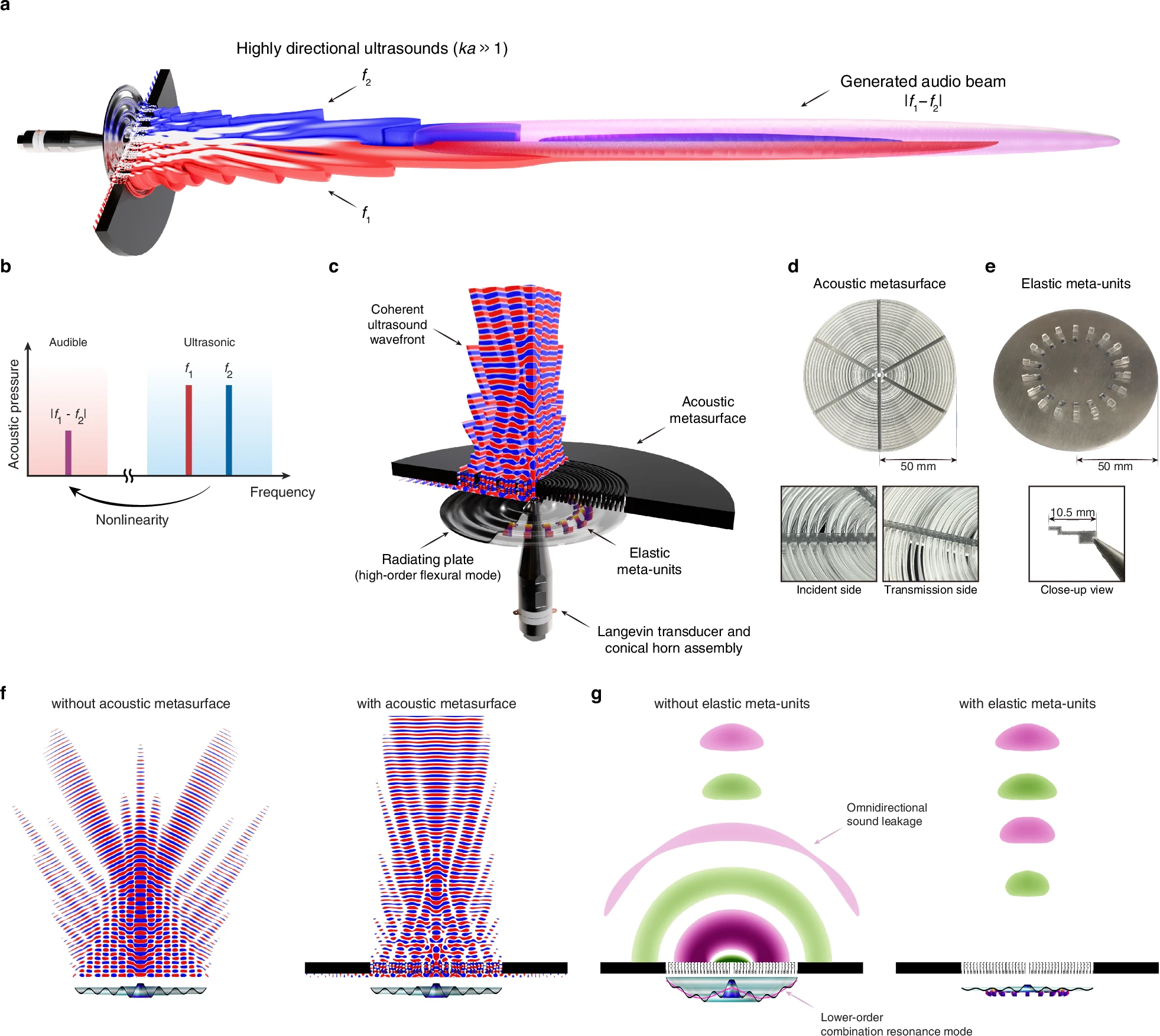
As a result, the single-element device directed sound over a frequency range of 500 Hz to 10 kHz—more than four octaves, covering a large portion of the audible spectrum. The researchers also conducted an experiment simulating aircraft seating, where different announcements or music might need to reach individual passengers without disturbing their neighbors. After playing real broadcast and music signals and measuring sound intensity at different angles, they observed a clear improvement after the elastic meta-units were added.
Another key advantage is ease of fabrication and adaptation. The metamaterial structures are modular and can be produced using 3D printing, allowing the device to be readily redesigned for different seat spacing, angles and other operating conditions.
Once commercialized, the technology could let passengers on planes or trains listen to personalized announcements or content without disturbing the person next to them. In museums and exhibition halls, explanations could be heard only by visitors standing in front of a particular display. The “sound only I can hear” once seen only in films may soon become part of everyday life.
“By co-designing the metamaterials and the ultrasonic device as a single system, we overcame the limitations of cost, complexity and design flexibility at the same time,” said Professor Junsuk Rho. “Research on acoustic and elastic metamaterials has largely remained at the stage of validating principles and demonstrating concepts. This study is the first to integrate metamaterials into functional device and demonstrate their potential for practical use.”
References
- Kim, W., Oh, B., Moon, W. et al. (2026) Dual-domain metamaterials co-integrated with a compact ultrasonic transducer for highly directional audio generation. Nat Commun doi: 10.1038/s41467-026-73604-0 ↩