Category archives: DIPC Advanced materials

A new two-dimensional carbon allotrope combining graphene and nanoporous design

A new two-dimensional carbon allotrope combining graphene and nanoporous design

ChemistryDIPC Advanced materialsDIPC Electronic PropertiesMaterials

By DIPC

Carbon is one of the most versatile elements in the periodic table. Beyond the familiar forms of graphite and diamond lies a rich family of carbon structures with surprising and useful properties. Among these, graphene, a single two-dimensional (2D) allotrope consisting in a layer of carbon atoms arranged in a perfect hexagonal lattice, has captivated […]

Giant collective Aharonov–Bohm oscillations in a kagome metal

Giant collective Aharonov–Bohm oscillations in a kagome metal

Condensed matterDIPC Advanced materialsMaterialsQuantum physics

By DIPC

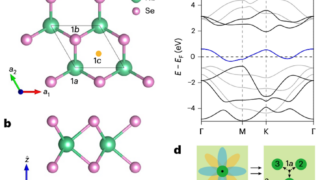
In the layered kagome metal CsV₃Sb₅, researchers have observed something that, until now, seemed almost impossible: robust quantum interference in the normal, non-superconducting state, persisting over distances of several micrometers. The interference is not the fragile single-particle kind seen in ultra-clean semiconductors at millikelvin temperatures. Instead, it behaves as if the entire stack of kagome […]

How charge and spin interact in any diffusive system with SOC

How charge and spin interact in any diffusive system with SOC

Condensed matterDIPC Advanced materials

By DIPC

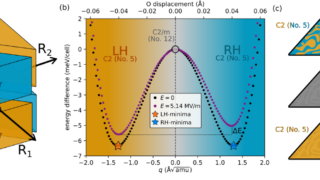
Imagine electrons as tiny particles zipping through a material, each carrying two key properties: charge, which powers our everyday electronics, and spin, like a little internal compass needle that points up or down. Charge flow is what we call electric current, but spin adds a magnetic twist, opening doors to advanced technologies like more efficient […]

A clash of quantum states in the mosaic phase of a transition metal dichalcogenide

A clash of quantum states in the mosaic phase of a transition metal dichalcogenide

Condensed matterDIPC Advanced materialsMaterialsQuantum physics

By DIPC

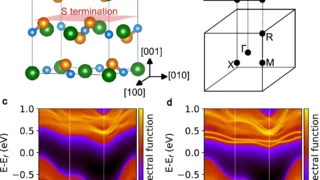
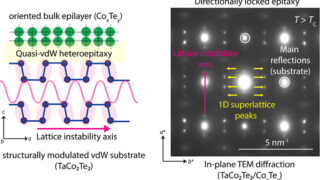
Imagine a material where electrons glide through without any resistance, moving like a perfectly synchronized dance troupe. This phenomenon, known as superconductivity, allows electricity to flow with zero energy loss, holding immense promise for everything from ultra-efficient power lines to advanced quantum computers. A a team of researchers dives into this fascinating world, focusing on […]

Dynamic and unconventional order in magnetic kagome metal FeGe

Dynamic and unconventional order in magnetic kagome metal FeGe

DIPC Advanced materialsMaterials

By DIPC

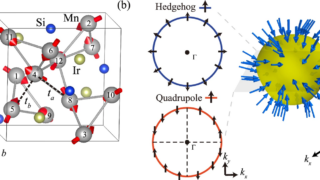
Imagine a lattice shaped like a network of interconnected triangles, called a kagome lattice, where atoms or particles struggle to find a comfortable arrangement. This unique structure creates a situation known as geometric frustration, where the particles can’t settle into a simple, orderly pattern because of the lattice’s shape. In a magnetic metal called FeGe […]

Graphene’s magic twist: fast and slow electrons

Graphene’s magic twist: fast and slow electrons

Condensed matterDIPC Advanced materialsMaterials

By DIPC

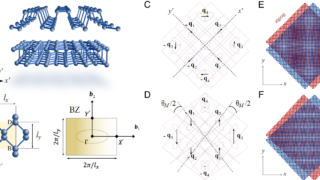
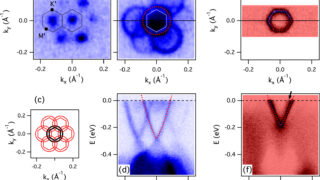
Graphene, a single layer of carbon atoms arranged in a honeycomb pattern, is renowned for its ability to conduct electricity with ease. When two graphene sheets are stacked and twisted at a “magic angle” of about one degree, something remarkable happens: the electrons slow down dramatically, creating “flat bands” where they interact strongly. A new […]

The cryogenic quantum twisting microscope and the phason mode of moiré systems

The cryogenic quantum twisting microscope and the phason mode of moiré systems

DIPC Advanced materialsMaterialsQuantum physics

By DIPC

In the realm of modern physics, few materials have captured the imagination quite like graphene, a single layer of carbon atoms arranged in a honeycomb lattice. Its remarkable properties, such as exceptional electrical conductivity and strength, have made it a cornerstone of research into quantum materials. A recent study published in Nature takes this fascination […]

Unlocking magnetism in nanographenes: The role of oxyradicals and molecular design

Unlocking magnetism in nanographenes: The role of oxyradicals and molecular design

ChemistryDIPC Advanced materialsDIPC InterfacesMaterialsNanotechnology

By DIPC

Nanotechnology is like a playground for scientists, where they tinker with materials at the scale of atoms to create new tools and devices with extraordinary properties. One of the most exciting areas in this field involves nanographenes, which are tiny pieces of graphene—a single layer of carbon atoms arranged in a honeycomb pattern, known for […]