Is water H₂O? (3): How chemists learned to count invisible atoms
Is water H₂O? (3): How chemists learned to count invisible atoms
Author: José Luis Granados Mateo is a postdoctoral researcher in the Department of Philosophy at the University of the Basque Country (EHU) and a member of the Integrated History and Philosophy of Science (iHPS) research group. His work focuses on history and philosophy of science, science and values, and the epistemology of scientific practices.
Water is H₂O. Few scientific formulas look more familiar, more compact, or more final. Two atoms of hydrogen, one of oxygen: the phrase seems to say what water really is beneath the shifting appearances of ice, vapour, rain, rivers and the liquid in a glass.
Yet that little subscript was not easy to earn.
By the early nineteenth century, chemists had good reasons to treat water as a compound of hydrogen and oxygen. The old idea of water as a simple element had lost its authority, as we saw in Is Water H₂O? (1) From Element to Compound. Electrolysis then gave that claim a new experimental force, making hydrogen and oxygen appear under electrical action, although not without raising puzzles of its own, as discussed in Is Water H₂O? (2) The Puzzle of Water Electrolysis. What remained unsettled was a more delicate question. Not whether water had constituents, but how many of each entered one molecule.
Was water HO? H₂O? Something else?
Today the answer feels almost automatic. In the first decades of atomic chemistry, it was not. Dalton’s atomic theory made HO the natural formula: one atom of hydrogen, one atom of oxygen. Avogadro proposed something much closer to the modern answer very early, but his proposal did not settle the matter. For more than half a century, some of the best chemists in Europe disagreed over the formula of one of the most ordinary substances in the world.
The confusion was public enough to become comic. In the 1860s, when agreement was finally beginning to form, an author identifying himself as a certified lunatic at Hanwell Asylum wrote to Chemical News mocking the chemists’ inability to agree even about water. One could contemplate the bewildering variety of formulas, he suggested, until the brain first became confused, then swam, and finally softened.
The joke had bite because the embarrassment was real. Chemical tables were full of combining weights, volumes, radicals, equivalents and atomic symbols. Water had long ceased to be elementary. Yet the old difficulty remained: to know the formula, chemists had to count atoms; to count atoms, they would have had to see them. And they could not.
Liebig put the matter painfully in 1851. Chemists possessed no direct means of ascertaining the number of atoms even in the simplest compound, because that would require seeing and counting them. Atomic chemistry needed numbers for entities no one could inspect.
So the problem was not that the answer lay beyond all reach. It lay beyond direct reach. Chemists had to learn to count invisible things by making them answer to operations that could be performed.
A number, and two worlds
The difficulty begins with a ratio.
Hydrogen and oxygen combine in fixed proportions by weight. In round modern numbers, water contains one part hydrogen for eight parts oxygen. Chemists could establish the ratio; the difficulty began when that ratio had to be translated into atoms.
Suppose water is HO. One atom of hydrogen combines with one atom of oxygen. Since the oxygen contribution weighs eight times as much as the hydrogen contribution, the oxygen atom must weigh eight times as much as the hydrogen atom.
Now suppose water is H₂O. Two atoms of hydrogen combine with one atom of oxygen. The same measured ratio now yields a different atomic weight: oxygen must weigh sixteen times as much as hydrogen.
The laboratory ratio has not changed. The invisible architecture has.
That was the circular trap. Molecular formulas required atomic weights; atomic weights required molecular formulas. Measurement gave combining proportions, not little labelled particles waiting to be counted. A consistent chemistry could be built with HO and oxygen as 8. Another could be built with H₂O and oxygen as 16. Once the difficulty spread across many compounds, chemists were no longer facing a local uncertainty about water. They were choosing among possible atomic worlds.
The difficulty appeared at the worst possible place: the point where atomic chemistry had to begin producing reliable numbers.
Dalton’s necessary guess
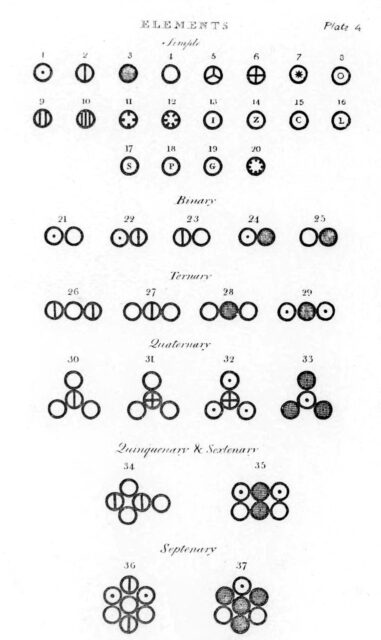
Dalton knew that atomic theory needed a starting point.
He approached water from within a broader problem. Chemical substances combined in fixed proportions; in some cases, the same elements combined again in different but still simple ratios. Atomic theory offered a machinery for these regularities. If matter consisted of particles with definite weights, then chemical combination could be understood as their joining in determinate numbers, and the arithmetic of chemistry began to point towards an unseen order. What it still failed to provide was the count itself: the number of atoms entering each compound.
Dalton therefore introduced rules of simplicity. They were not decorative assumptions added to an otherwise complete theory. They were what allowed the theory to produce numbers at all. When only one compound of two elements was known, Dalton assumed the simplest possible atomic constitution: one atom of each. Since water was the known compound of hydrogen and oxygen, its formula became HO. Hydrogen could be assigned atomic weight 1, oxygen 8, and the system could begin to move.
Judged from later chemistry, Dalton’s rule has an air of innocence. It was a methodological expedient rather than an experimental result, a way of allowing atomic theory to proceed when direct counting was unavailable. Dalton was not looking into water molecules and counting badly; he was working with weights, tables and regularities, in a period before spectroscopy, quantum theory or a settled molecular chemistry had made atoms answerable in other ways.
HO was wrong. It was not random. It belonged to a method that could bring order to combining weights before chemistry had better ways of counting atoms.
What gas volumes seemed to promise
Another route opened through gases.
Volumes could be measured, and gases combined with a striking regularity. Gay-Lussac showed that gases entered reactions in simple volume ratios. Two volumes of hydrogen combine with one volume of oxygen to form water vapour; other gases display similarly neat relations. To anyone looking for a way to count invisible particles, this was tempting.
If equal volumes of gases contained equal numbers of particles, volume could become a counting device. It would not show atoms individually, but it might give chemists a way to infer how many particles were involved.
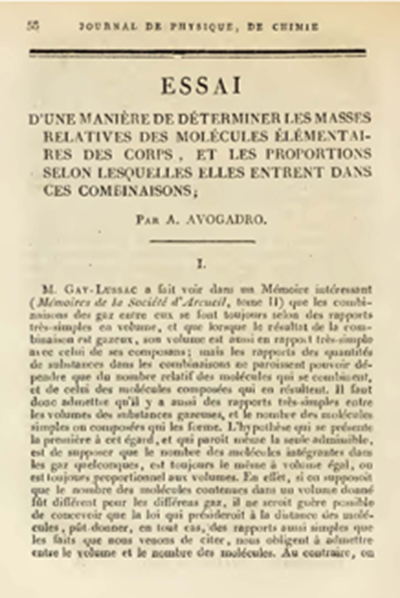
Avogadro made that move. Equal volumes of gases, under the same conditions, contain equal numbers of molecules. Grant that, and the formation of water vapour changes shape. Two volumes of hydrogen and one volume of oxygen produce two volumes of water vapour. The arithmetic works if hydrogen and oxygen gases are themselves molecular, H₂ and O₂, and if water is H₂O:
2H₂ + O₂ → 2H₂O
There it is, almost modern chemistry.
Yet the hypothesis did not conquer the field. The reasons were not merely psychological, nor reducible to conservatism. Avogadro solved one problem while creating others that looked serious at the time. Dalton saw no obvious reason why atoms of the same element should join into stable pairs. In his picture, atoms were surrounded by repulsive atmospheres of caloric; piling like atoms together was hardly the natural assumption. For electrochemical dualists, the difficulty sharpened further. Like atoms ought to have like electrical characters, and like electrical characters ought to repel. Why should oxygen atoms pair with oxygen atoms? Why should hydrogen atoms pair with hydrogen atoms? Why stop at pairs?
The hypothesis also asked chemists to treat elementary gases as molecules containing several atoms of the same element, and to imagine those molecules splitting during chemical combination. To those who trusted weights more readily than invisible gas particles, this was a large demand.
Even sympathetic chemists found the route uneven. Dumas tried, for a time, to develop Avogadro’s approach, but vapour-density results did not behave with perfect neatness. Mercury, phosphorus and sulphur made it hard to treat every elementary vapour on the model of hydrogen or oxygen.
Avogadro had offered a powerful clue. It was not yet the common language of chemistry. Water could have been H₂O in 1811; historically, that was not enough.
Atoms with handles
Behind the disagreement over water lay a larger problem. Nineteenth-century chemists were learning how to handle atoms at all: as weights, as volumes, as equivalents, as electrical units, as radicals, as centres of substitution.
For some, atoms were bearers of weight. For others, units in an electrochemical opposition. In Avogadro’s programme, gases offered a way of counting particles by volume. In organic chemistry, atoms and radicals became things that could be moved, exchanged and followed through reactions. Later structural chemistry would give them positions and patterns of connection.
Atoms entered chemistry through these practices unevenly: as things to be weighed, counted, exchanged, classified or connected.
A formula could be useful in one setting and awkward in another. Atomic weights could seem natural when derived from one class of operations and arbitrary when forced into another. Equivalents worked well for neutralisation and replacement. Volumes worked well for gases, though not without trouble. Substitution worked powerfully in organic chemistry. Electrochemical dualism arranged substances by polarity and affinity.
No single practice simply revealed atoms as they were. Each gave atoms a handle.
That is why the history of H₂O is not just a story about choosing the correct formula. The formula became convincing when atoms could be made to enter operations: weighed in one context, counted in another, substituted in a third, arranged elsewhere by their capacities for connection. Seeing was unavailable; work had to do the job of sight.
The caution of equivalents
One response to the circular trap was to avoid stepping fully into it.
Many chemists were cautious about atoms. Atomic language sounded metaphysical, or at least more speculative than the discipline required. Equivalent weights appeared safer. One substance could neutralise, replace or combine with another in a definite proportion, and those relations could be measured without deciding what atoms really were or how many of them sat inside a molecule.
Equivalents allowed calculation while holding invisible architecture at arm’s length. A chemist could say how much of one substance answered to another in reaction, without committing to a microscopic count.
This caution was productive. It helped chemists calculate, compare and classify. It also preserved ambiguity. In practice, an equivalent could behave rather like an atomic weight, even when chemists insisted that they were avoiding speculative atomism.
Water once again exposed the difficulty. If oxygen’s equivalent was 8 relative to hydrogen, HO looked natural. If oxygen’s atomic weight was 16, H₂O became natural. The issue depended on the passage from observable combining relations to invisible atomic units.
The appeal to equivalents allowed chemists to postpone bolder claims about atoms, while leaving a theoretical judgment embedded in the passage from measurable reactions to invisible units.
The detour through organic chemistry
The decisive work did not come from staring harder at water.
That is one of the surprises in this history. H₂O gained its strength elsewhere: in the movement of radicals, in substitutions, in families of organic compounds. Organic chemistry gave chemists a way to manipulate groups of atoms and to follow their replacements through reactions.
The key idea was the water type.
If water is H₂O, oxygen can be treated as holding two units together. In water, the two units are hydrogens. In alcohols and ethers, one or both hydrogens can be replaced by organic radicals. Water, alcohols and ethers could therefore be seen as members of a family, built around oxygen’s capacity to connect two branches.
At first this sounds like a tidy diagram. It became much more than that.
Williamson’s work on etherification gave the water type experimental substance. The older Liebig-Dumas view treated etherification largely as a removal of water from alcohol under the dehydrating action of sulphuric acid. Williamson rewrote the process as a traffic of groups. Sulphuric acid took an ethyl group from alcohol, leaving water behind; the resulting sulphovinic acid then handed that ethyl group to another alcohol molecule, taking hydrogen in return. Sulphuric acid was regenerated, and ether was produced.
The formula was doing work. It allowed chemists to follow the movement of groups through a sequence of transformations instead of merely recording elemental proportions at the beginning and the end.
Then came the sharper test. If the water-type picture was right, oxygen could hold two different radicals at once. Williamson therefore contrived ethers containing different combinations of methyl, ethyl and amyl groups. These were mixed ethers, not mere mixtures of symmetrical ethers. Under the rival Liebig-Dumas scheme, such mixed ethers should not have appeared as distinct compounds at all; at most, the experiments should have produced mixtures of symmetrical ethers.
Their production gave the water type operational force.

H₂O gained strength because it travelled. It helped chemists understand not only water, but alcohols, ethers and families of organic compounds. It made substitutions intelligible. It made room for oxygen as an atom with a definite combining capacity.
The problem had widened. Water was no longer an isolated substance to be analysed, but the simplest expression of oxygen’s capacity to bind, exchange and organise chemical groups.
Counting by substitution
Substitution reactions gave atoms a kind of experimental visibility.
No one saw oxygen holding two hydrogens. No one watched radicals attach themselves like beads on a wire. But chemists could replace one group with another and see what sort of compound resulted. If an atom or radical could be substituted without the molecule falling apart, that said something about the architecture of the compound. If replacing a central atom broke the molecule into two products, that said something else.
Here the language of valency began to acquire force. Oxygen and sulphur behaved as if they could bind two units. Chlorine behaved differently, as if it had only one hand. The metaphor is crude, but useful; later it would be disciplined into valency.
Water became the simplest member of a larger argument. If oxygen could connect two radicals in ethers, then the two hydrogens in water no longer looked like an arbitrary doubling. They were the simplest expression of oxygen’s twofold combining capacity.
The older picture of a central binding atom would later lose its privileged status. What remained was more durable: a number attached to an element’s capacity for combination.
This was a different kind of counting from Dalton’s simplicity rule or Avogadro’s gas volumes. Dalton counted by assuming the simplest combination. Avogadro counted through equal volumes. Organic chemists counted through substitutions, replacements and families of compounds. None of these methods made atoms visible. Each made them usable in a different way.
H₂O became embedded in a network of operations in which oxygen’s twofold capacity could be tested across many compounds. The formula began to earn its keep.
Cannizzaro and the story we like to tell
There is a familiar heroic version of the story. Avogadro discovered the key; chemists forgot it; Cannizzaro revived it at Karlsruhe in 1860; the fog lifted; H₂O won.
There is some truth in this. Not enough.
Cannizzaro’s intervention mattered. His presentation of atomic and molecular weights was clear, forceful and timely. By using Avogadro’s ideas, he gave chemists a way to distinguish atoms from molecules, molecular weights from atomic weights, formulas from combining proportions. His pamphlet circulated after Karlsruhe and influenced younger chemists who were looking for order in a confusing field.
The achievement was real. It was not miraculous.
By the time of Karlsruhe, many of the crucial battles had already been fought elsewhere. Organic chemistry had done a great deal of the work. Substitution, types, radicals and valency had given chemists practical ways to count and sort atoms. Cannizzaro clarified and spread a system that was already becoming workable; he did not unlock the problem by himself.
Nor did his account contain the strongest organic side of the story. Williamson, types, radicals and substitution had already made H₂O useful in ways that a purely Avogadrian argument could not.
Consensus emerged because several practices began to reinforce one another. Volumes, atomic weights, substitution patterns, organic structures and valencies gradually pulled in the same direction. H₂O did not win because an old hypothesis was finally remembered. It won because chemists had learned to make the formula work across a widening range of operations.
A formula becomes harder to doubt when it begins to do work elsewhere.
When H₂O became workable
By the 1860s, H₂O was no longer an isolated claim about water. It belonged to a broader chemical world.
Hydrogen was monovalent. Oxygen was divalent. Water belonged to a family of compounds in which oxygen could connect two units. Gas volumes supported the distinction between atoms and molecules. Organic substitutions gave chemists ways to test combining capacities. Atomic weights and molecular formulas could now be adjusted together with less arbitrariness than before.
Agreement on H₂O did not mean agreement on the reality of formulas. Some chemists treated them as useful instruments; others took them as claims about molecular architecture; many occupied positions somewhere between those poles. Chemical atomism became operationally secure before philosophical realism about atoms became uncontested.
The settlement also did not turn chemistry into a single perfectly unified language. Equivalent weights, atomic weights, empirical formulas, structural formulas and physical atomism did not collapse into one view. The field was rearranged. H₂O became stable within that rearrangement, not because every older tension disappeared, but because enough practices now supported the same count.
Once that happened, HO no longer looked like a reasonable simplification. It looked wrong. But it looked wrong from inside a later practice.
What H₂O hides
H₂O looks almost weightless on the page. Three symbols, one subscript, a formula learnt so early that it seems to have no history at all.
It has a long one.
Before chemists could write that subscript with confidence, water had to lose its ancient simplicity, acquire hydrogen and oxygen as constituents, and then submit to a harder demand. Its invisible parts had to be counted.
That last demand was the strangest. Weights could be measured, gases collected, volumes compared, substances replaced, compounds arranged into families. Yet no one could open a molecule and inspect its furniture. The number two had to come from elsewhere.
It came from operations. From volumes that made gases countable; from equivalents that allowed calculation; from substitutions that let radicals change places; from families of compounds in which oxygen repeatedly behaved as a twofold centre of combination. A count that no eye could read became stable through chemical work.
This is what the formula now conceals. H₂O is neither a convention nor a snapshot of an invisible object. It is a compressed history of practices, a small sign in which balances, gases, paper formulas, ethers, substitutions and valencies have disappeared into familiarity.
Water is H₂O. The difficulty lies in remembering how much chemistry had to be invented before that sentence could become obvious.
References
Avogadro, A. (1811). ‘Essai d’une manière de déterminer les masses relatives des molécules élémentaires des corps, et les proportions selon lesquelles elles entrent dans ces combinaisons’. Journal de physique, de chimie, d’histoire naturelle et des arts, 73, pp. 58–76.
Cannizzaro, S. ([1858] 1910). Sketch of a Course of Chemical Philosophy. Alembic Club Reprints, no. 18. Edinburgh: The Alembic Club.
Chang, H. (2012). Is Water H₂O? Evidence, Realism and Pluralism. Dordrecht: Springer. DOI 10.1007/978-94-007-3932-1.
Dalton, J. (1808). A New System of Chemical Philosophy, Part I. Manchester: Printed by S. Russell, for R. Bickerstaff, Strand, London.
Gay-Lussac, J. L. (1809). ‘Mémoire sur la combinaison des substances gazeuses, les unes avec les autres’. Mémoires de physique et de chimie de la Société d’Arcueil, 2, pp. 207–234.
Klein, U. (2003). Experiments, Models, Paper Tools: Cultures of Organic Chemistry in the Nineteenth Century. Stanford: Stanford University Press.
Liebig, J. von. (1851). Familiar Letters on Chemistry, in Its Relations to Physiology, Dietetics, Agriculture, Commerce, and Political Economy. 3rd ed. London: Taylor, Walton, & Maberly.
Rocke, A. J. (1984). Chemical Atomism in the Nineteenth Century: From Dalton to Cannizzaro. Columbus: Ohio State University Press.
Rocke, A. J. (2010). Image and Reality: Kekulé, Kopp, and the Scientific Imagination. Chicago: University of Chicago Press.
Williamson, A. W. (1850). ‘Theory of Ætherification’. The London, Edinburgh, and Dublin Philosophical Magazine and Journal of Science, 3rd series, 37(251), pp. 350–356.
Williamson, A. W. (1852). ‘On Etherification’. Quarterly Journal of the Chemical Society of London, 4, pp. 229–239. DOI 10.1039/QJ8520400229.