Is water H₂O? (1): From element to compound
Is water H₂O? (1): From element to compound
Author: José Luis Granados Mateo is a postdoctoral researcher in the Department of Philosophy at the University of the Basque Country (EHU) and a member of the Integrated History and Philosophy of Science (iHPS) research group. His work focuses on history and philosophy of science, science and values, and the epistemology of scientific practices.
Take a glass of water. Nothing about it seems to ask for a theory. It has no colour worth naming, no dramatic smell, no visible architecture. It runs, freezes, boils, evaporates, dissolves, erodes, circulates and nourishes. It belongs to weather, geology, physiology, cooking and plumbing before it belongs to chemistry.
Then science gives us the famous abbreviation: H₂O.
There is a curious finality in those three symbols. They seem to do what ordinary experience cannot. Rain, steam, ice, rivers, blood and laboratory wash bottles are all brought under a clean chemical statement. Two atoms of hydrogen, one atom of oxygen. For many people, H₂O is more than a formula. It is almost an emblem of scientific knowledge, the moment when science gets behind appearances and tells us what something really is.
Yet the formula stands at the end of a long story. Before water could be written as H₂O, it had to acquire a chemical interior. Chemists first had to learn to treat the most familiar liquid in the world as something that could be taken apart, recomposed and assigned constituents. The first transformation was not from one formula to another. It was from element to compound.
This is the starting point of Hasok Chang’s Is Water H₂O?, a book that does for water something close to what Inventing Temperature did for thermometry. Temperature now looks like a number waiting to be read from a scale. Chang showed that the scale had to earn that appearance of simplicity. Fixed points had to be stabilised, instruments compared, extrapolations justified. Measurement became routine only after it had first been constructed as a reliable practice.
Water presented another kind of difficulty. The problem was not how to make a phenomenon answer numerically, but how to make a familiar substance answer analytically. Chemists had to learn to look at water as more than something that flowed, froze, boiled, dissolved, condensed or could be purified. They had to ask whether it had an inside: whether it could be taken apart, made again, and understood through its constituents.
To us, that question feels almost unavoidable. In the eighteenth century, it was anything but.
When water had no parts
For much of European natural philosophy, water was an element. That claim can sound childish to us, though only because we hear it through the categories that later displaced it.
The idea was older than Aristotle. Thales had imagined water as the origin of things; Empedocles later placed it among the four basic “roots” of the world, alongside earth, air and fire. Aristotle gave that inherited scheme a more systematic form. But these were not elements in the modern chemical sense. No one was classifying them by atomic number, nuclear charge or molecular structure. They belonged to a physics of qualities and transformations, of hot and cold, wet and dry. Water was simple because, in that world, it occupied a basic place in the order of natural change.
By the eighteenth century, that older grammar had been heavily rewritten. Chemistry had become crowded with acids, alkalis, precipitates, metallic calxes, distillations and newly isolated “airs”. Water was everywhere in this world. It served as solvent, medium, reagent, product and experimental environment. It could be purified, frozen, boiled, condensed and recovered.
Still, none of that made it automatically compound. A substance can be experimentally familiar and still have no recognised chemical interior.
The difficulty is easy to miss because we already speak the language that solved it. We say that hydrogen burns in oxygen to form water. But eighteenth-century chemists did not begin with hydrogen and oxygen. They had inflammable air, dephlogisticated air, fixed air, nitrous air and other gaseous bodies whose identities were still unsettled. The experiment did not come with modern subtitles. The vocabulary in which its meaning now appears self-evident was itself one of the products of the revolution.
Water became a compound when certain operations began to count as analysis and synthesis: taking water apart, producing it again, and treating the substances involved as its constituents. This was more than a taxonomic adjustment. It changed the standard of chemical knowledge. To know a substance now meant, increasingly, to know what it was made of.
The wrong theory that worked
The defeated rival was phlogiston theory. Posterity has enjoyed defeating it again and again.
In the usual caricature, phlogiston was a ghostly fire-stuff. Combustible bodies contained it and released it when they burned. Metals contained it too. When heated in air, they lost phlogiston and became calxes. Heat the calx with charcoal, and the metal returned because phlogiston had been restored. Then Lavoisier introduced oxygen, and the ghost vanished.
What makes this story so satisfying? Precisely what makes it misleading. It tells the Chemical Revolution from the winner’s seat, where oxygen looks inevitable and phlogiston appears only to make its exit.
From inside the eighteenth-century laboratory, the story looks less like a comedy of error. Phlogiston was not a fantasy floating above the experiments. It belonged to things chemists and metallurgists handled every day. Metals dulled and lost their malleability when calcined. Calxes could be brought back to metal with charcoal. Ores became usable metals in furnaces. Fire, air, metals, respiration and reduction seemed to be tied together by a common traffic of activity. Phlogiston named that traffic. It was a mistaken name for a real pattern.
No one shows this better than Joseph Priestley. He was not a dim survivor of pre-modern chemistry, nor an experimental genius trapped in mere confusion, but one of the great investigators of the eighteenth century, a dissenting minister, political radical and virtuoso of pneumatic chemistry. In Leeds, living beside a brewery, he studied the “fixed air” rising from fermentation, now carbon dioxide. Later, by heating the red calx of mercury, he obtained a far more remarkable gas. Flames burned in it with unusual brilliance; animals could breathe it for longer than ordinary air; Priestley even tried it himself, noticing what he described as a peculiar lightness in his chest.
We call that gas oxygen. Priestley did not. To him, it was dephlogisticated air.
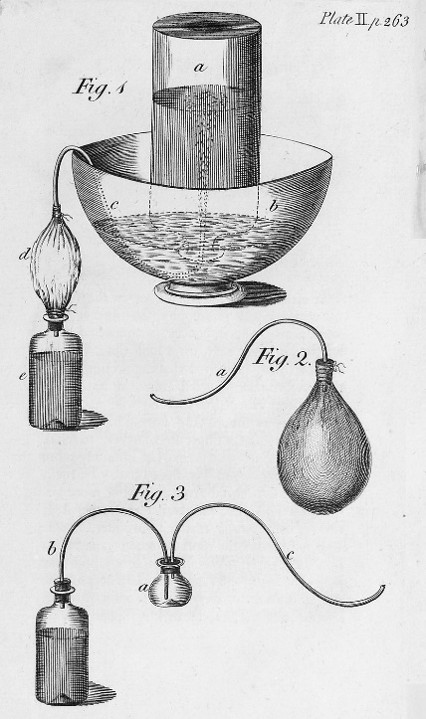
The name sounds absurd only when detached from the operations that made it meaningful. In phlogiston chemistry, ordinary air could become loaded with phlogiston. Air deprived of phlogiston would therefore be especially ready to absorb it again. It should support combustion powerfully and sustain respiration unusually well. That is exactly what Priestley saw. His interpretation was wrong, but it was not arbitrary. It made sense of real experimental behaviour.
Nor was the winning term free of theory. Lavoisier called the gas oxygen, meaning “acid-generator”, because he believed oxygen was the universal principle of acidity. That too was false. The defeated word preserved one mistake; the victorious word preserved another. One became a fossil of discarded chemistry. The other became familiar enough to hide its own history.
A few drops on the glass
The next turn in the story came from a gas with a wonderfully plain eighteenth-century name: inflammable air. We now call it hydrogen.
Henry Cavendish had studied this light, combustible gas in the 1760s. It could be produced by reacting metals with acids, and it burned readily. When inflammable air was burned together with dephlogisticated air, something extraordinary happened. Water appeared. Two invisible airs had produced the most familiar liquid in the world.
It is hard, now, not to let modern chemistry finish the sentence for us. Hydrogen combines with oxygen to form water. Of course. But the droplets on the glass did not settle the matter by themselves. They had to be interpreted.
A phlogistonist could tell the story differently. Perhaps inflammable air was water combined with phlogiston. Perhaps dephlogisticated air was water deprived of it, or at least air peculiarly ready to receive it. On that reading, the experiment did not reveal that water was composed of two gases. It showed that ordinary water could be restored through the right exchange of phlogiston.
That may sound evasive from our side of the Chemical Revolution. At the time, it was not an absurd reply. A flame, a gas, a misted vessel, a change in weight. None of these comes with its meaning attached. Evidence becomes evidence inside a working system of concepts, operations and standards. What counts as a substance? What counts as a component? What counts as analysis rather than transformation? Which variable should be trusted most, appearance, activity, weight, or reproducibility?
The new chemistry changed the setting in which the experiment was read. The appearance of water was no longer merely a striking event at the end of combustion. It became part of a quantitative account. How much inflammable air had disappeared? How much oxygen had been involved? How much water had been produced? Could water be decomposed and then recomposed, with the numbers matching closely enough to make the same substance appear on both sides of the operation?
At that point, water was no longer simply appearing on the glass. It was entering the balance sheet of chemistry.
The balance makes composition visible
A metal is heated in air. It dulls, loses its shine, gives up its malleability and turns into a calx. In phlogiston chemistry, this looked like a loss. The metal had given up the principle that made it metallic.
Then came the awkward fact on the bench. The calx was heavier.
Heavier, after a supposed loss.
That did not destroy phlogiston theory in a single blow. Good chemists could still defend it, and did. Yet the weight gain gave oxygen chemistry an opening. Perhaps calcination was better understood as combination with something from the air. Follow the weights carefully and chemical change begins to look different. Appearances still matter. Activity still matters. So do colour, heat, flame, residue and reversibility. But weight gives the whole operation a new discipline. It turns transformation into material accounting.
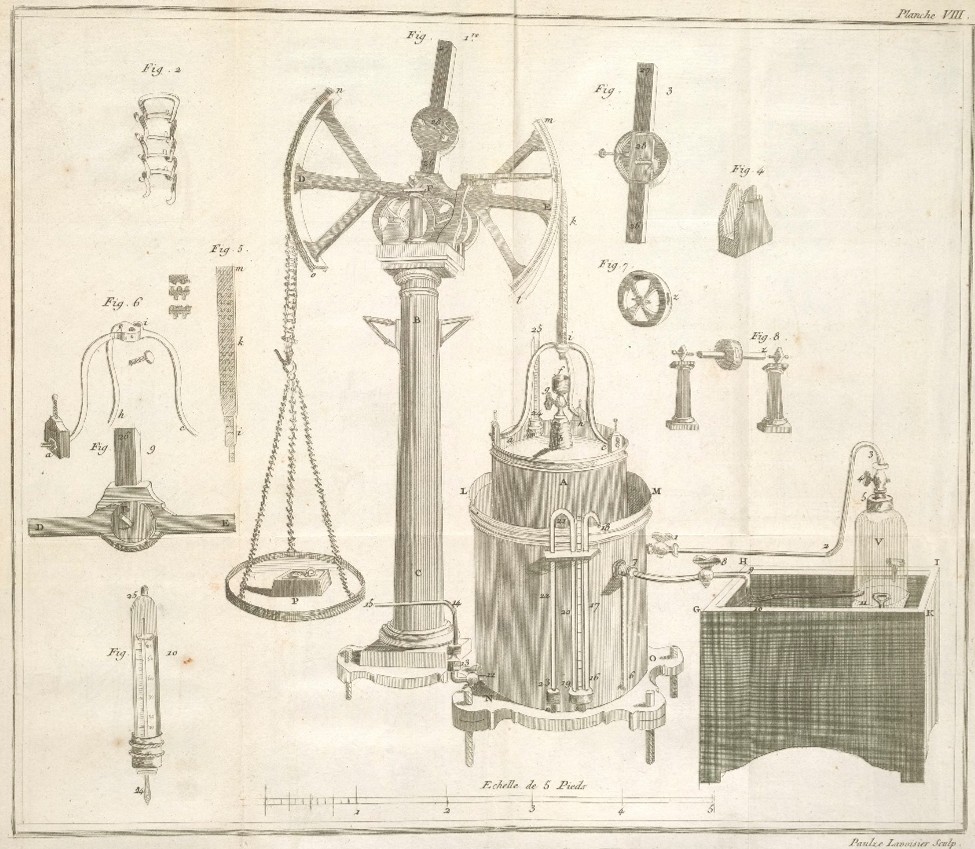
The same habit of attention changed the status of water. A substance that can be broken down into measured quantities of other substances, and then produced again from them, starts to lose its old simplicity. It has become analysable. It has constituents.
This was the strongest hand of the new chemistry. Combustion, calcination, gases and water could now be drawn into the same quantitative order. Chemical names changed too. A name was expected to do more than preserve origin, appearance, use or inherited convention. Ideally, it should tell chemists what a substance contained.
The point needs care. This was never a struggle between careful measurers and careless speculators. Cavendish was one of the most exact experimentalists of the century. Richard Kirwan, among the serious defenders of phlogiston, treated weight as a genuine difficulty. The disagreement concerned the authority of weight. Should it count as one experimental constraint among others, or should it become the privileged route to chemical identity?
That question slowly shifted the terrain. Phlogiston chemistry was most at home in a language of principles, powers and transformations. What gives a body combustibility? Why does a metal lose its metallic character? How can a calx be revived? What passes from one substance to another when reaction occurs?
The new chemistry pressed elsewhere. What does this substance contain? In what proportions? Can those constituents be separated and brought together again while the material account remains intact?
Once that style of reasoning became dominant, water’s old simplicity became harder to defend. Water could still be boiled, condensed, purified and recovered, just as before. Now it could also be weighed into a different story. It could be decomposed, recomposed, renamed and treated as a body with an interior.
No single knockout blow
The usual story of the Chemical Revolution likes a clean scene. Priestley isolates oxygen and fails to recognise it. Lavoisier understands what Priestley could not. Phlogiston collapses. Modern chemistry begins.
History was less obliging.
Priestley knew the new chemistry and resisted it. Cavendish remained cautious. Other competent chemists hesitated, adopted parts of the oxygen system, or kept some version of phlogiston alive. Their reluctance was not simple blindness. Phlogiston theory still connected combustion, respiration, calcination, reduction and the behaviour of airs. It had also helped produce many of the experimental facts that later counted in favour of oxygen chemistry.
Lavoisier’s system, for all its power, carried its own burdens. His theory of acidity was wrong. The very word oxygen preserved that mistake, since it named the gas as the supposed generator of acids. His chemistry also relied on caloric, an imponderable fluid of heat. Seen from the present, caloric does not look obviously more respectable than phlogiston. Lavoisierian chemistry was elegant, disciplined and transformative. It was not modern chemistry arriving whole and immaculate.
So the real historical question is more interesting than the textbook one. Why did one way of doing chemistry become more convincing, more portable, more teachable and more productive than another?
Much of the answer lies in the rise of compositionism. Oxygen chemistry made substances legible as combinations of measurable constituents. Reactions became material accounts. Chemical names began to function as compressed statements of composition. Laboratory operations, weights, gases and nomenclature could now be made to speak the same language.
Phlogiston still made sense of many transformations, but it sat uneasily in that emerging world. It named a principle of activity, a way of thinking about combustibility, metallic character, reduction and chemical power. The new chemistry increasingly wanted components. It asked what substances were made of, how much of each constituent they contained, and whether those constituents could be separated and brought together again.
As compositionism gained ground, phlogiston began to lose its natural habitat. It could still speak about combustion, reduction and chemical activity, but chemistry was moving towards another language: constituents, proportions, balances, material accounts. The revolution changed the answer, certainly. More importantly, it changed the kind of answer chemistry wanted.
The first metamorphosis of water
When water became a compound, it did more than shift from one scientific category to another. Its identity for chemistry changed.
Before this transition, water could pass through laboratory practice while keeping its apparent simplicity. It could be boiled, frozen, distilled, condensed, purified and recovered. It appeared everywhere, as liquid, vapour, solvent, medium, residue or product. Familiarity gave it stability. It did not yet give it an interior.
After the Chemical Revolution, the same substance began to occupy a different role. Water could be produced from other bodies, analysed through them, and assigned constituents. The liquid that returned from vapour or appeared after combustion now carried a hidden depth. It was no longer merely recovered; it could be accounted for.
Nobody saw that hidden constitution. There were no water molecules under a microscope, no direct image of hydrogen and oxygen joined together. The evidence came through laboratory work: gases prepared and collected, vessels sealed, mixtures burned, droplets condensed, weights compared, names revised. Compound water became credible through practice before it became imaginable as a molecular structure.
This is why the story should not run too quickly towards H₂O. Lavoisierian chemistry helped establish water as a compound of hydrogen and oxygen. It did not settle the formula. It was one thing to say that water was made from hydrogen and oxygen; it was another to decide how many atoms of each entered the compound. That question would take nineteenth-century chemistry into a different set of difficulties.
First came the more basic metamorphosis. Water ceased to be one of nature’s simple terms. It became a substance that could be decomposed, recomposed and written in the language of other substances.
The cost of clarity
The new chemistry clarified immensely. It disciplined measurement, stabilised nomenclature and helped make possible the modern science of composition. But clarity selects. It illuminates some things by pushing others into shadow.
Phlogiston theory had been concerned with chemical activity. Why do substances burn, reduce, revive, calcine, combine and transform? Early compositional chemistry was much better at saying what entered and left a reaction than at explaining why the reaction happened at all. It provided an excellent account book, though not yet a full theory of chemical agency.
Some questions once handled by phlogiston later returned in different forms. Chemical potential energy, oxidation-reduction and electrons all came to occupy parts of the conceptual space that phlogiston had once held. That does not vindicate phlogiston as a literal substance. It suggests something subtler and more useful. A false theory can preserve real questions. A victorious theory can be right and still leave work unfinished.
This is a more realistic picture of scientific progress. Oxygen chemistry won for good reasons. But those reasons were not contained in one devastating experiment before which only fools could hesitate. They belonged to a wider reorganisation of chemical practice.
Water’s first great chemical transformation was therefore not the discovery of a formula. It was the making of a new kind of object. The familiar liquid became something that could be analysed, recomposed, weighed and named through its constituents. Only after that could the later question become pressing: not whether water was compound, but what exactly its composition was.
Electricity seemed about to settle the matter. It made water yield hydrogen and oxygen directly, as if nature had finally supplied the decisive experiment.
Instead, the proof produced a new puzzle.
References
Chang, H. (2012). Is Water H₂O? Evidence, Realism and Pluralism. Springer. doi 10.1007/978-94-007-3932-1.
Chang, H. (2004). Inventing Temperature. Measurement and Scientific Progress. Oxford University Press.
Cavendish, H. (1784). ‘Experiments on Air’. Philosophical Transactions of the Royal Society of London, 74, 119–153.
Kirwan, R. (1789). An Essay on Phlogiston and the Constitution of Acids. London, J. Johnson.
Lavoisier, A.-L. ([1789] 1965). Elements of Chemistry. Dover.
Priestley, J. ([1796] 1969). Considerations on the Doctrine of Phlogiston, and the Decomposition of Water. Kraus Reprint.