Category archives: Humanities & Social Sciences

AI, problem solving, and the future of STEM education

AI, problem solving, and the future of STEM education

Artificial Intelligence • Education

By Invited Researcher

When I taught physics, chemistry and mathematics to secondary-school and sixth-form students, a correct answer was sometimes where the interesting part began. I would ask why they had used a particular equation. A solution that had looked perfectly sound could become much less convincing; occasionally the reverse happened, and a student whose algebra had gone […]

The ‘WarGames’ problem: AI agents don’t go rogue

The ‘WarGames’ problem: AI agents don’t go rogue

Artificial Intelligence • Philosophy of science

By Invited Researcher

Author: Deven Desai, Professor of Business Law and Ethics; Associate Director for Law, Policy, and Ethics at the Machine Learning Center, Georgia Institute of Technology AI agents don’t go rogue. That’s something only humans do. Nevertheless, a New York Times article – representative of much news coverage of AI – described an OpenAI hacking as […]

Is water H₂O? (1): From element to compound

Is water H₂O? (1): From element to compound

Chemistry • History • Philosophy of science

By Invited Researcher

Take a glass of water. Nothing about it seems to ask for a theory. It has no colour worth naming, no dramatic smell, no visible architecture. It runs, freezes, boils, evaporates, dissolves, erodes, circulates and nourishes. It belongs to weather, geology, physiology, cooking and plumbing before it belongs to chemistry. Then science gives us the […]

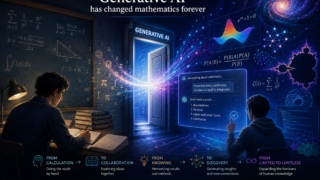
Generative AI has changed mathematics forever

Generative AI has changed mathematics forever

Artificial Intelligence • Mathematics • Philosophy of science

By Invited Researcher

Author: Melissa Lee, Senior Lecturer, School of Mathematics, Monash University Some weeks ago, artificial intelligence company OpenAI announced ten advances in mathematics and computer science made with their as-yet unreleased model Astra. The discoveries cover a wide range of mathematical fields, including geometry, cryptography and coding theory. These ten are just the latest in a […]

We are not ‘in the singularity’ with AI.

We are not ‘in the singularity’ with AI.

Artificial Intelligence • Economics

By Invited Researcher

Authors: Kai Riemer, Professor of Information Technology and Organisation, University of Sydney and Sandra Peter, Director of Sydney Executive Plus, Business School, University of Sydney “We are now, like, in the singularity”. These are the words of Sam Altman, CEO of OpenAI, speaking on the Relentless podcast on July 25. He added: “I’ve been waiting […]

Eight lifesaving ways to improve wildfire risk management

Eight lifesaving ways to improve wildfire risk management

Ecology • Economics • Environment

By Invited Researcher

Authors: María-Luisa Chas-Amil, Catedrática de Economía Aplicada, Universidade de Santiago de Compostela and Julia María Touza, Professor of Environmental Economics, University of York As the flames advanced towards the village of Bédar, in the Almería province of Andalusia, the mayor gave a desperate order to ring the church bells to warn residents. It was not […]

Doing and experiencing in language: how similar are they?

Doing and experiencing in language: how similar are they?

Language • Linguistics • Neurobiology • Neurolinguistics

By Invited Researcher

Author: Marta Sánchez López, Postdoctoral researcher at Research Centre for Basque Language and Texts (CNRS-IKER) – Université Bordeaux Montaigne. She also collaborates with the The Bilingual Mind Research Group (Gogo Elebiduna), University of the Basque Country. In our daily life, we perceive many different events around us with different participants involved, such as a woman […]