All that glows is not a carbon dot: biobased lighting materials from waste
All that glows is not a carbon dot: biobased lighting materials from waste
Materials that glow are part of our daily lives, and even if we rarely notice them, their use nowadays is widespread. They light up the screens we look at for hours and the light-emitting diodes (LEDs) in our homes; they enable biologists and physicians to explore cells, tissues and molecules using fluorescence microscopes; they turn invisible contaminants into visible signals in chemical sensors; and they hide security marks in banknotes, documents and products that only appear under ultraviolet light (Figure 1a). Research on luminescent nanoparticles for chemical and biological analysis, point-of-care diagnostics and imaging is thriving [1], and nanocrystals that glow are being considered for the backlighting of television displays [2]. In anti-counterfeiting, luminescent materials are valued because they combine optical complexity, hidden information storage and easy authentication under a specific excitation light [3].
Among other phenomena that are also being explored and implemented, a physical phenomenon called photoluminescence supports the aforementioned applications. When a photoluminescent material absorbs light, some of its electrons undergo transitions to higher-energy states. Then, when they relax back to their fundamental state, part of that energy is released as light. Because some energy is always lost along the way, the emitted light usually has a longer wavelength, which results in a variation of color, with respect to the absorbed light. Fluorescent highlighters, which glow intensely under a UV lamp, are an everyday example. Each application, however, asks for specific requirements such as color purity for displays, biocompatibility for medical imaging, long-term stability for security inks and low cost for large scale production.
Several materials can offer these different properties and application requirements (Figure 1b). The classic ones are organic dyes, small molecules that can be very bright but tend to weaken or even fade under intense illumination, and fluorescent proteins, which brought the glow into living cells. Semiconductor quantum dots are nanocrystals of a few nanometers in size whose color can be tuned simply by changing their size, shining brightly in very pure colors. However, they also face challenges of biocompatibility, photobleaching, toxicity, poor solubility and environmental impact [4]. Lead halide perovskite nanocrystals are a more recent and very promising family of materials, but their stability under environmental conditions still needs to be improved, and researchers are looking for related compounds free of heavy metals [2]. The list goes on with carbon nanotubes, graphene derivatives, nanodiamonds, metal nanoclusters, lanthanide (rare-earth)-doped nanoparticles and polymer dots, among others [1]. Their size, solubility, toxicity, brightness and resistance to fading vary widely, and each class has its own advantages and disadvantages depending on the application [5]. A luminescent material that is bright, stable, safe and cheap at the same time is still hard to find.
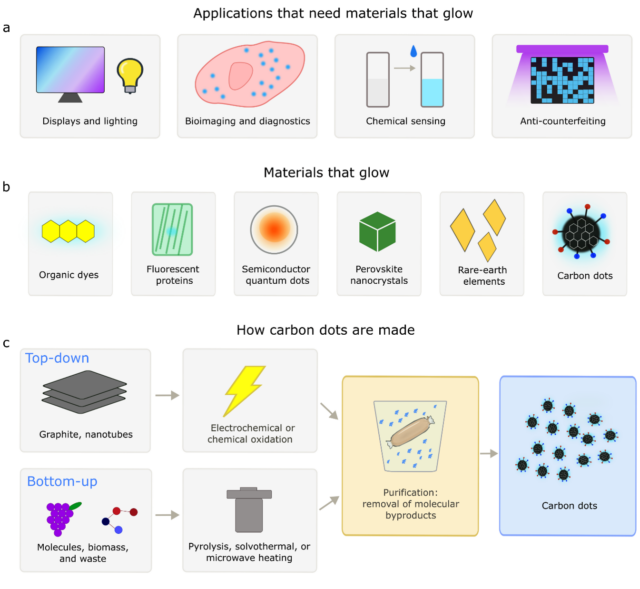
Among all these materials, carbon dots arise as an open opportunity to be explored for different applications. They are quasi-spherical nanoparticles usually smaller than 10 nanometers, made of a carbon-based core whose surface can present many different functional groups [5]. The name “carbon dots” covers a whole family of systems, from graphene and carbon quantum dots, with ordered cores, to carbon nanodots and carbonized polymer dots, with more disordered structures [5]. Carbon dots combine tunable light emission, good dispersibility and low toxicity with chemical inertness and photostability, and they are considered environmentally friendly [5]. Compared with semiconductor quantum dots, they are more biocompatible and can be obtained from abundant nontoxic materials [4], through a variety of simple and inexpensive routes [5]. Nevertheless, their optical properties are generally still less attractive than those of the best inorganic quantum dots, although they remain relatively unexplored [5]. They are already being studied for bioimaging, sensing, light-emitting diodes, solar energy conversion and catalysis [5], as well as for anti-counterfeiting [3].
The origin of the functional light response is still debated, and four main mechanisms have been proposed: quantum confinement in small and conjugated domains, defect states, molecular fluorophore states and crosslink-enhanced emission [5]. The third one is particularly intriguing as the small fluorescent molecules formed during the synthesis can remain attached to the carbon particles, or embedded in them, so that part of their glow comes, in a sense, from molecular structures [3,5].
There are two main ways of synthesizing carbon dots (Figure 1c) [5]: top-down and bottom-up approaches. Top-down approaches, historically the first, start from larger carbon materials such as graphite and reduce them into nanometer-sized pieces, mainly by electrochemical or chemical oxidation. This approach can yield relatively large amounts of material but usually require harsh processing conditions and long reaction times [5]. Bottom-up approaches, today the most popular, start from organic molecules or polymers that are heated until they carbonize, either without solvent (pyrolysis) or in a closed vessel with a solvent heated above its boiling point (solvothermal synthesis, or hydrothermal when the solvent is water), using flasks, autoclaves or microwave reactors [5]. Their advantages include the wide options of starting molecules, shorter reaction times and more uniform products, and the choice of precursors and conditions determines the size, degree of graphitization, surface groups and doping of the resulting dots [5]. Citric acid, often combined with nitrogen sources such as urea, is one of the most widely used precursors, and the solvent can also take part in this process, such as formamide and dimethylformamide which decompose during the reaction, releasing ammonia or dimethylamine that react with the precursor [5].
This freedom in the choice of starting materials is what connects carbon dots with sustainability. Instead of purified chemicals, the carbon can also come from biomass, an abundant, non-toxic, renewable, and inexpensive source. Agriculture and the food industry produce many residues, such as peels, pomace, husks, stems and damaged fruit, that are usually treated as waste. Turning them into functional nanomaterials paved the way of their use in the scope of circular economy, and biomass-derived carbon dots offer a compelling route to fluorescent nanomaterials from low-cost renewable feedstocks [3]. Plant biomass is made mainly of cellulose, hemicellulose and lignin; when it is heated in a solvent, its bonds break into small fragments containing carbon, hydrogen and oxygen, which then condense into carbon dots, and nitrogen-containing solvents such as formamide can add nitrogen to them [3].
However, using biomass as the carbon source can be tricky, bringing variability and cross-contamination [5]. The same condensation reactions that build carbon dots also produce a variety of molecular side products, that in many cases are very bright under UV light [3]. In other words, in the reaction mixture not only carbon dots are formed. It also delivers a mixture in which the particles coexist with different small molecules, some of them very fluorescent. If that mixture is not thoroughly purified, the obtained light response often attributed just to carbon dots may in fact come from these byproducts [6]. The problem is out there even when using simple precursors under hydrothermal conditions. For example, citric acid and urea may form molecular fluorophores that usually dominate the optical properties, and some red-emitting carbon dots have even been called “mythical”, because their color came from molecular dyes present in the mixture [5]. With biomass the problem can be worse considering its complex chemical composition [3].
There is a certain irony in this, because carbon dots were discovered themselves by chance during a purification [5]. In 2004, researchers purifying carbon nanotubes by electrophoresis isolated two major impurities, being one of them a fluorescent form of carbon which, they noted, promised to be an interesting nanomaterial [7]. Two decades later, proper purification and characterization are still described as essential steps and, in many cases, mandatory, for discovering useful properties of these materials. Experimental reports are urged to include reproducible purification procedures [5].
This is the challenge we decided to take on, with a particularly demanding feedstock of residues of damaged grapes from a local winery [3]. Besides cellulose, hemicellulose and lignin, grapes contain polyphenols such as flavonoids, tannins and the anthocyanins that give red wine its color, as well as sugars and proteins. Under the reaction conditions, sugars and amino acids undergo Maillard-type reactions, the same family of reactions that brown the crust of bread, while polyphenols act as ready-made aromatic building blocks [3]. This richness makes grapes attractive for making carbon dots, but it also multiplies the molecules that can form alongside them [3]. Our approach therefore combines two ideas which was to give a second life to carbonaceous waste and treating purification not as a routine step but as a central, analytical part of the process.
We prepared carbon dots from the grape residues in different solvents and purified them by dialysis where the crude product is kept in a membrane bag whose pores let small molecules escape while retaining the nanoparticles, and the surrounding water is renewed until it no longer absorbs or emits light [3]. It works much like a tea bag, except here we throw the tea away and keep what stays inside. Liquid chromatography coupled to mass spectrometry and nuclear magnetic resonance spectroscopy revealed several small molecules, some coming straight from the grape and others formed in the reactor, various of them belonging to families known to fluoresce, such as chromones and flavonoids [3]. These are precisely the molecules that dominate the optical response of an unpurified sample, and they were never carbon dots. At the same time, a few signals persisted after exhaustive purification without behaving like free molecules; we interpret them as small chemical groups anchored to the surface of the particles [3]. Here is important to distinguish free molecules, which are impurities to be removed, from groups bound to the particle which are part of the carbon dot.
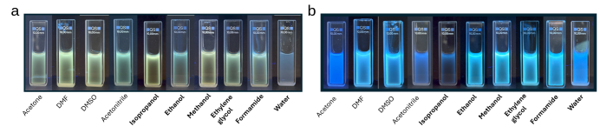
Only after purification could the measurements be properly interpreted. Under UV light, the purified dots glow in different colors depending mainly on the solvent used to synthesize them: those from formamide glow blue, while those from acetone glow green to yellow, and the solvent in which they are dispersed changes the color only slightly (Figure 2). The reason lies on the particle surface, since the synthesis solvent can determine which chemical groups attach to it, and those groups determine how the dots emit light [3].
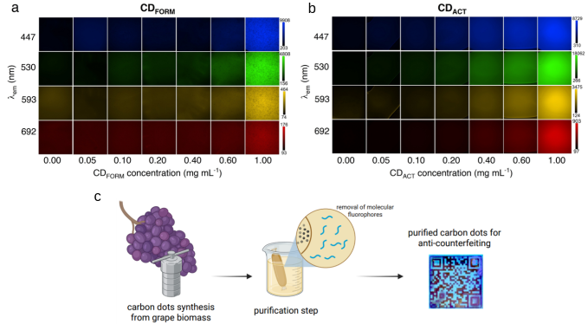
Finally, purified carbon dots have to prove useful in a specific application. We dispersed them in a UV-curable resin and printed films and a QR code with a 3D printer [3]. The films glowed under different excitation colors, more intensely as the amount of carbon dots increased (Figure 3a,b), and the QR code, invisible under ordinary light, became readable under a UV lamp, the same principle as the hidden marks on banknotes (Figure 3c) [3]. Because the carbon dots had been exhaustively purified, the glow of the printed code can be attributed to the carbon dots themselves, and not to molecular side-products [3].
Biomass is a generous but complex feedstock. Turning winery waste into luminescent nanomaterials is an attractive idea. But all that glows is not a carbon dot; the good news is that, with enough patience (and water), we can tell the difference.
Authors
Gabriel C. Fonseca1,2, Senentxu Lanceros-Méndez1,3,4and Jorge Sáiz1
1BCMaterials, Basque Center for Materials, Applications and Nanostructures, UPV/EHU Science Park, 48940 Leioa, Spain
2Geology Department, Faculty of Science and Technology, UPV/EHU, 48940 Leioa, Spain
3Ikerbasque, Basque Foundation for Science, 48009 Bilbao, Spain.
4Physics Center of Minho and Porto Universities Center of Physics Universities of Minho and Porto (CF-UM-UP) and Laboratory of Physics for Materials and Emergent Technologies, LapMET, University of Minho, Campus de Gualtar, 4710-057 Braga, Portugal.
Acknowledgements
Jorge Sáiz acknowledges the support from the Ramón y Cajal program, funded by the Spanish Ministry of Science and Innovation (RYC2022-036243-I). Funding by the Basque Government under the ELKARTEK programs is also acknowledged.
References
[1] W. R. Algar, M. Massey, K. Rees, R. Higgins, K. D. Krause, G. H. Darwish, W. J. Peveler, Z. Xiao, H.-Y. Tsai, R. Gupta, K. Lix, M. V. Tran, H. Kim, Photoluminescent nanoparticles for chemical and biological analysis and imaging, Chem. Rev. 2021, 121, 9243–9358. https://doi.org/10.1021/acs.chemrev.0c01176
[2] H. Huang, M. I. Bodnarchuk, S. V. Kershaw, M. V. Kovalenko, A. L. Rogach, Lead halide perovskite nanocrystals in the research spotlight: stability and defect tolerance, ACS Energy Lett. 2017, 2, 2071–2083. https://doi.org/10.1021/acsenergylett.7b00547
[3] G. C. Fonseca, A. Gomez-Simon, C. Mendes-Felipe, E. Avellanal-Zaballa, J. Bañuelos, U. Silvan, S. Lanceros-Méndez, J. Sáiz, Waste-to-value carbon dots from grape biomass: the critical role of purification and proof-of-concept for anti-counterfeiting, ACS Sustain. Resour. Manag. 2026, 3, 2264–2277. https://doi.org/10.1021/acssusresmgt.6c00127
[4] T. C. Wareing, P. Gentile, A. N. Phan, Biomass-based carbon dots: current development and future perspectives, ACS Nano 2021, 15, 15471–15501. https://doi.org/10.1021/acsnano.1c03886
[5] L. Ðorđević, F. Arcudi, M. Cacioppo, M. Prato, A multifunctional chemical toolbox to engineer carbon dots for biomedical and energy applications, Nat. Nanotechnol. 2022, 17, 112–130. https://doi.org/10.1038/s41565-021-01051-7
[6] J. B. Essner, J. A. Kist, L. Polo-Parada, G. A. Baker, Artifacts and errors associated with the ubiquitous presence of fluorescent impurities in carbon nanodots, Chem. Mater. 2018, 30, 1878–1887. https://doi.org/10.1021/acs.chemmater.7b04446
[7] X. Xu, R. Ray, Y. Gu, H. J. Ploehn, L. Gearheart, K. Raker, W. A. Scrivens, Electrophoretic analysis and purification of fluorescent single-walled carbon nanotube fragments, J. Am. Chem. Soc. 2004, 126, 12736–12737. https://doi.org/10.1021/ja040082h
[8] Q. H. Pho, M. Escriba-Gelonch, D. Losic, E. V. Rebrov, N. N. Tran, V. Hessel, Survey of synthesis processes for N-doped carbon dots assessed by green chemistry and circular and EcoScale metrics, ACS Sustainable Chem. Eng. 2021, 9, 4755–4770. https://doi.org/10.1021/acssuschemeng.0c09279