How strain shapes the quantum properties of twisted graphene
How strain shapes the quantum properties of twisted graphene
Imagine taking two identical sheets of chicken wire and laying them on top of one another. If you align them perfectly, they look like a single sheet. But if you rotate the top layer by just a tiny amount, a beautiful large-scale crawling pattern emerges. In physics, we call this a Moiré pattern.
When we do this with graphene, a single layer of carbon atoms arranged in a honeycomb lattice, something remarkable happens. By twisting these layers to a “magic angle” of about 1.1°, the electrons, which usually zip around at incredible speeds, slow down dramatically, and their mutual repulsion starts to dominate their behavior. This collective behavior leads to exotic states of matter like superconductivity, where electricity flows with zero resistance.
A recent study 1 explores what happens when we push beyond this magic angle. Specifically, the researchers looked at marginally twisted bilayer graphene, where the twist angle is even smaller (less than 1°). At these tiny angles, the material does not just sit there; it physically rearranges itself to find a more comfortable, lower-energy state.
Structural relaxation
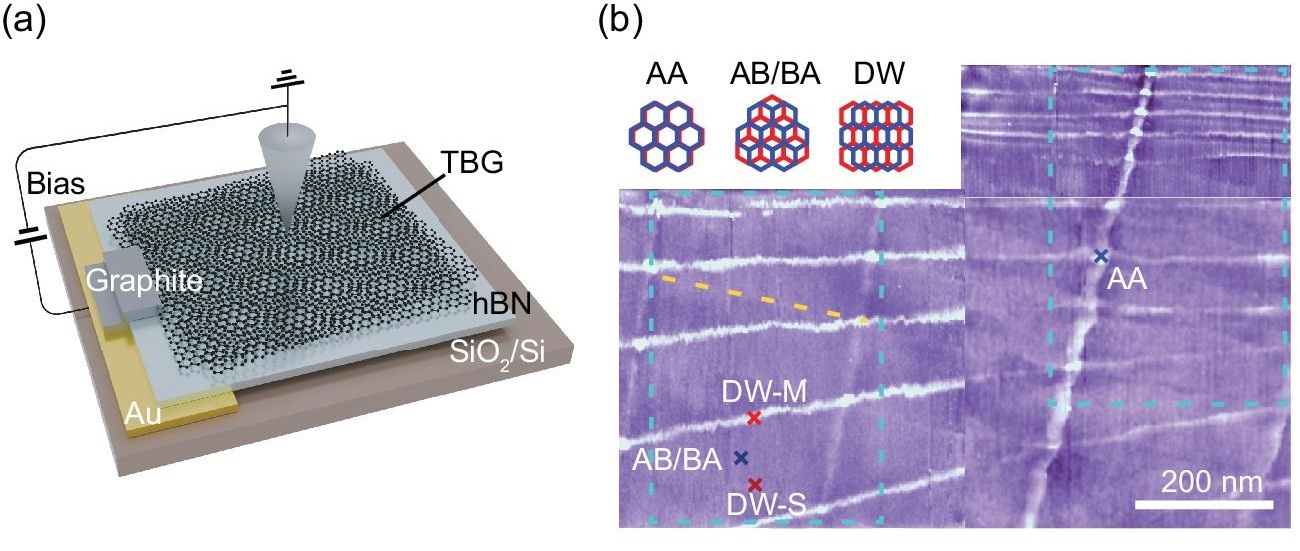
At very small twist angles, the carbon atoms face a dilemma. Some areas want to stay perfectly aligned (a configuration called AA stacking), while others prefer to be slightly offset (AB or BA stacking). Because the offset configuration is energetically cheaper, the atoms actually shift their positions to maximize those zones.
This process, known as structural relaxation, transforms the smooth Moiré pattern into a sharp, triangular network of domains. Think of it like a patchwork quilt where the patches are stable regions and the seams are narrow boundaries where all the strain is concentrated. The researchers used scanning tunneling microscopy, a technique that maps both the atomic structure and the electronic behavior of a surface at the same time, to confirm that these patterns are not just theoretical. They are physical signatures of atoms fighting to stay in their preferred arrangements.
Two kinds of signal
One of the most striking findings of this study is that not all domain wall boundaries are the same. Depending on how the graphene layers are strained during fabrication, two distinct types of boundary form: one dominated by shear (a sliding-type deformation) and one that combines shear with stretching. Each type leaves a different fingerprint in the local electronic spectrum measured by the microscope, almost like a barcode that identifies which kind of strain is present. This is precisely what the paper’s title means by “electronic signatures”: measurable, distinct signals that betray the underlying mechanical state of the material.
Reading the material like a map
In physics, the behavior of electrons is often described by a band structure, essentially a map of what energies electrons are allowed to have inside a material. When graphene is twisted and relaxes into domains, the electrons inside those domains behave very differently from those sitting on the boundary walls. The flat, stable domain interiors host electrons that are relatively free to move, while the narrow walls concentrate electrons with unusual, localized quantum states.
By identifying which type of boundary wall is present from its electronic signature alone, researchers can infer the strain state of the entire sample without needing to directly measure the atomic positions. It is like being able to read a map of invisible tensions running through the material, simply by listening to how electrons behave at the seams.
The frontier of twistronics
This work is in the frontier of twistronics, the emerging field that uses twist angle and mechanical deformation to engineer the quantum properties of two-dimensional materials.
The ability to read and potentially control electronic states through mechanical means, rather than by adding chemical impurities, opens the door to a new generation of electronics. We are talking about devices with more efficient transistors, more sensitive quantum sensors, and a deeper understanding of high-temperature superconductivity that could one day transform how we power our world.
This study provides a concrete method for using strain as a diagnostic tool, and potentially as a tuning knob, for the quantum properties of two-dimensional materials. It proves that in the world of the incredibly small, a little bit of tension can reveal a great deal.
Author: César Tomé López is a science writer and the editor of Mapping Ignorance
Disclaimer: Parts of this article may have been copied verbatim or almost verbatim from the referenced research paper/s.
References
- P. Ouyang, J. Yu, Q. Li, G. Jia, Y. Wang, K. Xiao, H. Zhang, Z. Hu, P. A. Pantaleon, Z. Zhan, S. Zhou, F. Guinea, Q. -K. Xue, and W. Li (2026) Structural and electronic signatures of strain-tunable marginally twisted bilayer graphene Natl. Sci. Rev. doi: 10.1093/nsr/nwaf568 ↩