Scaling the Hong–Ou–Mandel effect to ten-atom interference
Scaling the Hong–Ou–Mandel effect to ten-atom interference
Over a century ago, quantum physics revealed a surprising fact: truly identical particles do not behave like tiny billiard balls. When two indistinguishable particles meet under the right conditions, they can interfere with each other in ways that have no classical explanation. One of the most famous demonstrations of this phenomenon is the Hong–Ou–Mandel effect, first observed in 1987 with particles of light called photons. A new experiment 1 now extends this effect to more than ten atoms at once, opening a promising route toward highly precise quantum measurements and large-scale quantum technologies.
The original Hong–Ou–Mandel experiment
The original Hong–Ou–Mandel experiment, carried out by physicists Chung-Ki Hong, Zhe-Yu Ou, and Leonard Mandel at the University of Rochester, involves two identical photons arriving simultaneously at a beam splitter, an optical device that normally sends each incoming particle randomly to one of two outputs. Classical reasoning suggests each photon should independently choose a path, sometimes landing in different outputs. Quantum mechanics predicts something strikingly different. If the photons are truly indistinguishable, the two paths by which they could exit separately cancel each other out through destructive interference. The result: both photons always emerge together from the same output port. This counterintuitive bunching behavior, impossible to explain without quantum mechanics, has since become a cornerstone of quantum optics and a key tool in quantum information science.
The atomic equivalent of a paired photon input
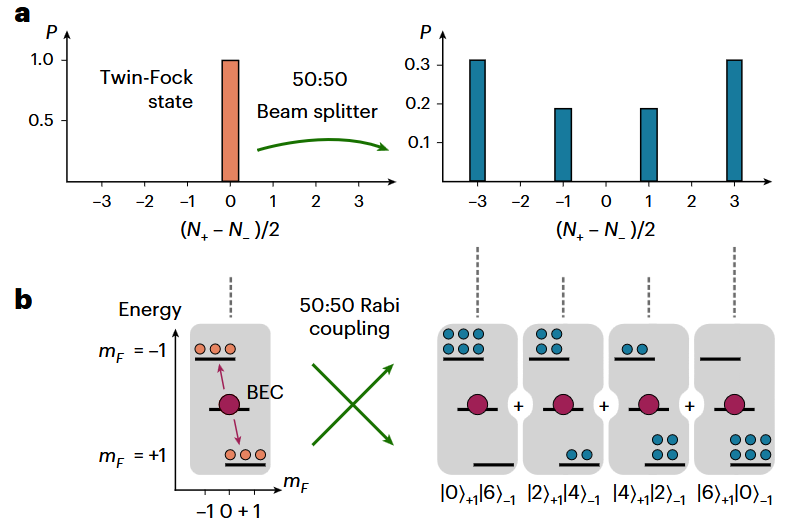
The new work explores what happens when this idea is extended far beyond two particles. Instead of photons, the experiment uses ultracold rubidium atoms gathered into a Bose–Einstein condensate, a state of matter first predicted in 1924 by Satyendra Nath Bose and Albert Einstein, and first created in the laboratory in 1995. In a Bose–Einstein condensate, a gas of atoms is cooled to temperatures just a tiny fraction of a degree above absolute zero, so cold that the atoms lose their individual identities and collectively occupy the same lowest-energy quantum state, behaving as a single coherent quantum entity. Through a process called spin-changing collisions, in which pairs of atoms are created simultaneously in two distinct quantum spin states, the experiment reliably produces states where exactly equal numbers of atoms occupy each of those two modes. These balanced, paired states are the atomic equivalent of the paired photon inputs used in the original Hong–Ou–Mandel setup.
A matter of counting
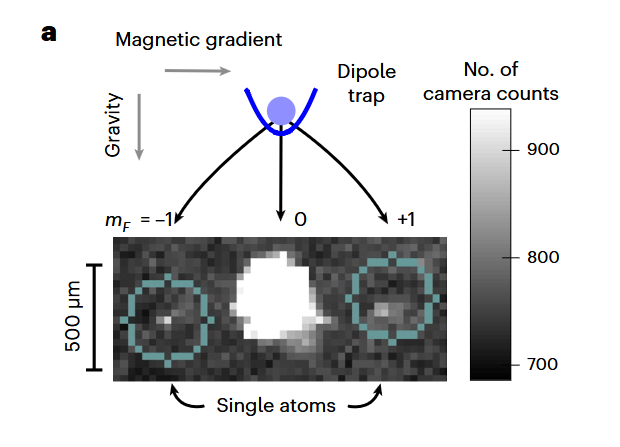
A major obstacle has long prevented such experiments from reaching larger numbers of atoms: counting them accurately enough. Quantum interference involving many particles produces very specific statistical patterns, and even small detection errors can obscure or mimic the effect. The key technical achievement of this research is a fluorescence-detection method capable of resolving individual atoms with a counting uncertainty far below one ato (specifically, just 0.2 atoms on average). Atoms released from the trap scatter light from carefully tuned laser beams; a high-quality camera captures that glow and translates it into an integer count of atoms in each output channel. This single-atom resolution is the critical enabling step for everything that follows.
After preparing equal numbers of atoms in two input modes, the experiment mixes them using a precisely timed sequence of microwave pulses, the atomic analogue of the beam splitter. Quantum theory predicts a striking outcome. Certain combinations of atom numbers in the two outputs should almost never appear, while others become unusually probable. In particular, only even numbers of atoms should appear in each output channel, creating a distinctive checkerboard-like pattern in the measurement statistics. The experiment revealed exactly this behavior for systems containing up to twelve atoms, providing a direct observation of many-particle Hong–Ou–Mandel interference in an atomic platform.
Bosonic bunching
The results also demonstrate a phenomenon known as bosonic bunching. Because the atoms are bosons (the same category of particles as photons, characterized by an integer quantum spin) they have a natural tendency to crowd into the same quantum state. After interference, outcomes in which many atoms gather at the same output become far more probable than classical reasoning would suggest. This collective behavior is a hallmark of quantum statistics and becomes increasingly pronounced as the number of particles grows.
Multipartite entanglement
Beyond demonstrating an elegant quantum effect, the experiment probes one of the most important resources in modern quantum science: entanglement. Entangled particles cannot be described independently; their properties are linked through a shared quantum state in ways that have no classical counterpart. By analyzing the measured atom-number distributions, the experiment shows that the generated states possess genuine multipartite entanglement, meaning the entanglement involves more than just pairs of particles. For systems containing up to eight atoms, the evidence indicates that all atoms participate in a single, fully entangled state. Even for twelve atoms, at least ten are certified to be mutually entangled.
The significance of this entanglement becomes clear when considering precision measurements. In ordinary, classical measurements, unavoidable statistical noise means that doubling the number of particles only improves the measurement precision by a factor of roughly 1.4 (the square root of two). Quantum entanglement can do much better. The ultimate limit allowed by quantum mechanics is known as the Heisenberg limit, where measurement error decreases in inverse proportion to the total number of particles, a quadratic improvement over the classical case. Reaching this regime is a central goal of a field called quantum metrology.
Metrological potential
To test the metrological potential of their states, the experiment measured the quantum Fisher information, a quantity from probability theory and quantum mechanics that captures how sensitively a quantum state responds to small changes in a physical parameter. The higher the Fisher information, the more precisely that parameter can be estimated. The observed Fisher information grew with the number of atoms following a scaling exponent of approximately 1.95, remarkably close to the theoretical value of 2 expected at the Heisenberg limit, and well above the classical scaling of 1. For twelve atoms, this represents a sensitivity enhancement of 6.4 decibels beyond what is achievable without entanglement.
Scalable capabilities
These results mean that it is certainly possible to combine three capabilities that are rarely achieved simultaneously: negligible particle loss, single-atom detection, and controllable many-particle interference. Photonic experiments have demonstrated related effects before, but photon loss and imperfect indistinguishability become increasingly problematic as particle numbers grow, ultimately limiting how large such experiments can be scaled. Neutral atoms offer a promising alternative: they can be trapped, manipulated, and detected while retaining exceptionally high fidelity, and the platform is in principle scalable to hundreds or thousands of atoms.
This experiment therefore represents more than a new demonstration of a textbook quantum effect. It shows that large groups of identical atoms can be prepared, interfered, counted one by one, and used to generate highly entangled states with near-optimal measurement sensitivity. Such capabilities point toward future quantum sensors, high-precision atom interferometers, and fundamental tests of quantum mechanics (including multiparticle Bell tests) operating in regimes that were previously inaccessible.
Author: César Tomé López is a science writer and the editor of Mapping Ignorance
Disclaimer: Parts of this article may have been copied verbatim or almost verbatim from the referenced research paper/s.
References
- Martin Quensen, Mareike Hetzel, Luis Santos, Augusto Smerzi, Géza Tóth, Luca Pezzè & Carsten Klempt (2026) Hong–Ou–Mandel interference of more than ten indistinguishable atoms Nature Physics doi: 10.1038/s41567-026-03302-7 ↩