Gabor-embedded PINN for overcoming spectral bias in high-frequency acoustic simulations
Gabor-embedded PINN for overcoming spectral bias in high-frequency acoustic simulations
Artificial intelligence is increasingly being used to solve the mathematical equations that describe the physical world, not only to recognize images or generate text. One promising approach, developed over the last decade, is the physics-informed neural network, or PINN: a type of neural network trained not on labeled examples but on the governing equations of a physical system. Instead of learning from many recorded solutions, the network learns by minimizing how badly its output violates the equation it is meant to satisfy. This makes it possible to obtain solutions when little or no experimental data exist even in high dimensions, which is why the approach has attracted so much attention across physics and engineering.
A new study applies 1 the idea to the simulation of acoustic waves of geophysical interest, like seismic imaging subsurface exploration. All of these applications rely on the Helmholtz equation, named after the nineteenth-century physicist Hermann von Helmholtz, which describes how a wave spreads out once its frequency is fixed. Higher frequencies mean more rapid oscillation, and more rapid oscillation is far harder to compute accurately. Conventional numerical methods handle this by using extremely fine computational grids, which quickly become slow and expensive as the frequency rises.
Neural networks offer an appealing alternative because they need no such grid, but they come with a stubborn flaw. Left to their own devices, they learn smooth, slowly changing patterns long before they learn rapidly oscillating ones, a well-documented tendency known as spectral bias, or low-frequency bias. For wave problems, where the interesting behavior is exactly the rapid oscillation, this bias means standard PINNs can take a very long time to train and often still miss fine detail.
Gabor-embedded PINN
The new approach addresses this by building oscillation into the network from the start, using Gabor functions. A Gabor function pairs a wave-like oscillation with a Gaussian envelope that fades toward zero away from its center, so the oscillation stays confined to a small region of space. These functions were introduced in 1946 by the Hungarian-British engineer Dennis Gabor, who later won the Nobel Prize in Physics for inventing holography, as a way to describe signals that are localized in both time and frequency; the same mathematical shape turns out to suit wavefields just as well. Instead of asking the network to invent every oscillation from nothing, the method hands it oscillations that already look like waves and asks it only to work out how they should be positioned and combined across space.
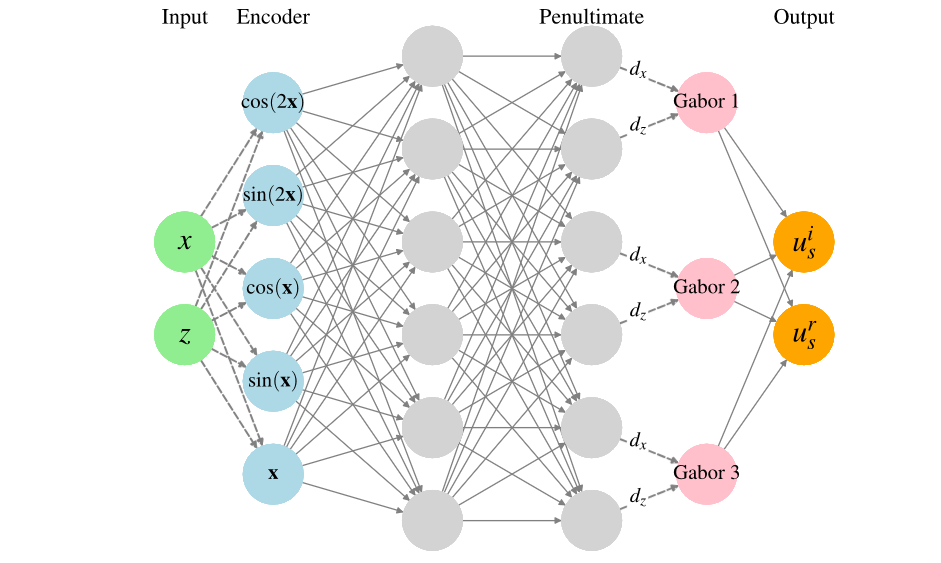
The central innovation is in how that positioning is learned. Rather than having the network output the wavefield directly, it is trained to output a transformed set of coordinates, and the Gabor functions applied in that transformed space produce the final oscillating solution. This shifts the burden of representing the wave’s fine structure into a coordinate mapping, which turns out to be much easier for the network to learn smoothly. Earlier attempts to combine Gabor functions with neural networks needed extra networks or additional parameters to control the position and strength of each function, adding complexity and, at times, instability during training. The new formulation avoids this: it needs no additional trainable parameters beyond what a conventional network of the same size would already have.
An absorbing boundary
A second contribution deals with the edges of the simulated region. Real waves can travel forever, but any simulation must stop somewhere, and naive boundaries send waves bouncing back into the domain as unwanted reflections. The established solution, first devised in 1994 for electromagnetic wave simulations and since adopted across many wave-based numerical methods, is a perfectly matched layer: a boundary region that gradually absorbs outgoing waves instead of reflecting them. Applying this technique inside a neural network training scheme usually calls for cumbersome complex-number arithmetic; the study works around this by splitting the calculation into separate, real-valued components and by supplying an approximate mathematical formula for the wave that would exist in a uniform medium, which keeps the training efficient without sacrificing accuracy near the boundary.
Fewer training steps, better results
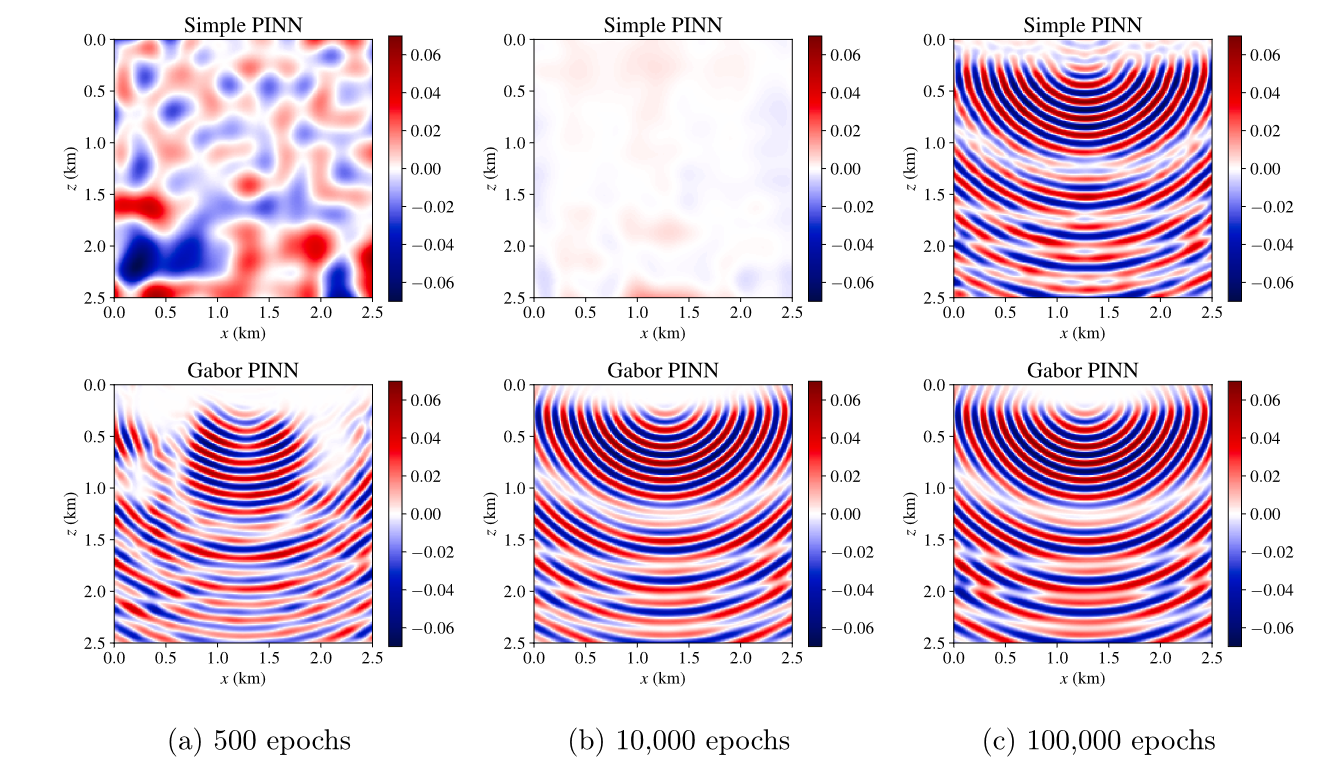
100,000). Source:
The method was tested across velocity structures of increasing complexity, from a simple layered medium to benchmark models resembling real, geologically folded terrain, and across a range of frequencies. In every case it was compared against an otherwise identical standard network trained the same way. It consistently reached accurate results in far fewer training steps, produced smaller errors, and stayed stable even when the network’s size or the random starting values of its weights were changed, an area where conventional networks, and earlier Gabor-based attempts by other researchers, tended to falter. The gap was largest precisely where standard methods struggle most: at higher frequencies.
Notably, these improvements did not come from making the network bigger. They came from embedding a piece of mathematical knowledge about how waves behave directly into the network’s structure, freeing its limited capacity to focus on learning spatial relationships rather than reinventing basic oscillations over and over. Because the Helmholtz equation also governs electromagnetic waves and other oscillatory phenomena, the same strategy could plausibly extend beyond acoustics, provided the physical equations involved are adapted accordingly. Combining mathematical structure with machine learning can produce methods that are simultaneously faster, more accurate, and less computationally demanding than relying on general-purpose neural networks alone.
Author: César Tomé López is a science writer and the editor of Mapping Ignorance
Disclaimer: Parts of this article may have been copied verbatim or almost verbatim from the referenced research paper/s.
References
- Mohammad Mahdi Abedi, David Pardo & Tariq Alkhalifah (2026) Gabor-enhanced physics-informed neural networks for fast simulations of acoustic wavefields Neural Networks doi: 10.1016/j.neunet.2025.107978 ↩