Enhanced BCMA – CAR T-cell therapeutic efficacy in multiple myeloma
Enhanced BCMA – CAR T-cell therapeutic efficacy in multiple myeloma
Author: Marta Irigoyen is a postdoctoral researcher at CIC bioGUNE
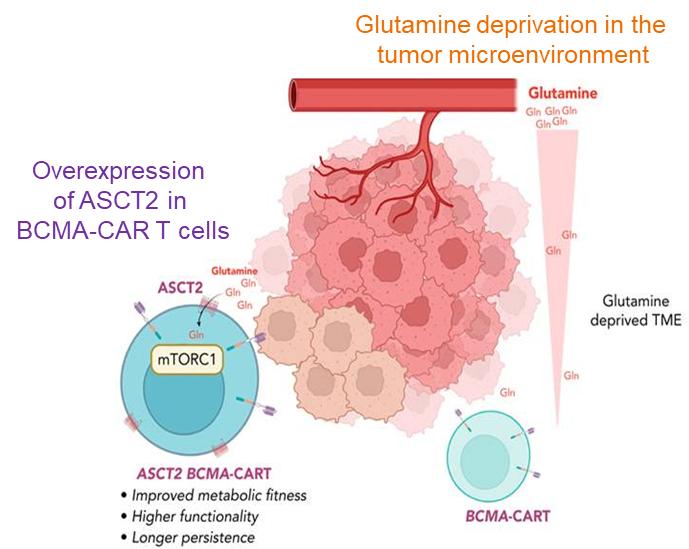
Chimeric antigen-specific receptor (CAR) T-cell immunotherapy targeting B-cell maturation antigen (BCMA; BCMA-CAR T cells) has produced remarkable clinical responses in advanced multiple myeloma (MM), with a substantial fraction of patients achieving complete remission 1. However, many patients relapse within months, largely due to insufficient CAR T-cell persistence, a recognized mechanism of acquired resistance 2. A major barrier to durable responses is the tumor microenvironment (TME), which is profoundly reshaped by tumor metabolic reprogramming 3. In fact, many tumor types, specially MM, are highly dependent on glutamine (Gln) metabolism for cell survival and proliferation 4. Thus, Gln “addiction” depletes local Gln levels and availability, impairing antitumor T-cell effector functions and promoting immune escape.
Based on these observations, a team of researchers hypothesized 5 that Gln deprivation within the TME limits the efficacy of CAR T-cell therapies. Indeed, antigen-specific T cells fail to proliferate and to produce interferon gamma (IFN-γ) under Gln-restricted conditions. They therefore investigated whether enhancing Gln uptake via overexpression of the Human SLC1A5 (ASCT2) amino acid transporter could improve the metabolic fitness and the antitumor activity of BMCA-CAR T cells in MM.
To assess the functional impact of ASCT2 overexpression in T cells, the authors infected CD8+ and CD4+ T cells from mice with an expression vector containing Asct2. To assess the impact of enhanced Gln uptake on T-cell function, CD4+ and CD8+ T cells from mouse spleens were stimulated with anti-CD3/CD28 beads at varying Gln concentrations. Interestingly, Asct2 overexpression significantly improved T-cell proliferation and IFN-γ production. Similar enhancements were observed in CD8+ OT-I (these cells contained a transgenic TCR designed to recognize ovalbumin (OVA) peptide 257-264 on MHC class I, modeling thus cytotoxic T-cell responses) and CD4+ OT-II T cells (these cells contained a transgenic TCR designed to recognize OVA peptide 323-339 on MHC class II, modeling the helper T-cell responses). Thus, Asct2-overexpressing OT-I T cells showed increased cytotoxicity against B16OVA cells. B16OVA cells are a well established in vitro model for cancer immunotherapy, expressing ovalbumin in order to facilitate strong immune responses to tumor antigens. The authors found that, even at low Gln levels, Asct2-overexpressing CD4+ OT-II T cells were more efficient lysing B16OVA cells.
Next, to assess the potential of Asct2 overexpression to enhance ACT therapy in vivo, B16OVA tumor-bearing mice were treated with either control or Asct2 CD8+ OT-I T cells. Interestingly, 14 days after tumor injection they found lower levels of Gln in the interstitial fluid, confirming a Gln-deficient TME. Then, mice were subcutaneously injected with B16OVA cells and, 7 days later, treated with control or Asct2 CD8+ OT-I T cells. Remarkably, mice treated with Asct2 CD8+ OT-I T cells exhibited a delay in tumor growth as evidenced by tumor weight and survival rate analysis. Moreover, mice treated with Asct2 CD8+ OT-I T cells showed a higher number of IFN-γ–producing antigen-specific T cells in the spleen compared with control T cells.
Given the well-established Gln “addiction” of MM 6 and the consequent Gln depletion in the bone marrow (BM), the authors next evaluated whether Asct2 overexpression in BCMA-CAR T cells could improve Gln uptake and potentially benefit CAR T-cell immunotherapy in MM. Because MM expresses BCMA, they generated a murine anti–Bcma-CAR T-cell therapy effective against MM in vivo. They tested whether Asct2 overexpression could improve their efficacy in vivo and observed that Bcma-CAR cells exhibited robust proliferation and high IFN-γ secretion when stimulated with Bcma. Besides, subsequent co-culture experiments with Bcma-expressing MM cells confirmed that Bcma-CAR T cells selectively secreted IFN-γ, and displayed cytolytic activity against MM cells. Replacement of the GFP reporter with ASCT2 yielded BCMA-CAR/ASCT2 T cells with enhanced Gln transport capacity. In coculture assays, ASCT2-expressing BCMA-CAR T cells exhibited superior cytolytic activity against MM cells, particularly under low-Gln conditions.
To evaluate if Asct2 overexpression could enhance ACT immunotherapy with Bcma-CAR T cells in vivo, they used a murine model in which mice were challenged with MM cells and treated IV with CD8+ and CD4+Bcma-CAR T cells (1:1 ratio) or Asct2 Bcma-CAR T cells. Interestingly, Asct2 Bcma-CAR T cells significantly improved overall survival (OS) in mice challenged with tumors, achieving 90% survival at day 100 after treatment. Besides, fourteen days after CAR T-cell transfer, there was a significant reduction in tumor cells in the BM of both CAR T-cell–treated mice groups, being more significant in the BM of mice treated with Asct2 Bcma-CAR T cells compared with those treated with Bcma-CAR T cells. Moreover, there was a higher number of infiltrating CAR T cells in both the spleen and BM of mice receiving Asct2 Bcma-CAR T cells. Then, they next evaluated the antitumor effect of the Bcma-CAR T cells in a genetic MM preclinical model that closely mimics common genetic alterations observed in human MM and, similarly, treatment with Asct2 Bcma-CAR T cells significantly enhanced OS compared with conventional Bcma-CAR T cells.
Finally, the authors explored the clinical relevance of ASCT2 expression in MM. RNA-seq analysis of BM aspirates of untreated patients with MM compared ASCT2 expression levels in various B-cell subtypes obtained from healthy donors as previously described, showed a marked upregulation in MM cells compared with normal B-cell subsets, suggesting a potential prognostic relevance of ASCT2 expression in MM. Next, to explore the clinical relevance of ASCT2 overexpression in human CAR T cells, they created 2 lentiviral constructs encoding an antihuman BCMA-CAR. They prepared a conventional BCMA-CAR and the ASCT2 BCMA-CAR construct coexpressing ASCT2. Notably, ASCT2 BCMA-CAR T cells showed greater proliferation and higher IFN-γ production upon BCMA stimulation at various Gln concentrations, and they had a higher proportion of naïve stem cell memory and central memory subsets. To further demonstrate the importance of ASCT2, they performed cytotoxicity assays with BCMA-CAR T cells against tumor cells with different ASCT2 levels. Silencing ASCT2 in MM cells reduced Gln uptake and confirmed the functional importance of this transporter in tumor–immune metabolic competition.
In summary, Asct2 overexpression enhances T-cell and CAR T-cells metabolic fitness and effector function under Gln-restricted conditions. In both B16OVA melanoma and MM in vivo tumor models, this strategy improved antitumor immunity and increased overall survival. These findings support metabolic engineering of CAR T cells as a rational approach to overcome nutrient deprivation in the TME an to enhance durable tumor control.
References
- Rodriguez-Otero P, Ailawadhi S, Arnulf B, Patel K, Cavo M, Nooka AK, Manier S, Callander N et al. (2023) Ide-cel or standard regimens in relapsed and refractory multiple myeloma N Engl J Med. 388:1002-1014. doi: 10.1056/NEJMoa2213614. ↩
- Ledergor G, Fan Z, Wu K, McCarthy E, Hyrenius-Wittsten A, Starzinski A, Chang H, Bridge M et al. (2024) CD4+ CAR-T cell exhaustion associated with early relapse of multiple myeloma after BCMA CAR-T cell therapy. Blood Adv. 8:3562-3575. doi: 10.1182/bloodadvances.2023012416. ↩
- Hanahan D. (2022) Hallmarks of cancer: new dimensions. Cancer Discov. 12:31-46. doi: 10.1158/2159-8290.CD-21-1059. ↩
- Zhang J, Pavlova NN, Thompson CB. (2017) Cancer cell metabolism: the essential role of the nonessential amino acid, glutamine. EMBO J. 36:1302-1315. doi: 10.15252/embj.201696151. ↩
- Navarro F, Lozano T, Fuentes-García A, Sánchez-Moreno I, Larrayoz M, Justicia P, Perucha B, Martinez-Tabar M, Martinez-Turrillas R, Casares N et al. (2025) Reprogramming glutamine metabolism enhances BCMA-CAR T-cell fitness and therapeutic efficacy in multiple myeloma Blood 146:2931-2944. PMID: 40971494 DOI: 10.1182/blood.2024027496. ↩
- Bolzoni M, Chiu M, Accardi F, Vescovini R, Airoldi I, Storti P, Todoerti K, Agnelli L et al. (2016) Dependence on glutamine uptake and glutamine addiction characterize myeloma cells: a new attractive target. Blood 128:667-679. doi: 10.1182/blood-2016-01-690743. ↩