Is Water H₂O? (2): The puzzle of water electrolysis
Is Water H₂O? (2): The puzzle of water electrolysis
Author: José Luis Granados Mateo is a postdoctoral researcher in the Department of Philosophy at the University of the Basque Country (EHU) and a member of the Integrated History and Philosophy of Science (iHPS) research group. His work focuses on history and philosophy of science, science and values, and the epistemology of scientific practices.
By 1800, water had already changed once. It was no longer one of nature’s simple terms, but a compound of hydrogen and oxygen (see Is Water H₂O? (1) From Element to Compound). The new chemistry had a powerful account of that change. What it still wanted was a more direct experiment: water itself, giving up its constituents.
Then came Volta’s pile.
It was not a spectacular object. Discs of metal stacked in pairs, pieces of moist material between them. Yet it altered the experimental life of electricity. Static machines produced sparks, shocks and theatrical moments. The pile offered something steadier. Electricity could now be made to act for long enough to enter chemistry.
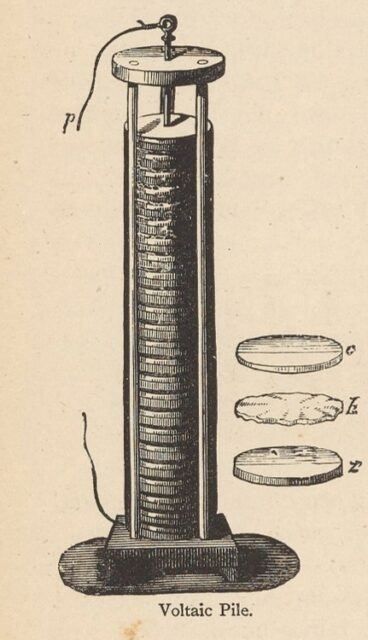
Nicholson and Carlisle tried it on water almost at once. They placed wires from the pile in the liquid. Gas appeared, or rather the two sides of the reaction began to declare themselves. Hydrogen was released at one wire; oxygen, in the earliest arrangement, fixed itself to the other, nearly two inches away. Later, with gold or platinum electrodes, oxygen could be collected as gas. The awkward fact remained. The two supposed products of one decomposition appeared at opposite electrical ends of the apparatus.
At first glance, this looked like the experiment the new chemistry had been waiting for.
The trouble was that it looked a little too good.
A cleaner decomposition
The first article in this series followed water from element to compound. That change had not been a simple passage from error to fact. It involved a wider transformation of chemical practice: new gases, new names, balances, combustion experiments, recomposition, and a growing confidence in quantitative composition.
Electrolysis seemed to bypass much of that history. No flame, no combustion vessel, no burning of inflammable air with oxygen, no droplets collected on glass. The battery appeared to make water surrender its constituents directly. If water was composed of hydrogen and oxygen, here was synthesis in reverse: pass electrical action through the liquid and the two gases would come out.
Strictly speaking, electrical decomposition of water was not new. In 1789, Adriaan Paets van Troostwijk and Jan Rudolph Deiman had used repeated sparks of static electricity to obtain a mixture of hydrogen and oxygen from water, then recombined that mixture into water. Their experiment mattered. It was also awkward. The gases came together, in small quantities, and separating them for testing was difficult.
Nicholson and Carlisle’s version looked sharper. The Voltaic pile produced sustained action. The products could be made to appear separately. Hydrogen here, oxygen there. Each could be collected, examined and identified.
That was the improvement. It was also where the puzzle began.
When neatness becomes suspicious
Suppose water is decomposed. What, exactly, has been decomposed? A particle of water, perhaps. Yet if that particle is split into hydrogen and oxygen, why do the products not appear together? Why does hydrogen emerge at one wire and oxygen at the other? Why should the layout of the battery govern the place where each product appears, while the water between the wires shows no visible sign of being torn apart?
This was not an experiment going wrong. The gases appeared reliably. They appeared at the expected poles. That was precisely what made the situation uncomfortable.
Nicholson noticed the difficulty at once. Hydrogen appeared at one wire; oxygen was found at the other, nearly two inches away. The space between them did not look like a region where water was being visibly pulled into its parts. No trail of bubbles marked the route. The products simply appeared at opposite ends of the electrical arrangement, as if the battery had assigned them places.
Others saw the same embarrassment. Cuvier put it bluntly: if oxygen and hydrogen came from the same particle of water, why did they appear at two distant points, each always at its own wire? Haüy pressed the problem in molecular terms. If one molecule of water was decomposed, why were its products separated? If two molecules were decomposed, why did one give only hydrogen and the other only oxygen?
The question was almost childishly simple. That was why it would not go away.
Today we speak of ions, electrodes and charge transport. Those words make the old difficulty vanish before we have properly felt it. Around 1800, chemists had poles, attractions, affinities, particles, electrical fluids, acids, alkalis, metals, and a growing suspicion that electricity and chemistry belonged together. The experiment was clear enough. The mechanism was not.
Chang calls this the distance problem. The phrase is exact. The gases appeared with too much order for a simple story of local decomposition.
The distance problem
The obvious interpretation could still be defended. Perhaps electricity pulled the constituents of water apart. Oxygen went to one pole, hydrogen to the other. Many experiments already suggested that substances had different electrical tendencies, so the idea was hardly absurd.
It left the hardest part untouched.
What travelled through the water? Hydrogen? Oxygen? Something already separated? Something charged? If the constituents were detached somewhere between the electrodes, why did they not appear on the way? If they moved invisibly, why did they not recombine? And if decomposition happened only at the wires, how could it be the decomposition of the same portion of water?
Changes in apparatus did not remove the difficulty. Davy tried water held in separate gold cups, connected only by a moist bridge of fine asbestos, an arrangement he attributed to William Hyde Wollaston. The products still appeared at distant sites. The more carefully experimenters separated the places of action, the more pressing the question became: where, exactly, was water being decomposed?
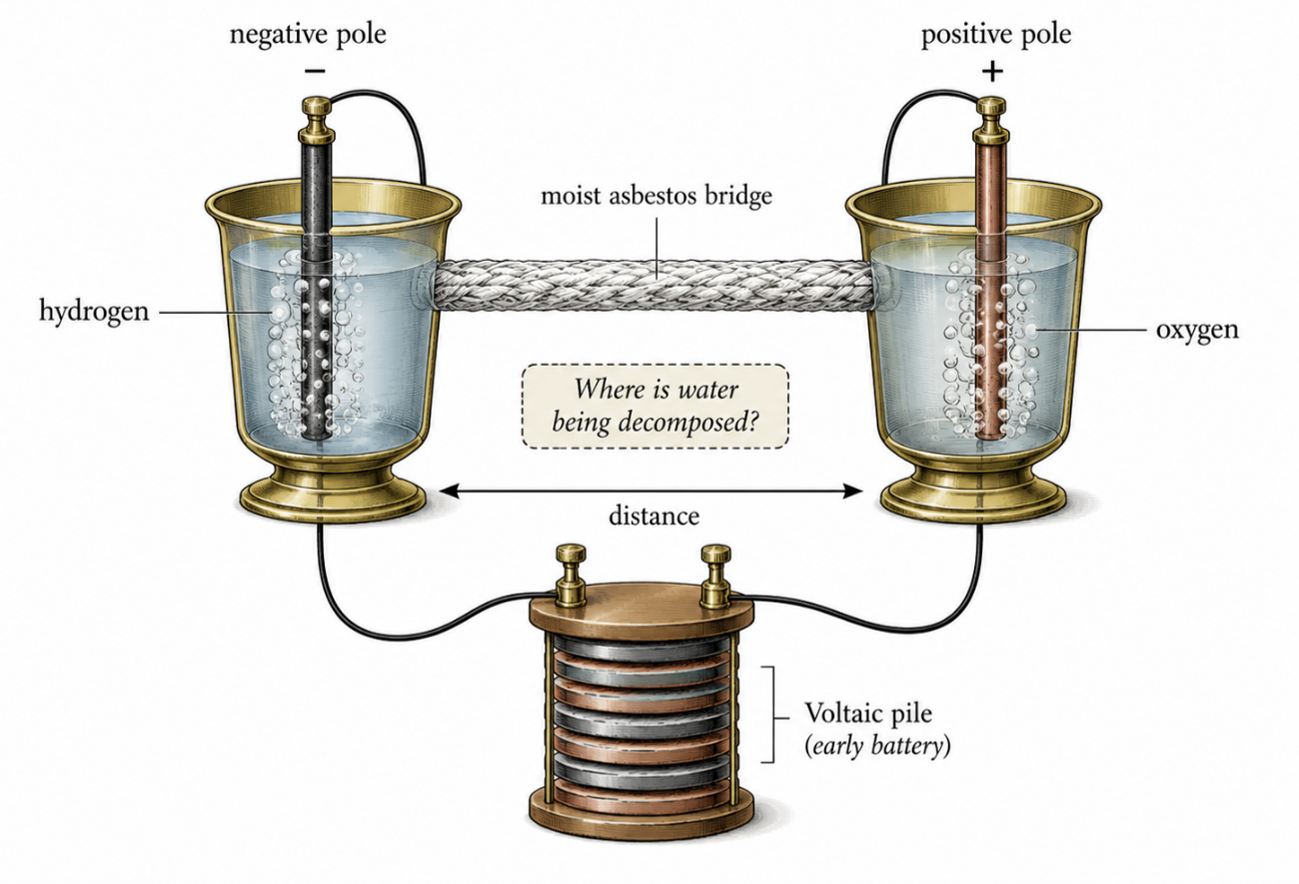
That was the oddity. Electrolysis was not messy. If anything, it was too orderly. Hydrogen went one way, oxygen another. The battery gave a geography to the products of decomposition.
A flame did nothing like this. When inflammable air burned with oxygen, water appeared as the product of combination. There were difficulties, of course, but not difficulties of distance. Electrolysis changed the spatial form of chemical evidence. Water did not answer in one place. It answered at two.
Under electrical action, water no longer seemed merely something to be composed or decomposed. It seemed to contain routes.
Ritter changes the verb
Johann Wilhelm Ritter changed the verb.
For Lavoisierian chemists, electrolysis was analysis. Electricity decomposed water into hydrogen and oxygen. Ritter proposed the reverse. Electrolysis was synthesis.
At the negative pole, water combined with negative electricity and yielded hydrogen. At the positive pole, water combined with positive electricity and yielded oxygen. No product needed to travel from a decomposed particle somewhere in the middle of the liquid. The gases were made where they appeared.
It was a radical move. It was not foolish. Ritter took the most striking feature of the experiment seriously: the gases emerged at different poles. He did not treat that separation as an inconvenience to be patched up later. He built his interpretation around it. If hydrogen appears here and oxygen there, perhaps the two gases are being formed locally by two different electrical processes.
The price was high. Water became elementary again. Hydrogen and oxygen became compounds of water and electricity.
To modern chemistry, this looks perverse. Seen from the apparatus, it had one plain advantage: the gases were produced where they were found. Electricity was still widely treated as something with material agency. If a pile drove something into a liquid, why could that something not combine chemically with the liquid? Why must electricity be only the knife, and never part of what is made?
The phlogistonist echo was clear enough. If inflammable air could be read as water combined with phlogiston, hydrogen could be read as water combined with negative electricity. Identify phlogiston with negative electricity, and Ritter’s scheme comes surprisingly close to older anti-Lavoisierian accounts of water.
Priestley, from America, also saw that the new experiment did not force the Lavoisierian reading. He followed the debate through Nicholson’s journal and argued that electrolysis need not be understood as the decomposition of compound water. His intervention matters because it shows how differently the same electrical process could be read. For Lavoisierians, the gases were constituents released from water. For Priestley, they could still be products of another chemical-electrical process.
Ritter’s view did not last. Chemistry was becoming more firmly Lavoisierian, and elementary water had little room left in the emerging discipline. Still, electrolysis itself had not supplied a neat refutation. Ritter had solved the distance problem rather well. His view lost ground as chemists built an electrochemical practice around compound water.
Keeping water a compound
The Lavoisierian problem was delicate. Chemists had to hold three claims together. Water was composed of hydrogen and oxygen. Electricity decomposed it. Yet the products appeared at different electrodes, with no visible decomposition in between.
So the theory needed help.
One option was invisible transfer: one constituent moved through the liquid to its proper pole. Another was a chain of decompositions and recompositions, in which neighbouring particles handed hydrogen and oxygen along until the products emerged at the ends. In related versions, the whole liquid was imagined as electrically ordered, so that the final gases appeared only where that order met the metal.
These were rescue hypotheses. The phrase can sound dismissive, although it need not be. They were attempts to make a powerful practice intelligible. Electrolysis worked. Its effects could be repeated, varied and extended. What was missing was a mechanism that made the spatial separation of the gases sit comfortably with compound water.
The chain idea had a certain elegance. No single particle of hydrogen or oxygen needed to travel the whole distance. A constituent could be passed along through a succession of exchanges, like a message moving through a crowd. The gas would appear only at the end of the chain.
But what exactly was being passed? How were the exchanges coordinated? Why did the process end at just the right pole? The explanation helped, though it left plenty in the dark.
The transfer idea had its own attraction. If chemical particles had electrical characters, perhaps they could be drawn through the liquid. Again, however, the path remained hidden. The water between the wires did not display the process one wanted to see. Without a developed theory of ions and charge transport, the mechanism remained speculative.
None of this made the hypotheses useless. They kept research going. They suggested new apparatuses, new distances, new electrodes, new liquids and new comparisons. An experiment need not be fully understood before it becomes useful.
That is more or less what happened.
When water stopped being negotiable
By the early nineteenth century, compound water was becoming part of the working furniture of chemistry. Not every detail had been explained. The distance problem remained. Yet fewer and fewer chemists were prepared to reopen the older question of whether water might be elementary.
Water as a compound was no longer simply a hypothesis under trial. Increasingly, it was a condition for further work.
That shift mattered. Once water was taken as compound, electrochemistry could ask other questions. What moved towards each pole? What kinds of substances were decomposed by the pile? How did acids, alkalis, salts and metals behave under electrical action? What changed when the electrode, distance or solution changed? How much chemical change corresponded to how much electrical action?
The material practice hardened. Trough batteries became easier to handle. Gold and platinum electrodes helped prevent the products from disappearing into reactions with the metal. Separate cups connected by wet asbestos became a standard arrangement. The theory remained unsettled, but the apparatus was becoming disciplined.
The unresolved puzzle did not stop electrochemistry. Experimenters varied the arrangement. They separated vessels, introduced bridges, changed electrodes, added acids and salts, and studied what appeared where. The field learnt to handle the phenomena before it possessed a settled account of what moved inside the liquid.
Later developments brought more discipline. Faraday gave electrolysis a quantitative discipline in the 1830s. By the end of the nineteenth century, Arrhenius’s theory of ionic dissociation would help make sense of processes that had long remained obscure. That later clarity, though, should not be read backwards into 1800. For decades, electrochemistry advanced with a problem at its centre.
What electricity did to water
Electrolysis changed what water could be made to do in the laboratory. It did not simply reveal a truth waiting inside the liquid. It altered the route by which that truth could be pursued.
The first article in this series followed water into the balance sheet of chemistry. Water became a substance that could be produced, analysed, recomposed, weighed and named through its constituents. Electrolysis added another sort of depth. Water could now be interrogated electrically. Its constitution became a problem of poles, currents, attractions, transport and hidden motion.
Lavoisierian chemistry had given water constituents. Electrochemistry gave it pathways.
The familiar classroom demonstration hides that difficulty. The bubbles are easy to see. Their meaning was not. Hydrogen here, oxygen there: that simple separation forced chemists to imagine invisible processes inside a liquid that otherwise looked continuous and unchanged.
Electrolysis made compound water harder to abandon, without making it transparent. It turned water into an electrochemical object: something that could conduct, polarise, transport, release and exchange. The question was no longer only whether hydrogen and oxygen belonged to water. It was how electrical action could make them appear at all.
Still, electrolysis could not settle the formula. It could make water yield hydrogen and oxygen. It could not tell chemists how those elements should be counted.
That was the next difficulty. Once water had constituents, chemistry still had to learn how to count them.
References
Chang, H. (2012). Is Water H2O? Evidence, Realism and Pluralism. Dordrecht: Springer. doi: 10.1007/978-94-007-3932-1.
Davy, H. (1807). ‘The Bakerian Lecture, on Some Chemical Agencies of Electricity’. Philosophical Transactions of the Royal Society of London, 97, pp. 1–56. doi: 10.1098/rstl.1807.0001.
Faraday, M. (1834). ‘Experimental Researches in Electricity.—Seventh Series’. Philosophical Transactions of the Royal Society of London, 124, pp. 77–122. doi: 10.1098/rstl.1834.0008.
Nicholson, W. (1800). ‘Account of the New Electrical or Galvanic Apparatus of Sig. Alex. Volta, and Experiments Performed with the Same’. Journal of Natural Philosophy, Chemistry, and the Arts, 4, pp. 179–187.
Singer, G. J. (1814). Elements of Electricity and Electro-Chemistry. London: Printed for Longman, Hurst, Rees, Orme, A. Brown, and R. Triphook.
Volta, A. (1800). ‘On the Electricity Excited by the Mere Contact of Conducting Substances of Different Kinds’. Philosophical Transactions of the Royal Society of London, 90, pp. 403–431. doi: 10.1098/rstl.1800.0018.
Wilkinson, C. H. (1804). Elements of Galvanism, in Theory and Practice: With a Comprehensive View of Its History, from the First Experiments of Galvani to the Present Time. 2 vols. London: John Murray.