The brain’s hidden backup gene: How an evolutionary copy helps protect human brain development
The brain’s hidden backup gene: How an evolutionary copy helps protect human brain development
Author: José R. Pineda got his Ph.D. from University of Barcelona in 2006. Since 2007 he has worked for Institut Curie and The French Alternative Energies and Atomic Energy Commission. Currently he is a researcher of the EHU. He investigates the role of stem cells in physiologic and pathologic conditions.
For decades, geneticists have focused on genes themselves as the main actors in health and disease. Yet our genomes also contain thousands of genetic copies, often dismissed as evolutionary relics with little biological importance. A remarkable new study challenges that view by showing that one such copy, known as a retrocopy, may play a crucial role in protecting the developing brain from genetic damage. The findings not only uncover the cause of a previously poorly understood neurodevelopmental disorder, but also reveal how evolution may have equipped mammals with genetic backup systems that help safeguard brain development. The work centers on a gene called RBMX, located on the X chromosome. RBMX produces a protein that helps cells process RNA, the molecular intermediate between DNA and proteins. Before a protein can be made, newly transcribed RNA molecules must be carefully edited through a process called “splicing”, in which irrelevant segments are removed and the remaining pieces joined together. RBMX acts as a “molecular editor”, ensuring that this process occurs accurately and preventing cells from producing faulty proteins 1. This function is particularly important during embryonic development, when tiny errors can have profound consequences for organ formation, especially in the brain.
Although RBMX was already suspected to be involved in intellectual disability syndromes, evidence had remained scarce because very few affected families had been identified worldwide. To investigate this question, the researchers led by Juliette D. Godin assembled an international cohort of eleven male patients from nine unrelated families carrying disease-causing variants in RBMX. These individuals presented a broad spectrum of neurodevelopmental abnormalities, including intellectual disability, developmental delay, microcephaly, abnormalities of the corpus callosum, visual defects, seizures and genital malformations. The severity varied substantially from patient to patient, raising an important question: why does disruption of the same gene produce such diverse outcomes?
To identify the genetic defects, the team used modern DNA sequencing technologies, including whole-exome sequencing and targeted gene panels. These approaches allow scientists to examine the protein-coding regions of the genome and search for disease-causing mutations. Once candidate variants were identified, they were confirmed using additional genetic analyses and family studies. The researchers found several distinct RBMX mutations, ranging from small deletions and amino acid substitutions to mutations that prematurely truncate the protein. Intriguingly, the mutations clustered into two major groups: those affecting the beginning of the protein and those damaging its end. This observation would later prove crucial for understanding how the disease develops. One of the most surprising discoveries emerged when the researchers turned to evolution. Many genes occasionally generate copies of themselves through a process known as retrotransposition. In this process, an RNA molecule is copied back into DNA and inserted elsewhere in the genome. Because these copies lack the normal gene structure, most eventually become inactive. However, RBMX possesses a highly similar copy called RBMXL1, which arose independently in primates and rodents. Despite originating through separate evolutionary events, both copies retained striking similarities to the ancestral RBMX gene, suggesting they may have been preserved because they perform an important function. To explore this possibility, the investigators examined when and where RBMX and RBMXL1 are expressed in the human brain. Using transcriptomic datasets that measure gene activity across developmental stages, they showed that both genes are highly active during prenatal brain development and are expressed in many of the same cell types, including neural progenitors and developing neurons. Single-cell analyses revealed that most neurons simultaneously express both genes, suggesting they may work together during brain formation.
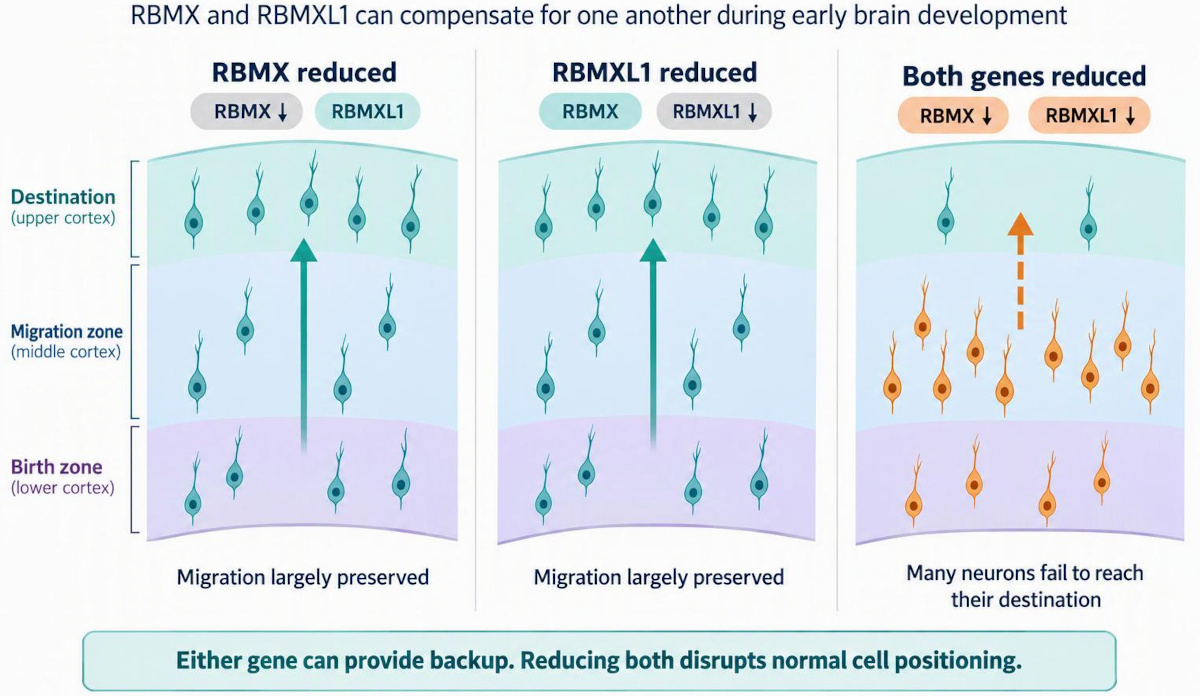
Next, they investigated whether the two proteins carry out similar molecular tasks. To do this, they used a series of sophisticated biochemical experiments. One approach, called yeast two-hybrid screening, allows researchers to identify proteins that physically interact with one another. Another method, mass spectrometry, can catalog hundreds of proteins associated with a target protein. Both techniques revealed extensive overlap between the interaction networks of RBMX and RBMXL1. In fact, the two proteins not only shared most of their interaction partners but also interacted with each other directly. The evidence indicated that RBMXL1 functions in essentially the same molecular environment as RBMX. Then, they examined whether the two proteins also recognize the same RNA targets. Using techniques known as CLIP and splicing assays, they showed that RBMXL1 binds many of the same RNA molecules as RBMX and influences their processing in a similar manner. Although RBMXL1 was slightly less efficient in some experiments, it could perform key splicing functions normally attributed to RBMX. These findings suggested that RBMXL1 acts as a functional backup capable of compensating, at least partially, for RBMX deficiency (Figure 1).
A major challenge arose, however, when comparing humans and mice. If RBMX is so important, why do mice lacking the gene only show relatively mild abnormalities compared with human patients? To answer this, the team generated and analyzed knockout mice lacking Rbmx. They performed extensive anatomical studies, measuring dozens of brain structures with high-resolution imaging techniques. Surprisingly, the mutant mice displayed only modest reductions in brain size and small changes in the corpus callosum, far less severe than the abnormalities observed in humans. The explanation appears to lie in gene dosage. Whereas humans possess a single RBMXL1 retrocopy, mice retain two related retrocopies. The researchers reasoned that these additional copies may provide stronger compensation in mice, thereby buffering the effects of RBMX loss. This idea was tested experimentally using developing mouse embryos. Through a technique called “in utero electroporation”, DNA or RNA molecules are delivered directly into the brains of living embryos using brief electrical pulses. This allows scientists to manipulate genes in specific populations of neural progenitor cells and observe how brain development changes over the following days. When either Rbmx or its retrocopy was reduced individually, brain development proceeded largely normally. However, simultaneously reducing both genes produced clear developmental defects. Neural cells failed to migrate correctly and accumulated in inappropriate regions of the developing cortex. Remarkably, reintroducing either human RBMX or human RBMXL1 restored normal development. This elegant experiment provided direct proof that the two genes can substitute for one another during corticogenesis, the process through which the cerebral cortex is formed.
The study also revealed that not all RBMX mutations behave in the same way. By introducing patient-derived mutations into mouse embryos and cellular models, the researchers discovered two distinct disease mechanisms. Some mutations effectively weakened RBMX function, producing a partial loss of activity. Others appeared to have the opposite effect, actively interfering with normal cellular processes and behaving as gain-of-function or dominant-negative mutations. The location of the mutation within the protein determined which mechanism occurred. This helps explain why different families carrying RBMX mutations can experience markedly different clinical symptoms. To understand how these mutations disrupt brain development at the molecular level, the team analyzed RNA processing in patient cells. They focused particularly on genes involved in neurodevelopment, including ATRX, a gene already linked to intellectual disability syndromes. Using RNA sequencing and targeted splicing analyses, they demonstrated that RBMX mutations alter the way specific RNA molecules are edited before protein production. Importantly, boosting RBMXL1 expression could correct some of these defects, directly demonstrating its ability to compensate for pathogenic RBMX variants.
Beyond its clinical relevance, the work has important evolutionary implications. Retrocopies have traditionally been regarded as genomic curiosities or inactive remnants of past evolutionary events. This study shows that at least some retrocopies remain biologically active and can provide meaningful protection against disease. The fact that humans and mice independently evolved similar RBMX retrocopies that retained overlapping functions strongly suggests that natural selection favored the preservation of this genetic backup system. The findings also raise intriguing therapeutic possibilities. If increasing RBMXL1 activity can compensate for RBMX deficiency, future treatments might aim to enhance the expression or function of this naturally occurring backup gene. The concept resembles current therapies for spinal muscular atrophy, which exploit a related compensatory gene to restore essential protein function. Although such approaches remain speculative, the study provides a strong “proof of principle” that modifying gene redundancy could become a therapeutic strategy.
Ultimately, this research transforms our understanding of both genetic disease and genome evolution. By establishing RBMX mutations as a cause of severe neurodevelopmental disorders and demonstrating that RBMXL1 acts as a functional genetic backup, the study reveals that evolution has left behind more than “molecular fossils”. Hidden among the countless copied genes in our DNA may be protective systems that help ensure robust brain development. Far from being passive remnants of evolutionary history, some retrocopies appear to be active participants in shaping, protecting and possibly even expanding the complexity of the mammalian brain.
References
- Tilliole P, Mattausch C, Tilly P, Leitão E, Boutaud L, Lehalle D, An I, Argilli E, Aufox S, Callewaert B, Charles P, Cinkornpumin JK, Courtin T, Vecchia MD, Davis EE, Dimitrov BI, Dobyns W, Epifanova E, Grandgirard E, Jung M, Jurgensmeyer Langas S, Kaya S, Keren B, Khan TN, Lejeune E, Li M, Marie Y, Morlet B, Nava C, Pastor WA, Plassard D, Prada CE, Rastetter A, Schwaller N, Sestan N, Sherr E, Temple SL, Tenywa JF, Tielens S, van Haeringen A, Whitley H, Nguyen L, Steenpaß L, Rhinn M, Collins SC, Héron D, Cormier-Daire V, Attie-Bitach T, Yalcin B, Depienne C, Godin JD. (2026) RBMX functional retrocopy safeguards brain development in a species-dependent context. Brain doi: 10.1093/brain/awag218. ↩