Category archives: DIPC Computational and Theoretical Chemistry

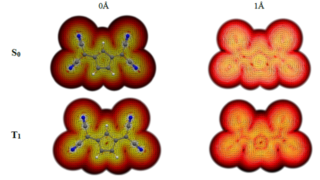
Tuning the excited-state Hückel‐Baird hybrid aromaticity

Tuning the excited-state Hückel‐Baird hybrid aromaticity

ChemistryDIPC Computational and Theoretical Chemistry

By DIPC

Molecules when excited from their ground state (S 0 ) to their lowest electronically excited states often change their electronic structure considerably, which impacts on a range of important molecular properties. For example, the reactivity of a molecule in its excited state often differs markedly from that in its S 0 state. Also, the charge […]

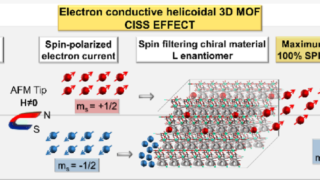
A 3D metal-organic framework as ideal electron spin filter

A 3D metal-organic framework as ideal electron spin filter

DIPC Computational and Theoretical Chemistry

By DIPC

During the last decades, the electronics industry has been very successful in pushing forward the advancement of electronic building blocks, but the limit of silicon-based electronic devices especially in terms of miniaturization are almost reached. There are many ideas how to overcome this problem, for example, by adding functionality based on approaches originating from molecular […]

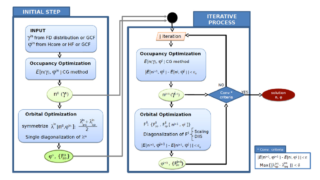
Donostia Natural Orbital Functional (DoNOF), an open-source program for quantum chemistry

Donostia Natural Orbital Functional (DoNOF), an open-source program for quantum chemistry

DIPC Computational and Theoretical Chemistry

By DIPC

Today, computational chemistry helps the experimental chemist understand experimental data, explore reaction mechanisms or predict completely new molecules. There is no doubt that understanding at the molecular level will ultimately lead to an ab initio process design. Thus, the solution of the quantum mechanical many-electron problem is one of the central problems of physics and […]

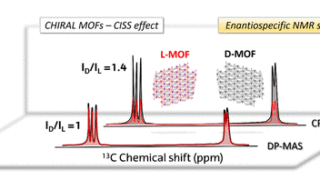
Remarkable enantiospecific response in Cross-Polarization Solid-State NMR experiments

Remarkable enantiospecific response in Cross-Polarization Solid-State NMR experiments

DIPC Computational and Theoretical Chemistry

By DIPC

If a nucleus has a non-zero spin, it behaves as a small magnet. Therefore, in an external magnetic field, the nuclear magnetic moment vector precesses about the field direction but only certain orientations are allowed by quantum rules. Thus, for hydrogen (spin 1/2) there are two possible states in the presence of a field, each […]