Cosmic bombardment may have opened Earth’s crust for prebiotic chemistry
Cosmic bombardment may have opened Earth’s crust for prebiotic chemistry
Asteroids and planetesimals regularly bombarded Earth between about 4.6 billion and 3.5 billion years ago, during the Hadean and Archean eons. Because few rocks today are more than 4 billion years old, our understanding of the planet’s environment during that time is limited. However, samples from the moon and its cratered surface hint at the period’s rate of cosmic impacts.
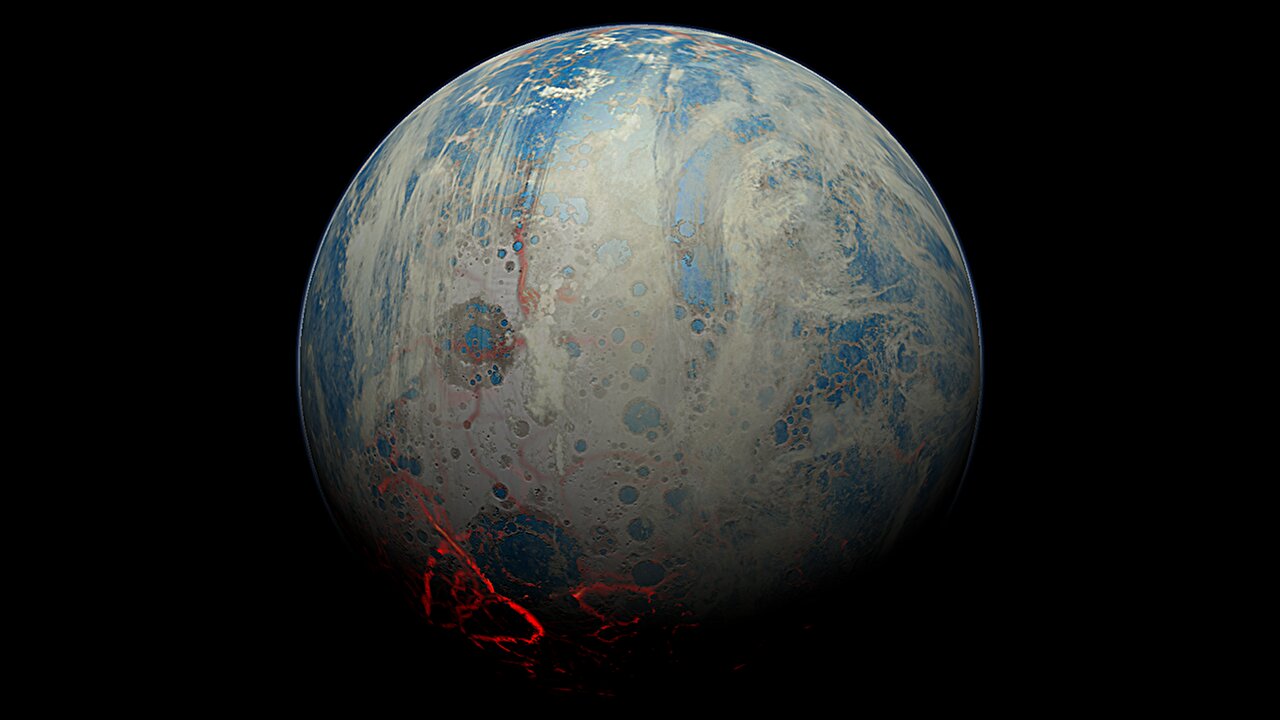
Early asteroid strikes were responsible for significant changes in Earth’s crust, which was primarily basaltlike at the time. Shock waves from collisions fractured the crust and increased porosity, allowing fluids and gases to move through the rocks. Prior research suggests that the resulting hydrothermal systems—such as the network of geysers around Yellowstone National Park—provided the environment for the origin and evolution of early life on Earth.
New research 1 explored how surface impacts during the Hadean and Archean allowed fluids and gases to move through crustal environments. The authors built a large suite of impact simulations with the iSALE shock physics code, varying parameters such as basalt crust thickness, geothermal gradients and the presence or absence of a 5-kilometer-deep (3-mile-deep) ocean.
The simulations detailed how collisions on the surface shaped permeability in the crust. The researchers then integrated a model for ancient bombardment data to understand the cumulative effects of repeated strikes over time.
The results indicate that before 4.3 billion years ago, impacts may have made the crust far more permeable, particularly in its top 8 kilometers (5 miles). From the simulations, the authors inferred that the size of permeable regions depended on impact energy and that geothermal gradients and rock composition in the crust affected the degree of fragmentation after impact. These porous domains formed potential settings for prebiotic chemistry within the early crust.
The research is the first comprehensive study of impact-generated permeability in early Earth’s outermost layer. The results provide a novel framework for evaluating how bombardment influenced hydrothermal circulation and geochemical alteration during the Hadean and Archean eons, with implications for understanding the origin and evolution of life in Earth’s earliest days.
References
- Alexander, A. M., Marchi, S., & Johnson, B. C. (2026). Widespread impact-induced crustal permeability on the early Earth AGU Advances doi: 10.1029/2025AV002097 ↩