Squeezing light into smaller circuits with molybdenum oxychloride
Squeezing light into smaller circuits with molybdenum oxychloride
Most of the data that crosses the oceans travels as pulses of infrared light inside optical fibres. Those pulses must be generated, steered and detected by components packed ever more tightly onto chips, a technology called integrated photonics. Telecommunications rely on wavelengths between 1,260 and 1,675 nanometres, and the 1,550-nanometre region at the heart of this range is where glass fibres lose the least light.
Shrinking those components runs into a barrier understood since 1873, when the German physicist Ernst Abbe showed that a microscope cannot distinguish details smaller than about half the wavelength of its light. The same wave nature makes it difficult, in ordinary materials, to squeeze light into a space much narrower than its wavelength.
Polaritons, a way around
One way around the barrier is to make light share its energy with matter. In 1958 the American physicist John Hopfield described how light inside a crystal can mix with the crystal’s own excitations, and the hybrid waves became known as polaritons. If light couples to electrons sloshing collectively back and forth, the hybrid is a plasmon polariton; if it couples to vibrating atoms, it is a phonon polariton. Either way, the hybrid can have a wavelength far shorter than light in empty space, and can therefore be squeezed into far smaller regions.
Some crystals respond to light very differently depending on direction. In a few, electrons react to the light’s electric field as in a metal along one direction, but as in an insulator along another. Polaritons in such materials are called hyperbolic, because the curve describing their allowed wavelengths is a hyperbola rather than a circle. In principle this permits extremely short wavelengths, and it produces unusual effects such as negative refraction, in which a wave bends the “wrong” way at a boundary, and canalization, in which energy travels as a narrow beam without spreading.
Over the past decade, the best-studied natural examples, hexagonal boron nitride and molybdenum trioxide, have worked only in the mid-infrared, at wavelengths several times longer than those of telecommunications. Artificial metamaterials can reach shorter wavelengths, but they suffer substantial losses and are demanding to fabricate.
Molybdenum oxychloride, the alternative
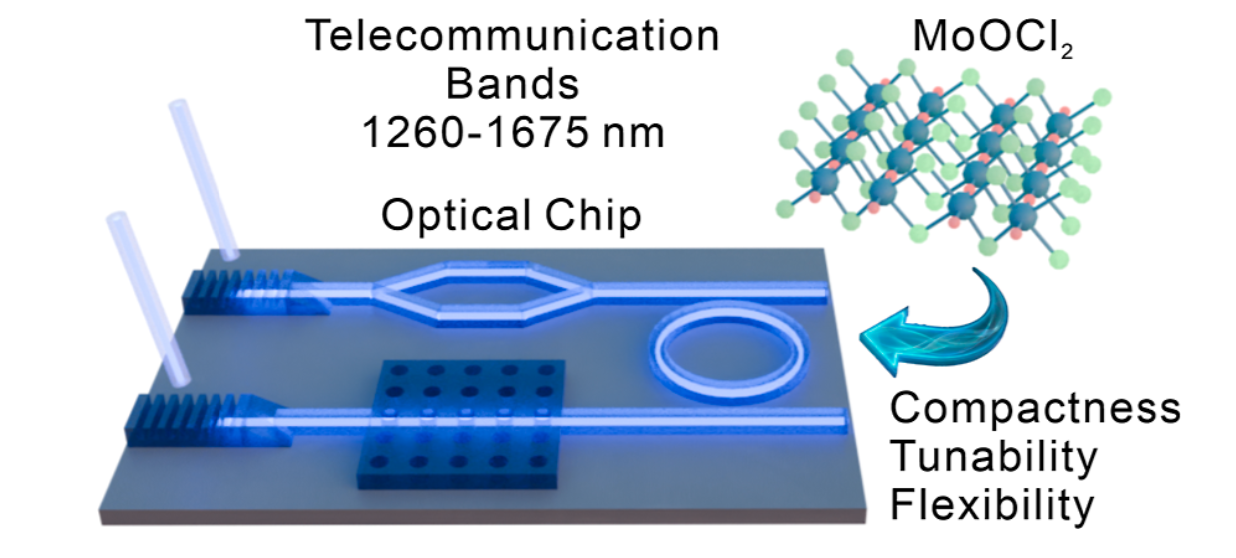
Molybdenum oxychloride, MoOCl2, offers another route. This layered crystal, grown in laboratories since its first synthesis in the 1960s, consists of sheets held together by weak forces, so thin flakes can be peeled off, much as graphene is peeled from graphite. Along one crystal axis it behaves like a metal, and along the other two like an insulator. The result is a hyperbolic response from about 500 nanometres to about 4 micrometres, a range that includes every telecommunication wavelength. This behaviour is intrinsic to the crystal rather than engineered into a patterned structure. Since 2024, several independent groups have imaged its plasmon polaritons at visible and near-infrared wavelengths.
Calculations now explore 1 whether it could work at telecommunication wavelengths too. They use the crystal’s measured optical properties and a layer only 10 nanometres thick, at 1,550 nanometres. Suspended in air, the layer supports plasmon polaritons with a wavelength close to that of light in empty space, so confinement is weak, even weaker than in a standard silicon waveguide. On gold, the picture changes. The polariton wavelength shrinks many times, concentrating the energy into a far smaller region. The polaritons also become canalized: in simulations, a point source launches a narrow beam along one crystal axis with almost no spreading.
This suggests a “virtual waveguide”: a channel for signals that needs no carving, because the crystal axis sets the direction and the gold makes the effect possible. Its stability in air, tolerance of heat and compatibility with fabrication have yet to be tested. A more conventional alternative, a strip about 20 nanometres wide and 10 nanometres thick, also confines polaritons in simulations.
Polaritons control
Periodic patterns can control polaritons just as repeating structures called photonic crystals control light. In the simulations, a layer on gold is perforated by holes spaced 240 nanometres apart. Leaving out a single hole creates a defect that traps polaritons, and the calculated intensity there is about 2.3 times that at the same spot in a perfect lattice. Because the crystal responds differently along different directions, rotating it also matters. When a layer is placed on gold patterned with holes and twisted by 30 degrees, a characteristic feature of the calculated polariton spectrum shifts from 0.81 to 0.71 electronvolts, roughly from 1,530 to 1,750 nanometres. That would allow tuning after manufacture, which a fixed pattern cannot offer.
The final calculations concern emission. In 1946 the American physicist Edward Purcell, studying radio-frequency signals from atomic nuclei, realised that the rate at which a quantum system emits radiation spontaneously is not fixed: placed in a suitable environment, it changes. This Purcell effect now guides the design of light sources, including single-photon emitters for quantum technologies. Here, an emitter held above a 10-nanometre layer of MoOCl2 decays faster. Within about 20 nanometres the enhancement is comparable to that of graphene, but farther away it exceeds both graphene and bulk gold, because the layer offers many high-momentum polariton states into which the emitter can release its energy.
These results are theoretical. Experiments so far have used visible and near-infrared light, shorter than telecommunication wavelengths, and have shown polaritons through near-field microscopy and electron imaging, along with strong optical anisotropy. One experiment even placed a thin MoOCl2 flake on an optical fibre to act as an ultrathin polarizer for visible light. Polaritons at telecommunication wavelengths, canalization on gold, trapping in defects, propagation losses and coupling efficiency all remain to be measured.
If the predictions hold, MoOCl2 would extend hyperbolic polaritons from the mid-infrared to the wavelengths that carry the internet, pointing towards optical circuits that fit information into far smaller spaces.
Author: César Tomé López is a science writer and the editor of Mapping Ignorance
Disclaimer: Parts of this article may have been copied verbatim or almost verbatim from the referenced research paper/s.
References
- H. Tong, C. Clemente-Marcuello, K. V. Voronin, P. Alonso-Gonzalez, and A. Y. Nikitin (2026) MoOCl2 as a Natural Hyperbolic Platform for Integrated Nanophotonics at Telecommunication Bands ACS Photonics doi: 10.1021/acsphotonics.6c00974 ↩