Star clusters as fossils of galactic history
Star clusters as fossils of galactic history
When astronomers in the eighteenth century first turned powerful telescopes toward the Milky Way, they noticed something puzzling: tight, spherical swarms of stars scattered across the sky. Now we know that each contains hundreds of thousands of suns packed into a region just a few dozen light-years across. These objects, known today as globular clusters, were beautiful curiosities for more than a century. It was only in the twentieth century that astronomers began to appreciate their real value: because globular clusters can survive for ten billion years or more — nearly the entire age of the Universe — they are living records of the conditions in which they were born. Reading those records can teach us how galaxies, including our own Milky Way, assembled themselves from primordial gas over cosmic time.
Stars are rarely born alone
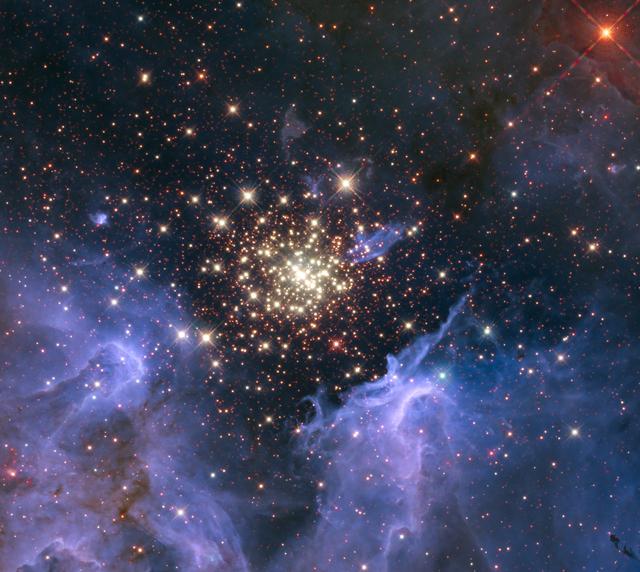
In the densest, coldest pockets of gas inside galaxies, gravity can trigger a burst of star formation in which thousands or even millions of stars emerge almost simultaneously from the same cloud. When enough stars form close together, their mutual gravity can hold them in a bound group for billions of years, producing a massive star cluster. Whether a newborn cluster survives its earliest years depends on how efficiently stars form locally and how strongly the surrounding galactic environment (rotating gas, gravitational tides, giant molecular clouds) pulls it apart. Regions deep inside a galaxy, where gas is dense and rotation is fast, are particularly fertile nurseries for long-lived clusters. The sparse, tranquil outskirts of a galaxy, by contrast, rarely produce clusters that survive.
L-Galaxies 2020, extended
To understand the full population of star clusters across billions of years of cosmic history, simulation is essential, because observations can only detect the brightest and nearest clusters. Tracking every cluster in a fully realistic simulation of an entire galaxy is, however, prohibitively expensive in computing time. A practical alternative is a semi-analytical model: a framework that combines large dark-matter-only simulations, which are relatively cheap to run, with a set of physical equations that describe how gas cools, stars form, galaxies merge, and heavy elements accumulate over time. A recent study 1 has extended one such framework, called L-Galaxies 2020, to include the formation and long-term evolution of individual massive star clusters for the first time.
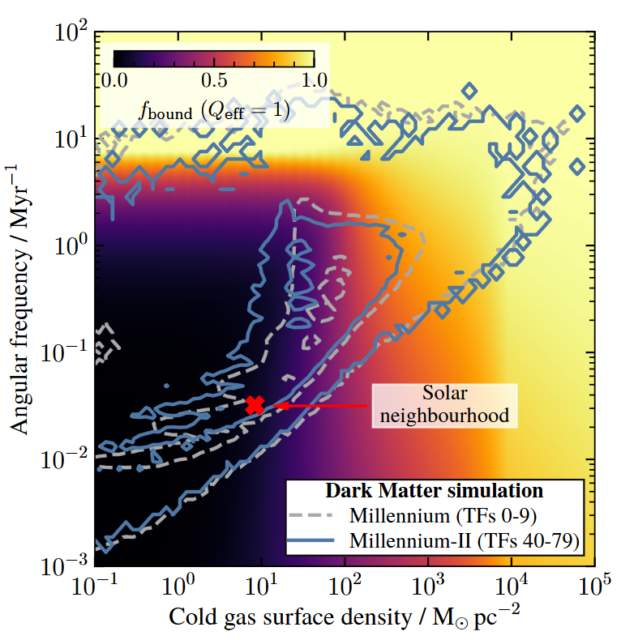
In the model, each galaxy is divided into twelve concentric rings. The gas density, star-formation rate, and gravitational stability of each ring are computed separately, allowing the simulation to identify which parts of a galaxy are likely to produce bound clusters and which are not. Cluster masses are drawn statistically from a mass function — a mathematical description of how common clusters of different sizes are — in which small clusters are far more numerous than massive ones, consistent with observations of nearby galaxies. Every newly formed cluster is also assigned an initial size, a chemical composition equal to that of the gas it formed from, and a position within its ring. The simulation then follows up to 2,000 individual clusters per galaxy across cosmic time.
Star clusters do not remain unchanged
As the most massive stars within a cluster age and explode as supernovae, the cluster steadily loses mass. Repeated close encounters between stars inside the cluster (a process called two-body relaxation) gradually eject stars from the system. Clusters orbiting through the disk of their host galaxy are further eroded by collisions with giant molecular clouds, which inject energy and cause stars to escape. When two galaxies merge, the violent redistribution of stars can fling disk clusters into the galaxy’s halo, where the tidal environment is calmer and clusters are more likely to survive intact. The simulation models all of these processes together.
The sheer complexity of the cluster population
The simulations reproduce several well-established observational benchmarks. Young, massive clusters are preferentially found in galaxies with high rates of star formation, matching data from hundreds of nearby galaxies. More massive galaxies contain more clusters overall and tend to host the most massive individual ones. The model also successfully reproduces the relationship between a galaxy’s mass and the average chemical richness (metallicity) of its cluster population: larger galaxies, which have had more time and more material for chemical enrichment through successive generations of stars, host clusters that contain more heavy elements such as iron.
One of the most striking findings is the sheer complexity of the present-day cluster population. The clusters visible around a galaxy today are not a single, uniform family. Some formed within the galaxy itself and remained in its disk. Others were dragged into the halo during major mergers that destroyed the disk structure of both colliding galaxies. Still others were imported wholesale from smaller satellite galaxies that were gradually torn apart and absorbed. This mixture of origins means that the cluster population encodes a detailed, if difficult to decode, record of every significant merger and episode of star formation a galaxy has undergone across its entire history.
Rich cluster, poor cluster
The chemical compositions of clusters offer another layer of information. Many galaxies appear to host two distinct populations of clusters: one relatively metal-poor group, thought to have been accreted from smaller, chemically primitive satellite galaxies, and one more metal-rich group, formed in situ from already-enriched gas. The simulations predict that this bimodality is present in roughly 20 to 50 percent of galaxies, and that it becomes less pronounced in the most massive systems, where extensive merger histories blend together populations from many different sources and smooth out any clear separation.
Size misfits
Not everything falls neatly into place. The physical sizes of star clusters — how large they are in space — remain difficult to reproduce across all galaxy types and masses simultaneously. Different assumptions about the initial sizes of newly formed clusters improve agreement with observations in some galaxies while worsening it in others. This persistent discrepancy points to gaps in the understanding of the earliest evolutionary phase of star clusters, when they are still embedded in their natal gas clouds and the surrounding environment shapes them most strongly.
Taken together, this work shows that it is now possible to follow individual star clusters through billions of years of galaxy formation within a computationally practical framework. The approach opens new avenues for using clusters as probes of galaxy assembly — not just by studying what they look like today, but by tracing their origins back to the specific mergers, gas inflows, and star-formation episodes that gave rise to them. What eighteenth-century astronomers admired as decorative curiosities in the sky turn out to be among the most informative archives of cosmic history that exist.
Author: César Tomé López is a science writer and the editor of Mapping Ignorance
Disclaimer: Parts of this article may have been copied verbatim or almost verbatim from the referenced research paper/s.
References
- N. Hoyer, S. Bonoli, N. Bastian, D. Herrero-Carrion, N. Neumayer, D. Izquierdo-Villalba, D. Spinoso, R. M. Yates, M. Polkas, and M. C. Artale (2026) Massive star clusters in the semi-analytical galaxy formation model L-Galaxies 2020 Astron. Astrophys. doi: 10.1051/0004-6361/202554325 ↩