The Particle Odyssey: ITACA and the quest for neutrinoless double beta decay
The Particle Odyssey: ITACA and the quest for neutrinoless double beta decay
One of the great unanswered questions in physics concerns the nature of neutrinos, the lightest known particles with mass. A process called neutrinoless double beta decay could provide the answer. In ordinary double beta decay, two neutrons inside a nucleus transform into two protons, emitting two electrons and two antineutrinos. In the neutrinoless version, only the electrons emerge. The idea has deep roots: in 1937 the Italian physicist Ettore Majorana proposed that some particles could be their own antiparticles, and two years later Wendell Furry realized that if neutrinos were such particles, double beta decay could occur without releasing any neutrinos at all. Observing this neutrinoless process today would confirm that neutrinos are indeed their own antiparticles and would show that a fundamental rule of particle physics, known as lepton number conservation, is not exact after all.
Chasing a decay that may never happen
The process, if it happens, must be extraordinarily rare. Current experiments are already sensitive to decays with half-lives greater than 10²⁶ years, far longer than the age of the Universe, and future detectors aim to probe even rarer events still.
One of the most promising technologies for this search uses xenon gas compressed to high pressure. When a charged particle moves through the gas, it ionizes xenon atoms and creates flashes of ultraviolet light. Electric fields then guide the liberated electrons toward sensors, allowing the event to be reconstructed in three dimensions. Xenon gas also allows exceptionally precise measurements of the energy deposited by the decay.
A neutrinoless double beta decay would release two electrons from a common point. As they travel through the gas, they follow winding paths and lose most of their energy at the ends of their trajectories, producing two small regions of concentrated energy deposition. This double-ended structure gives a characteristic signature that distinguishes the sought-after events from most background processes, which typically produce only a single electron track.
The main obstacle is that the drifting electrons spread out as they move through the gas. This diffusion blurs the image of the tracks, especially for events that occur far from the sensors. The amplification process used to make the faint electron signal detectable introduces further smearing. As a result, the distinctive two-electron pattern can become difficult to recognize, particularly deep inside large detectors.
ITACA (Ion Tracking with Ammonium Cations Apparatus)
An alternative approach 1 is to image not only the electrons but also the positive ions left behind by the ionization process. Tiny amounts of ammonia (NH3), around one hundred parts per billion, can be added to the xenon gas. Rapid chemical reactions convert the positive xenon ions into ammonium ions (NH4+)almost as soon as they form, without significantly affecting the light signals or the transport of the electrons.
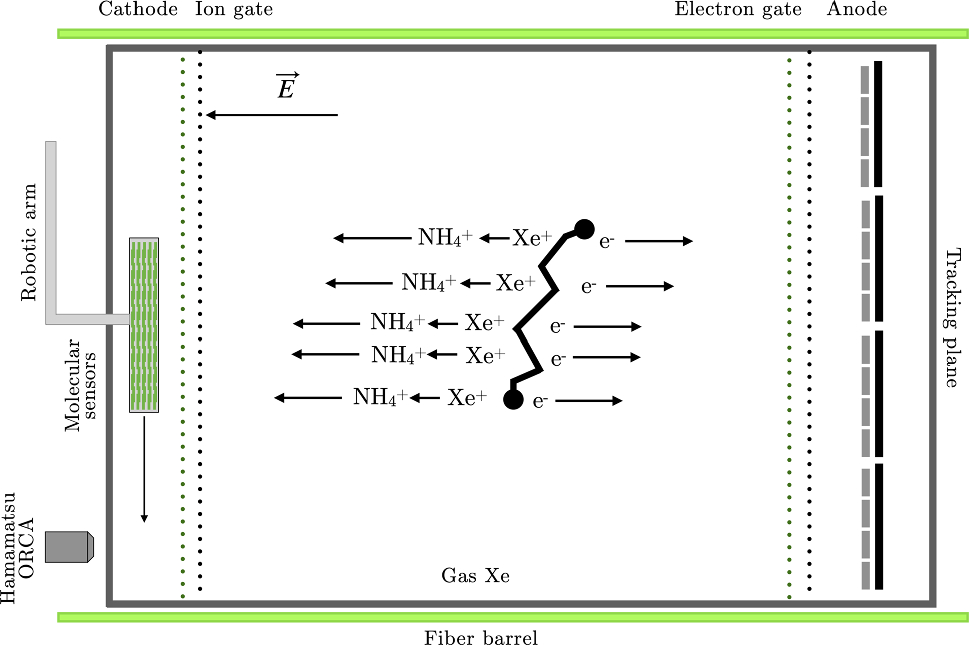
These ammonium ions move far more slowly than electrons and diffuse much less along the way. Electrons cross the detector in a few milliseconds, whereas the ions can take anywhere from a fraction of a second to several seconds to reach their own collection point. Because the ion cloud stays comparatively compact, it can preserve fine details of the original interaction that may already be lost in the blurred electron image.
The two effects turn out to work against each other in a useful way. Wherever an electron happens to be born close to its collecting sensors, its own image stays sharp, while the corresponding ions still have most of their long journey ahead of them and their image comes out blurred. Deep in the gas, far from the electron sensors, the opposite happens: the electron image becomes badly smeared over its long drift, but the ions in that region have only a short remaining distance to travel and arrive with their picture largely intact. Because the two blurring effects are anti-correlated in this way, at least one of the two pictures, electron or ion, stays sharp no matter where in the detector a decay occurs, keeping the overall reconstruction quality close to uniform throughout the full detector volume.
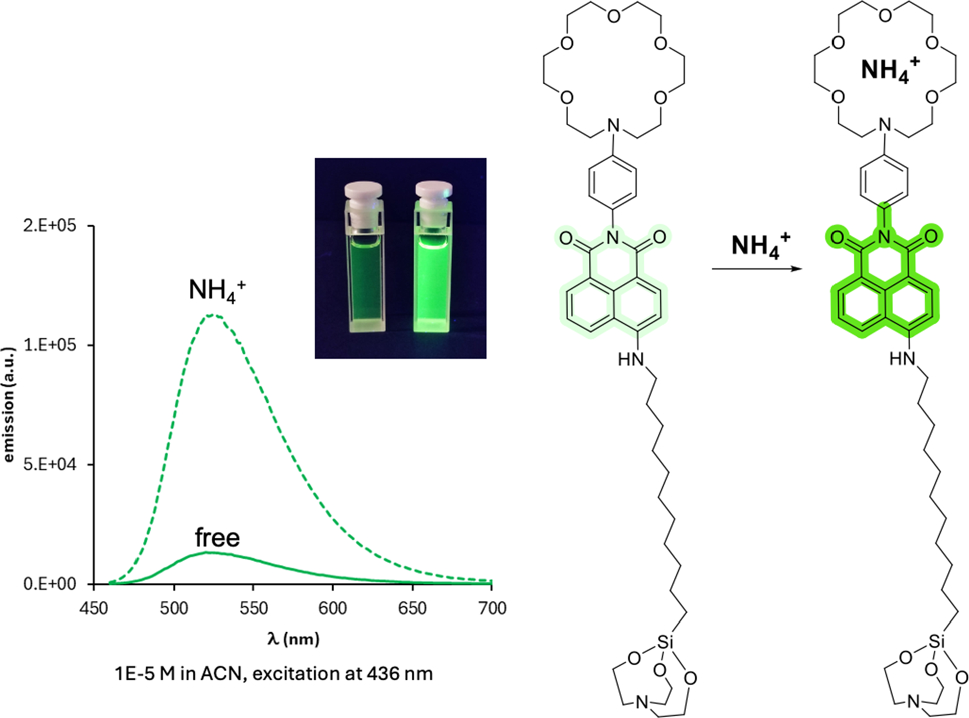
The ion image itself is recorded by letting the ions land on specially prepared molecular surfaces coated with fluorescent sensors that respond specifically to ammonium ions. When illuminated by a laser, only the molecules that have actually captured an ion light up. A microscope and camera system can then scan this surface and reconstruct the ion track with very high spatial resolution.
The researchers call this system ITACA, after Ion Tracking with Ammonium Cations Apparatus. The researchers themselves would be Penelope, waiting for a husband and king who may, or may not, appear.
Would ITACA be the final destination?
Simulations indicate that these ion images preserve the characteristic two-endpoint structure expected from neutrinoless double beta decay, even in the presence of background noise from unbound sensor molecules that occasionally glow on their own. The sharper topology this provides should make it substantially easier to reject events produced by natural radioactivity and other processes that can otherwise mimic the sought-after signal.
Taken together, the additional information carried by the ion tracks could reduce troublesome background events by roughly an order of magnitude beyond what current xenon-gas detectors achieve, and by close to a factor of twenty for some of the most problematic radioactive backgrounds, those whose energy lies dangerously close to the signal itself. Improvements of this size would substantially increase the chances of finally catching neutrinoless double beta decay in the act, and with it, the chance to learn whether the neutrino holds one of the most unusual properties in all of particle physics.
Author: César Tomé López is a science writer and the editor of Mapping Ignorance
Disclaimer: Parts of this article may have been copied verbatim or almost verbatim from the referenced research paper/s.
References
- J. J. Gomez-Cadenas, L. Arazi, M. Elorza, Z. Freixa, F. Monrabal, A. Pazos, J. Renner, S. R. Soleti, and S. Torelli (2026) A journey to ITACA Eur. Phys. J. C doi: 10.1140/epjc/s10052-026-15501-w ↩