Who gets to name geological time?
Who gets to name geological time?
Author: José Luis Granados Mateo is a postdoctoral researcher in the Department of Philosophy at the University of the Basque Country (EHU) and a member of the Integrated History and Philosophy of Science (iHPS) research group. His work focuses on history and philosophy of science, science and values, and the epistemology of scientific practices.
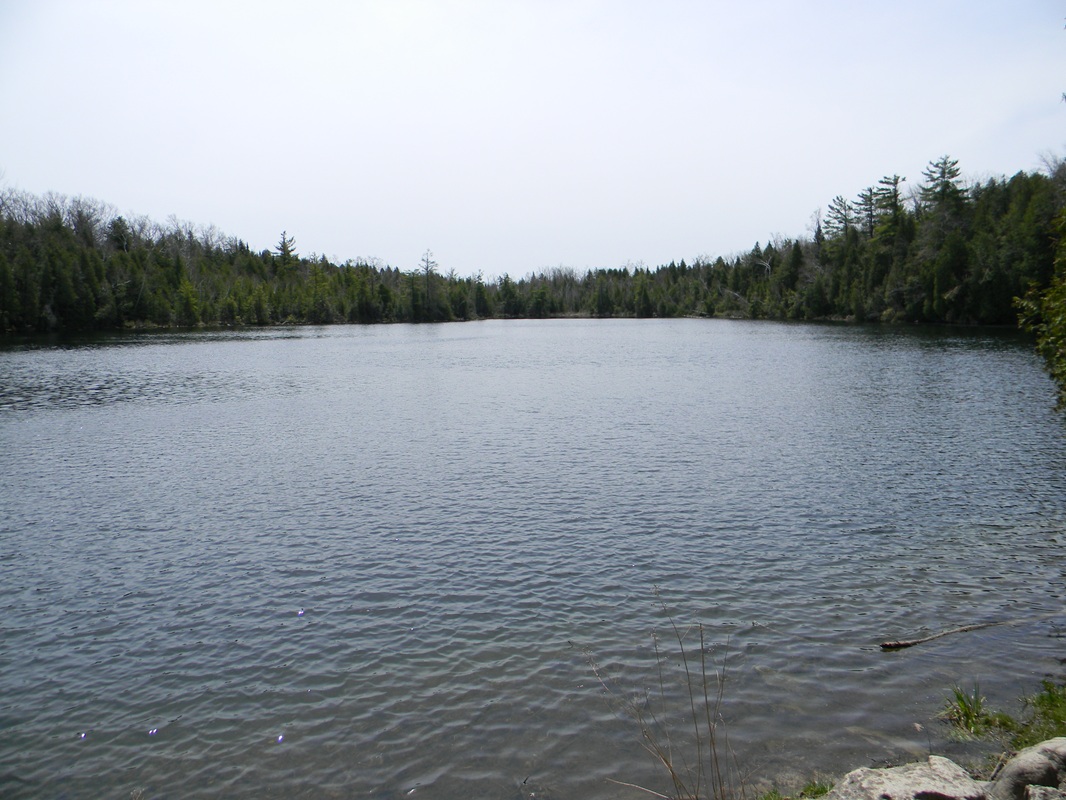
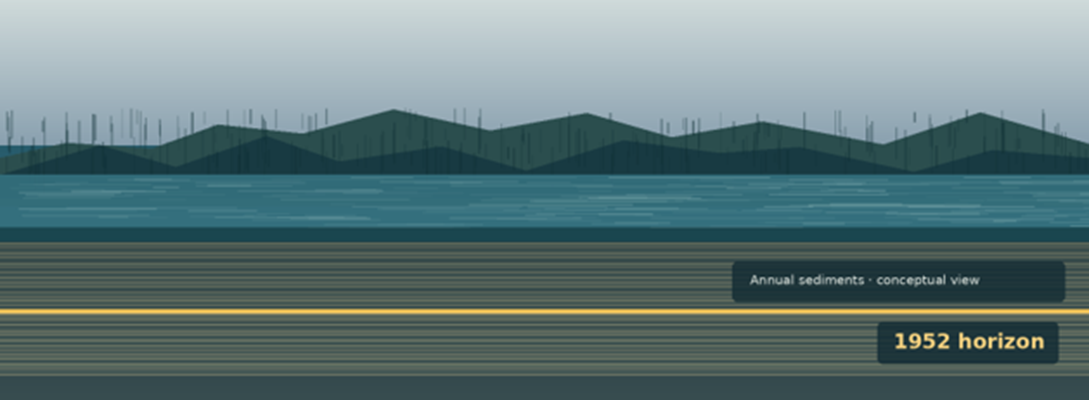
Crawford Lake, in Ontario, keeps an unusually precise diary. Year after year, new sediment settles on its bed, forming layers that can be counted almost like pages in a calendar. One of those layers, dated to the autumn of 1952, registers the early major rise in plutonium produced by nuclear weapons testing. A team of researchers proposed making that horizon the starting point of a new geological epoch: the Anthropocene.
On 4 March 2024, the proposal was rejected. Twelve members of the Subcommission on Quaternary Stratigraphy voted against it, four supported it and three abstained. The sediments had not changed. Nor had the evidence for rapid, human-driven planetary transformation. What failed was a particular attempt to turn that evidence into an official division of geological time.
I first examined the vote in Anthropocene rejected and what it means from an epistemological perspective (2024). In What the Anthropocene rejection reveals about scientific cultures (2026), I explored the contrast between Earth System Science and traditional stratigraphy. That contrast remains illuminating, but a closer reconstruction of the dispute has shown why it cannot explain everything. In a new Perspectives on Science article, Jaume Navarro and I identify two distinct gaps that the failed classification brought into view.
An excellent marker, but for what?
The modern Anthropocene began as an Earth-system diagnosis. Around 2000, Paul Crutzen and Eugene Stoermer drew attention to the extraordinary extent of humanity’s influence on the planet. Subsequent work documented the Great Acceleration, particularly the sharp rise after the Second World War in socioeconomic activity and associated changes across the Earth system. Yet a diagnosis of global transformation is not itself a formal geological unit.
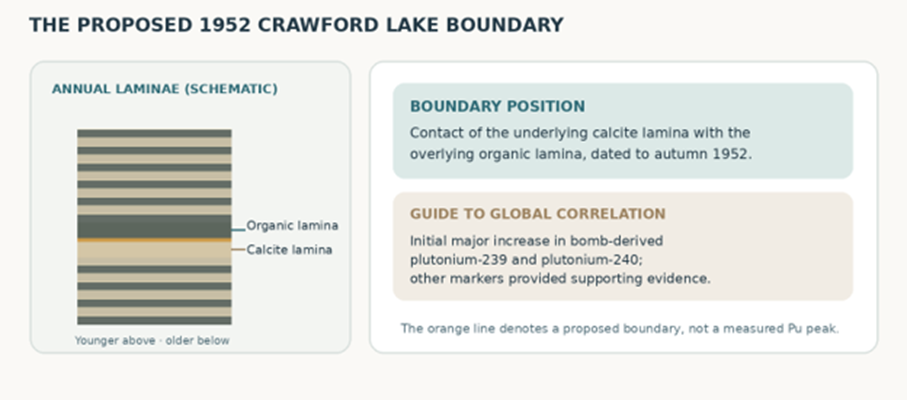
That distinction explains why the Anthropocene Working Group was established in 2009, following an initiative within the Subcommission on Quaternary Stratigraphy itself. Its task was to examine whether a proposed Anthropocene Series/Epoch could meet stratigraphic requirements. A Series is a material body of strata; an Epoch is the corresponding interval of geological time. Their boundaries are ordinarily tied to an agreed physical reference point, a Global Boundary Stratotype Section and Point, or GSSP.
The Anthropocene Working Group did not simply point to a dramatic graph and ask geologists to endorse it. Over fifteen years, its members assembled and compared geological records from different environments. At Crawford Lake, plutonium-239 and plutonium-240 provided the principal guide to a proposed boundary dated to 1952; other chemical, industrial and biological indicators offered supporting evidence. The dossier was designed to connect one precisely dated horizon to signals found much more widely.
But what exactly would the boundary have represented? Certainly not the first occasion on which humans modified their environment. Agriculture, deforestation and urban settlements preceded nuclear testing by millennia. The proposed 1952 horizon was meant to anchor an interval of exceptionally rapid and globally legible transformation, not to identify the first human impact on nature.
This is the first distinction that matters. A marker is not the same thing as the whole history it helps to organise. A precise reference boundary can be scientifically powerful and still leave open further questions: what sort of geological object is being delimited, what transformation it is supposed to stand for, and what place it deserves in the official time scale.
The classificatory gap
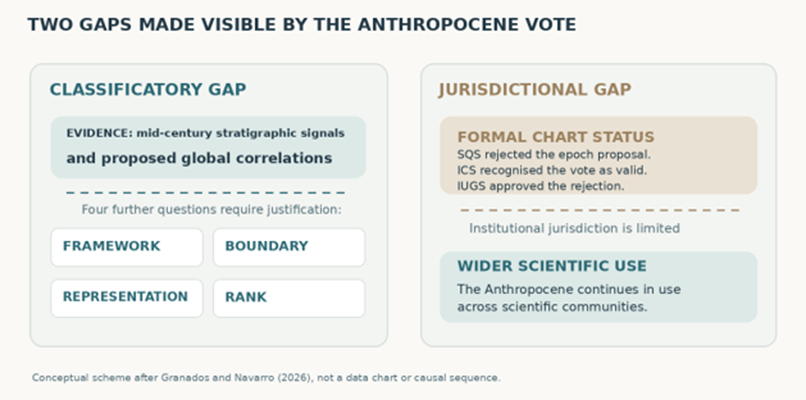
In our article, we call the distance between evidential articulation and classificatory determination the classificatory gap. The term names a simple but often overlooked point. Evidence may strongly support the claim that something important happened, yet still underdetermine how that something should be classified.
In the Anthropocene debate, this meant that the evidence did not have to carry just one argumentative burden. It had to support the identification of a globally correlatable horizon. It also had to support the choice of a boundary-centred framework, the interpretation of the relevant transformation, and the claim that the interval warranted the rank of Series/Epoch rather than some lower category or a different temporal form altogether.
Supporters of the proposal argued that the magnitude, novelty and persistence of post-1950 changes justified treating the mid-twentieth century as the beginning of a new epoch. Critics did not necessarily deny the significance of those changes. Some questioned whether a sharply bounded epoch was the best way to organise the evidence. Others thought that a longer, diachronous event captured the phenomenon more adequately. The disagreement was therefore not exhausted by the question of whether plutonium could serve as a useful marker.
The jurisdictional gap
The second contribution of our article concerns scientific authority. The vote of March 2024 settled an institutional question: the proposed Anthropocene Series/Epoch would not be added to the International Chronostratigraphic Chart. Yet the same vote did not settle the future meaning of the term Anthropocene across science more broadly.
That is why we distinguish a jurisdictional gap. Geological institutions have codifying authority over the formal time scale. They can accept or reject proposed units within that chart. But the Anthropocene had already acquired a scientific life beyond stratigraphy, in Earth System Science, environmental history, archaeology, museum practice and many other settings. The power to ratify the chart did not amount to an equal power to govern every legitimate use of the term.
Once this is recognised, the paradox of the Anthropocene becomes easier to understand. A proposal may fail in its official route to classification and yet continue to organise significant bodies of research. Formal rejection does not simply erase uptake. It redistributes the relevant forms of authority.
Other ways of dividing human geological time
The article also broadens the debate historically by revisiting Antonio Stoppani’s nineteenth-century Anthropozoic. Stoppani proposed a human age of the Earth on grounds very different from those invoked in contemporary Earth System Science. Yet his case helps to show that the problem is not only when an interval begins, but also according to what principle geological time should be organised.
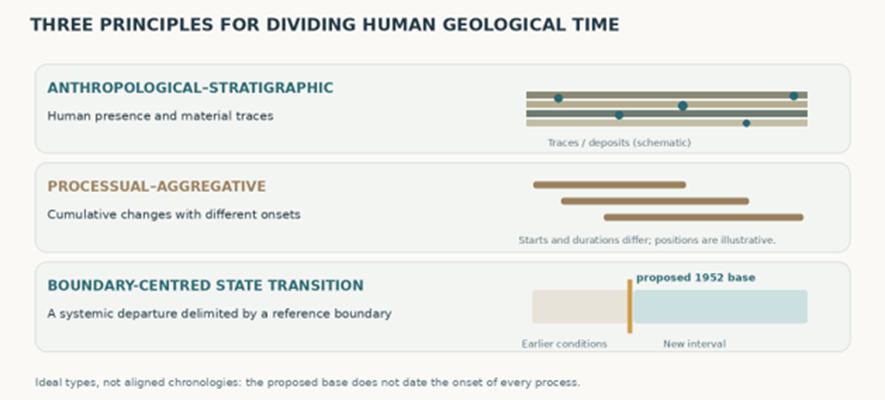
This allows us to distinguish three overlapping principles of periodisation. An anthropological-stratigraphic principle gives priority to human presence and material traces. A processual-aggregative principle groups together transformations that began at different times and in different places. A boundary-centred state-transition principle identifies a major systemic shift and uses it to define a new interval. These are not three equivalent chronologies. They are three different ways of turning evidence into temporal order.
What the rejected proposal teaches us
What remains most revealing about the Anthropocene controversy is not simply that experts disagreed. It is that the disagreement made visible several kinds of decision that successful classifications often hide: what the evidence is evidence for, which framework is appropriate, what kind of authority an institution possesses, and where that authority stops.
The case therefore reaches beyond stratigraphy. It shows why scientific classifications are not mechanical summaries of data. They are reasoned attempts to stabilise meanings, organise evidence and define domains of competence. Some of those decisions are empirical through and through. Others require judgement about use, scope, purpose and institutional remit.
The sediments of Crawford Lake still preserve the signals on which the Anthropocene Working Group built its case. What was rejected was not the record itself, but the proposal to give one horizon a particular place in the official geological chart. Between finding a trace of the past and deciding what it should mean lies a great deal of scientific work—and more judgment than a golden spike might suggest.
References
Granados Mateo, José Luis (2024). Anthropocene rejected and what it means from an epistemological perspective Mapping Ignorance, 21 March 2024.
Granados Mateo, José Luis (2026). What the Anthropocene rejection reveals about scientific cultures Mapping Ignorance, 11 May 2026.
Crutzen, Paul J., and Eugene F. Stoermer (2000). “The Anthropocene.” Global Change Newsletter 41: 17–18.
Gibbard, Philip L., et al. (2022). “A practical solution: the Anthropocene is a geological event, not a formal epoch.” Episodes 45 (4): 349–357.
Granados, José Luis, and Jaume Navarro (2026) The Rejected Epoch: Classification, Jurisdiction, and the Meanings of the Anthropocene Perspectives on Science doi: 10.1162/POSC.a.589.
Longino, Helen E. (2002). The Fate of Knowledge. Princeton: Princeton University Press.
Stoppani, Antonio ([1873] 2013). “The Anthropozoic Era: Excerpts from Corso di Geologia.” Translated by Valeria Federighi. SCAPEGOAT 5: 346–353.
Waters, Colin N., Simon D. Turner, Zhisheng An, et al. (2024) Executive Summary: The Anthropocene Epoch and Crawfordian Age: Proposals by the Anthropocene Working Group EarthArXiv doi: 10.31223/X5VH70.
This article was supported by the Basque Government’s Postdoctoral Research Programme (2023-2028).