What the rocks from asteroid Bennu reveal about the chemical origins of life
What the rocks from asteroid Bennu reveal about the chemical origins of life
In September 2023, NASA’s OSIRIS-REx spacecraft brought home a remarkable gift: the first pristine sample ever collected from a carbon-rich asteroid called Bennu. After two years of careful study in laboratories worldwide, scientists have confirmed that Bennu’s dust and pebbles contain many of the very same small molecules life on Earth relies on as its fundamental building blocks.
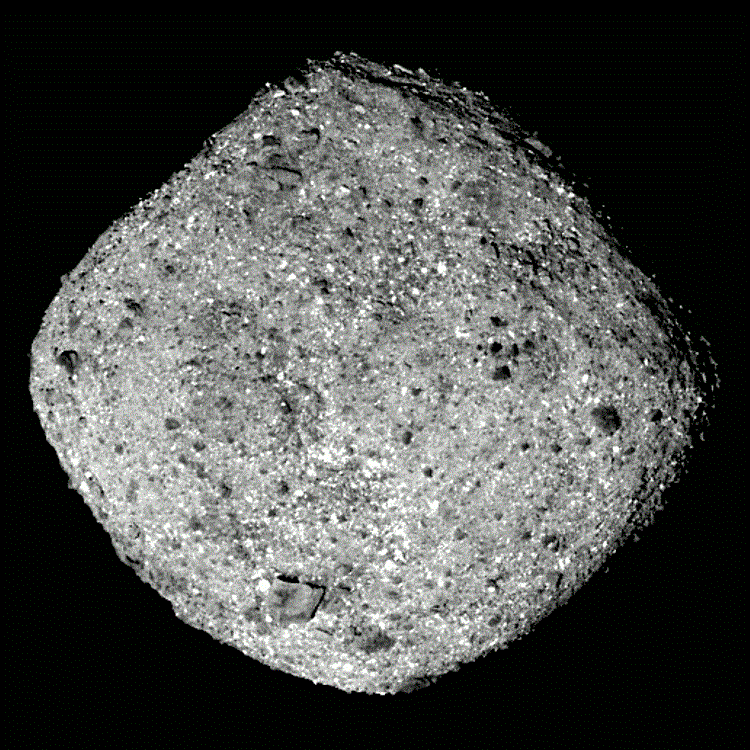
A new study 1 reports that Bennu carries all five nucleobases found in DNA and RNA (adenine, guanine, cytosine, thymine, and uracil) together with a large set of amino acids, the molecules that link up to form proteins. Discovering both families of compounds in the same untouched asteroid sample is exciting news for everyone trying to understand how chemistry first became biology.
Why Bennu’s material is unique
Until now, most of our knowledge about organic molecules in space came from meteorites that landed on Earth. Those samples are valuable, but they have often spent thousands or millions of years exposed to air, rain, and microbes. Contamination is a constant concern.
Bennu’s rocks are different. Scientists collected them directly from the asteroid in 2020, sealed them inside a capsule, and returned them to Earth in 2023 under strictly clean conditions. This careful handling means we can trust that the molecules detected truly came from space.
A fine powder and three pebbles
Researchers studied both a fine powdery mixture and three separate pebbles, each likely broken from different boulders on Bennu. They used two main approaches:
- Wet chemistry, dissolving soluble molecules in water or solvents.
- Pyrolysis, heating samples without oxygen to release and identify compounds locked in tougher material.
These methods revealed a surprisingly rich inventory. In the powder alone, the team identified:
– All five nucleobases used in DNA and RNA (A, G, C, T, U).
– Fourteen of the twenty standard amino acids that life on Earth uses to build proteins, plus a possible trace of tryptophan, an amino acid never confidently seen in extraterrestrial material before.
– Many other small organic compounds containing nitrogen, sulfur, and ring structures similar to those in biological cofactors.
These are not proteins or DNA strands, and certainly not living cells. They are the simple precursor molecules, the basic pieces that could, under the right conditions, begin to assemble into something more complex.
Different pebbles, different chemistry
The three individual pebbles are not identical. Some contain more soluble amino acids, others show different nucleobase ratios, and their insoluble organic matter varies in structure. This chemical patchwork reveals that Bennu’s original parent body (a larger object that fragmented long ago) once held pockets of liquid water. Separate studies of the same sample have also found salt crystals, sodium carbonate minerals that form only when salty water evaporates. Together, these clues paint a picture of an ancient asteroid with warm, briny puddles that concentrated molecules and encouraged reactions.
Water and prebiotics
The results support three key ideas:
- Life’s building blocks formed in space. We now have clean evidence that nucleobases and amino acids can arise together in a primitive asteroid and survive for billions of years until delivered to a young planet.
- Water was already active long before Earth’s oceans. Even small amounts of liquid water inside asteroids altered and enriched organic material, showing that prebiotic chemistry was happening across the early Solar System.
- Early Earth likely received a diverse starter kit. Impacts probably delivered a rich mixture of amino acids, nucleobases, salts, and other compounds, giving chemical evolution plenty of raw material to work with.
Importantly, no one found life, fossils, proteins, or DNA on Bennu. The molecules are small and simple. Yet they are exactly the small, simple molecules that researchers use in the lab to recreate the first steps toward self-replicating systems.
A miniature world
Bennu has delivered a 4.5-billion-year-old time capsule. Its rocks show a miniature world where organic molecules formed in the solar nebula, were modified by transient salty water inside a small planetary body, and then remained almost unchanged until today.
The pebbles tell us that the raw materials for life were widespread, not rare. Wherever liquid water appeared, even briefly in the cold of space, chemistry had an opportunity to move one step closer to life.
For scientists working to retrace those steps, Bennu has just provided some of the purest, most revealing ingredients ever obtained from beyond Earth. The next task is to discover exactly how those ingredients, whether on a young Earth or perhaps inside asteroids themselves, first learned to copy themselves and become alive.
References
- A. Mojarro, J.C. Aponte, J.P. Dworkin, J.E. Elsila, D.P. Glavin, H.C. Connolly, & D.S. Lauretta (2025) Prebiotic organic compounds in samples of asteroid Bennu indicate heterogeneous aqueous alteration Proc. Natl. Acad. Sci. U.S.A. doi: 10.1073/pnas.2512461122 ↩