Peak glacier extinction
Peak glacier extinction
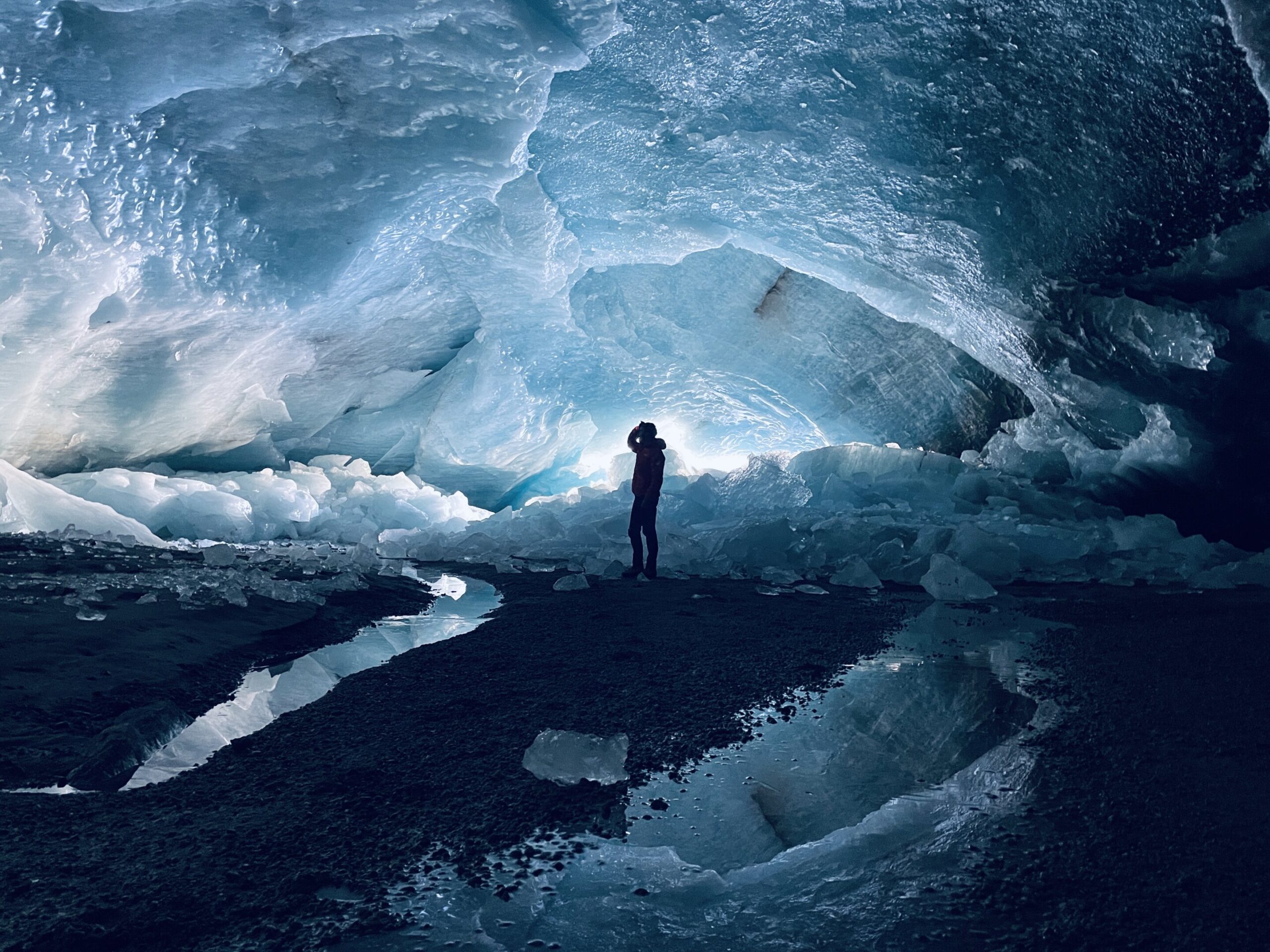
Glaciers are melting worldwide. In some regions, they could even disappear completely. Looking at the number of glaciers disappearing, the Alps could reach their peak loss rate as early as 2033 to 2041. Depending on how sharply the planet warms, this period may mark a time when more glaciers vanish than ever before. Worldwide, the peak glacier loss rate will occur about ten years later and could rise from 2,000 to 4,000 glaciers lost each year.
For the Alps, the outlook is stark: If current climate policies steer the world towards a temperature rise of +2.7 °C, only about 110 glaciers would remain in Central Europe by 2100—a mere 3% of today’s total. At +4 °C, that number would plunge to around 20. Even medium-sized glaciers such as the Rhône Glacier would shrink to tiny remnants of ice or disappear completely. In this scenario, the mighty Aletsch Glacier would fragment into several smaller parts.
This continues a trend that ETH Zurich researchers have already traced in the past—and it shows no sign of slowing: only recently, they revealed that between 1973 and 2016, more than 1,000 glaciers vanished in Switzerland alone 1.
More than half of small glaciers lost
An international team of researchers led by ETH Zurich, Swiss Federal Institute for Forest, Snow and Landscape Research (WSL), and the Vrije Universiteit Brussel has drawn this and further conclusions in a groundbreaking study 2 that, for the first time, calculates how many glaciers worldwide disappear each year, are likely to remain until the end of the century, and for how long.
Unlike previous research, which mainly focused on global ice mass and surface area loss, the ETH Zurich-led team shifts the spotlight to the number of disappearing glaciers, their regions, and the timeline of their disappearance. Their findings reveal that regions with many small glaciers at lower elevations or near the equator are particularly vulnerable—including the Alps, the Caucasus, the Rocky Mountains, as well as parts of the Andes and African mountain ranges that lie in low latitudes.
“In these regions, more than half of all glaciers are expected to vanish within the next ten to twenty years,” says Van Tricht, a researcher at ETH Zurich’s Chair of Glaciology and the WSL.
How many glaciers in the Alps—and worldwide—will survive?
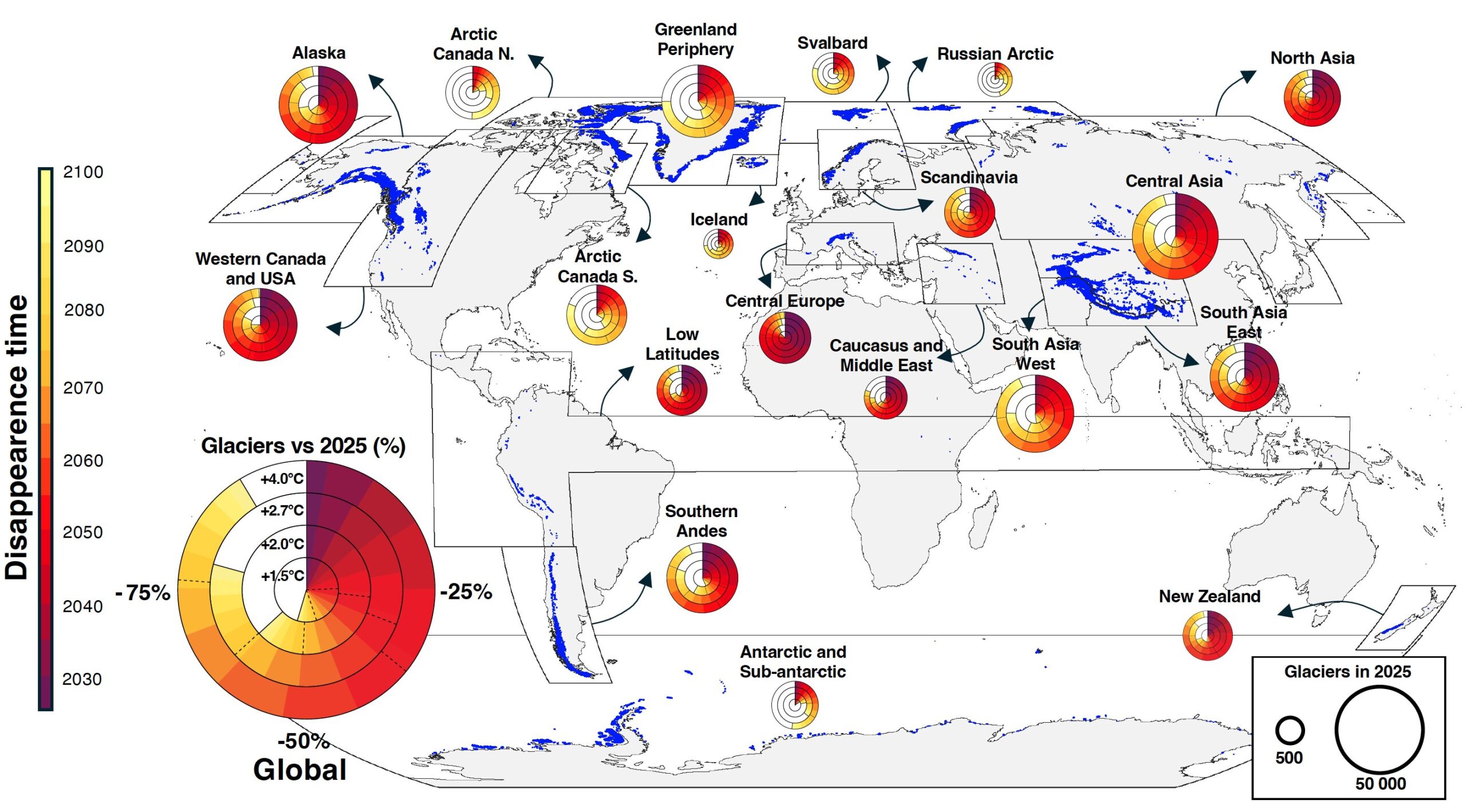
The pace of glacier retreat depends on the extent of global warming. For this reason, the researchers ran projections using three state-of-the-art global glacier models and several climate scenarios. For the Alps, they found that with a +1.5 °C rise, 12% of glaciers would remain by 2100 (roughly 430 out of about 3,000 in 2025); at +2.0 °C, around 8% or ca. 270 glaciers would survive—and at +4 °C, just 1%, or 20 glaciers.
For comparison: In the Rocky Mountains, around 4,400 glaciers would endure under the 1.5 °C scenario—about 25% of today’s roughly 18,000 glaciers. At +4 °C, only about 101 would remain, a 99% loss. In the Andes and Central Asia, about 43% would survive at 1.5 °C. But at +4 °C, the numbers plummet: in the Andes, only around 950 glaciers would remain, a 94% loss; in Central Asia, roughly 2,500 glaciers—a 96% decline. Overall, it can be said that in a scenario with a global temperature rise of +4.0 °C only about 18,000 glaciers would remain, whereas at +1.5°C there would be around 100,000.
The study also shows that there is no region left where glaciers’ numbers are not declining. Even in the Karakoram of Central Asia, where some glaciers temporarily grew after the turn of the millennium, glaciers are projected to disappear.
Every degree of warming matters—or twice as many glaciers will die
In their study, the ETH Zurich researchers introduce the term “Peak Glacier Extinction,” which marks the point or zenith when the number of glaciers disappearing within a single year reaches its maximum. After that, the annual loss rates decline—simply because most of the smaller glaciers have already disappeared. From a climate policy perspective, this matters: the shrinking of glaciers continues even as the number of disappearing glaciers will decline after the peak.
The team calculated this peak for different warming scenarios. Under a +1.5 °C rise in global warming, as envisaged by the Paris Agreement, it would occur around 2041, when roughly 2,000 glaciers vanish in just one year. At +4 °C, the peak shifts to about 2055—but climbs to around 4,000 glaciers. That the peak comes later under stronger warming may seem paradoxical. The reason: in warmer conditions, not only do small glaciers melt completely, but larger glaciers vanish as well. Capturing this total loss of even the biggest glaciers is a key strength of the new approach.
The researchers show that at +4 °C, twice as many glaciers disappear at the peak as under +1.5 °C. While about half of today’s glaciers survive in the 1.5-degree scenario, only one-fifth remain at +2.7 °C—and just one-tenth at +4 °C. Every tenth of a degree counts in slowing the decline.
“The results underline how urgently ambitious climate action is needed,” says Daniel Farinotti, co-author and ETH Zurich Professor of Glaciology.
What does glacier retreat mean for politics, culture and economies?
How does glacier retreat affect people and culture? The new perspective promises fresh insights for politics, business, and culture. Previous studies focused on measuring glacier loss by mass and volume, which allowed projections for sea-level rise and water resource management. “The melting of a small glacier hardly contributes to rising seas. But when a glacier disappears completely, it can severely impact tourism in a valley,” says Lander Van Tricht.
The new study not only reveals when and where glaciers will vanish; it can also help policymakers, communities, the tourism sector and natural hazard managers prepare for a future with less ice and water.
References
- Linsbauer A, Huss M, Hodel E, Bauder A, Barandun M. (2025) Vanished glaciers of the Swiss Alps: An inventory-based assessment from 1973 to 2016. Annals of Glaciology doi:10.1017/aog.2025.10031 ↩
- Van Tricht, L., Zekollari, H., Huss, M. et al. (2025) Peak glacier extinction in the mid-twenty-first century. Nat. Clim. Chang. doi: 10.1038/s41558-025-02513-9 ↩