Crafting the ideal glass in two dimensions
Crafting the ideal glass in two dimensions
Imagine cooling a liquid so fast it turns into glass: a solid that’s jumbled inside, unlike neat crystal lattices. In 1948, Walter Kauzmann noticed a puzzle. As liquids cool, their entropy (a measure of disorder) drops faster than in crystals. Below a certain temperature, a supercooled liquid would have less entropy than the crystal, implying a perfectly ordered yet disordered “ideal glass” with zero extra arrangements. This seemed impossible, creating the famous Kauzmann paradox.
A recent study 1 tackles this in two dimensions using computer simulations of soft disks (circles that can overlap slightly). They developed a clever non-thermal method to build an “ideal jammed packing” at zero temperature, the frozen limit of an ideal glass.
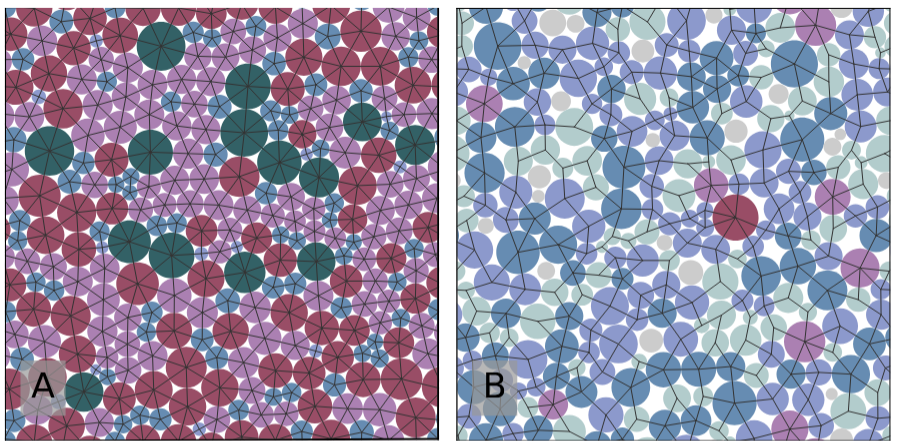
Starting with randomly placed polydisperse disks (varied sizes to prevent crystallization) in a square box, they minimize energy while allowing radii to adjust under constraints that preserve the overall size distribution. This creates nearly fully connected networks. They then enforce a complete “triangulated” contact graph—every space filled with triangles—using geometric tools like the circle packing theorem and a Lagrangian constraint system. The result: a disordered packing with every disk touching six neighbors on average, no gaps, and tiny overlaps.
These packings reach a density around 0.910, denser than typical jammed glasses (about 0.849) and even slightly above the ordered hexagonal lattice (0.9069). They lack crystalline order, shown by rapidly decaying orientational correlations and no long-range translational order. Yet they behave like crystals mechanically: stiff bulk and shear moduli stay high and constant even at zero pressure, with vibrations following crystal-like Debye scaling—no “boson peak” hump seen in ordinary glasses. They are hyperuniform (density fluctuations vanish at long wavelengths) and melt at surprisingly high temperatures compared to usual packings.
By constructing this unreachable ideal state directly, the researchers resolve the paradox: an amorphous system can indeed achieve crystal-like order in entropy and properties without any crystalline structure. In 2D, this breakthrough offers a shortcut to well-equilibrated glasses and opens full exploration of jammed and glassy behavior.
References
- Viola Bolton-Lum, R. Cameron Dennis, Peter Morse, and Eric Corwin (2026) Ideal Glass and Ideal Disk Packing in Two Dimensions Phys. Rev. Lett. doi:10.1103/vldy-r77w ↩