On the threefold birth of the scientific method (2): René Descartes
On the threefold birth of the scientific method (2): René Descartes
In my last entry we had a glimpse on the ideas of one of the three main ‘fathers’ of ‘the’ scientific method, Francis Bacon. As I told then, inverted commas are justified because there is nothing like ‘the’ scientific method, only a family of different, and at times mutually inconsistent, sets of procedures, rules and practices, and of course there has never been something like the ‘birth’ of such a thing (a little bit like the beginning of a famous work by historian of science Steven Shapin: “there was no such thing as the Scientific Revolution, and this is a book about it”). So, let’s keep playing the game. Our next big name in this story is one of the most important philosophers in the history of the West, the French René Descartes (or Cartesius, as was named in Latin). Actually, our third protagonist, Galilei, was slightly older, but since he was the one whose work is more directly connected to scientific practice, I prefer to leave it to the end, grouping first the views that are more ‘philosophical’. We have to say, nevertheless, that, contrary to Bacon, Descartes, though not as paramount as Galilei, was indeed a highly productive scientist, making important advances in fields as diverse as optics, mechanics, or geometry (in fact, he was the creator of analytic geometry, that of Cartesian coordinates).
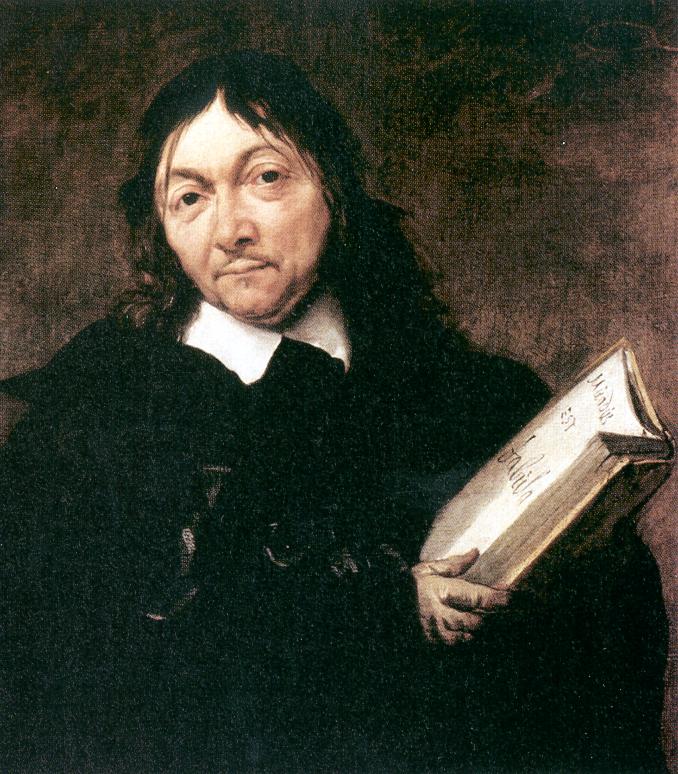
As I mentioned in the last entry, Descartes’ view of ‘the method’ is in some way almost the opposite from the Bacon’s. If the British was the champion of ‘induction’, the French (who attached such importance to the question of the method that his most important book -and a true bestseller of the time- was, as everybody knows, entitled Discourse on the Method) defended instead a radically deductive procedure.
According to Descartes, rather than gathering as much data as possible or carrying out very complex experiments—where each individual’s tendency to perceive things in a particular way could corrupt the quality of observations—what mattered most was to reflect on each problem as carefully as possible, analyzing it in terms of the simplest and most evident elements, and ensuring that each step in our reasoning also possessed the greatest possible degree of evidence. This is what we know as the deductive method.
It is not that Descartes completely disparaged empirical observation (on the contrary, he attached greater importance to learning directly from the world than from books), but he did not have as much faith as Bacon in the validity of its results, and accepted only those observations he could make himself with the greatest possible rigor, distrusting the observations reported by others, and in this sense, leading to a view of knowledge much more ‘solitary’ that the collective, institutional and public enterprise it was in the case of Bagen.
In general, Descartes has gone down in history as the promoter of methodological doubt—that is, beginning any investigation by doubting everything we thought we knew about the matter, assuming that even our sensory perceptions may be nothing more than an illusion (see the box “Descartes and Tickling”), and retaining only those firmest and most indubitable principles we manage to identify. In general, these principles will take the form of mathematical laws, so that the deductions we can make from them may possess the highest degree of rigor and validity. In Bacon’s defense, it should also be noted that his Novum Organum begins precisely by systematically classifying the prejudices (or “idols,” as he calls them) that can and often do lead us into error, which is a kind of ‘methodological doubt’ in itself, of course. It goes without saying that the Baconian and Cartesian views of how to produce scientific knowledge are rather disparate when it goes ‘large-scale’, so to say, the French giving more value to the rigor of individual processes, and the English to the institutional arrangement, and it is also clear that it has been Bacon’s view that is more recognizable in the way science actually works nowadays.
The argument from tickling
However, I can’t resist the temptation of finishing with one wonderful example of the reasons that made Descartes doubt ‘observation’, and promoting ‘clear thought’ over it. As it is known, both Galileo and Descartes claimed that most of the sensations by which we perceive the things around us are nothing more than subjective qualities (also called secondary qualities), which do not reflect the true properties of objects (their primary qualities), which in turn are reducible to mathematizable and measurable magnitudes such as extension or weight. A wonderful argument that allows us to doubt the objective reality of those sensations was given by Descartes at the beginning of another of his works, The World, or Treatise on Light, a revolutionary essay that the French philosopher did not dare to publish because he finished it at the same time as Galileo’s condemnation by the Inquisition.
“Touch is, of all our senses, the one we consider least deceptive and most reliable; so if I show you that touch itself makes us conceive many ideas that in no way resemble the objects that produce them, it will not be strange if something similar happens with sight. Lightly pass a feather over the lips of a drowsy child, and he will feel that he is being tickled: do you think that the sensation of tickling perceived by the child resembles anything that is really in that feather? (…) Therefore, I see no reason to believe that what is in the objects from which we receive the sensation of light is any more similar to that sensation than the action of a feather is to tickling. I do not present this example to convince you that light is one thing in objects and another in our eyes, but only so that you may doubt it and, without inclining toward the opposite opinion either, may now examine with me what light really consists in.”
References
Descartes, René, 1998, The World and Other Writings, Cambridge University Press.
– 1999, Discourse on Method and Related Writings, Penguin.
Shapin, Steven, 1998, The Scientific Revolution, The University of Chicago Press.