How a shifting photonic crystal creates a robust laser
How a shifting photonic crystal creates a robust laser
New research 1 numerically demonstrates how carefully structured materials can control light in ways that are both precise and robust. It brings together ideas from photonics and topology to show how a laser can emerge from the boundary between two distinct optical regimes.
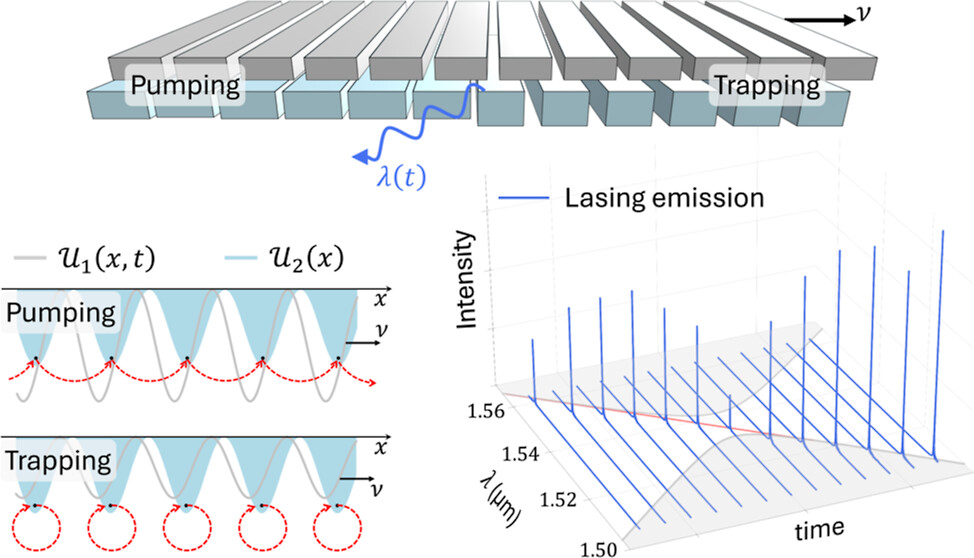
The physical system considered in the study is a bilayer photonic crystal. A photonic crystal is a material in which the refractive index varies periodically, and this periodic structure determines how light propagates through it. In the case studied here, there are two such periodic layers placed close together. Both share the same spatial period, but one layer can be shifted relative to the other. This relative displacement is not just a geometric detail; it acts as a parameter that changes how light experiences the combined structure.
When light travels through a periodic medium, it does not behave arbitrarily. Instead, its allowed frequencies organize into bands, separated by gaps where propagation is not permitted. In the bilayer system, the presence of two overlapping periodic patterns creates a more complex band structure. The balance between the influence of each layer determines whether light tends to move through the structure or remain confined.
Thouless pumping
The idea of Thouless pumping (named after physicist David Thouless) provides a framework for understanding this behavior. Originally developed in condensed matter physics, it describes how a system can transport particles in a controlled and quantized way when its parameters are varied slowly over time. In the photonic version, the role of particles is played by the electromagnetic field distribution. As the relative position of the two layers is varied gradually, the location of the optical mode can shift across the structure. Over a full cycle of this shift, the light effectively moves by an integer number of unit cells, a result tied to the topology of the system rather than to its microscopic details.
A topological distinction
In the bilayer photonic crystal, the authors identify two qualitatively different regimes. In one, the gradual shift of the layers leads to this transport behavior, so that light effectively migrates through the structure. In the other, the same variation does not produce net motion, and the light remains localized. The distinction between these regimes is not simply a matter of degree. It reflects a change in a topological property of the band structure, meaning that one regime cannot be smoothly transformed into the other without closing the bandgap that separates allowed and forbidden frequencies.
This topological distinction becomes especially important when two regions of the structure are brought together, each prepared in a different regime. At the interface between them, the system must accommodate the mismatch in topology. The result is the formation of a localized optical mode confined to that boundary. This mode is not an incidental feature; it is guaranteed by the difference between the two phases and therefore persists even if the structure is slightly altered or imperfect.
The authors then consider what happens when optical gain is introduced. Gain allows certain modes to amplify and eventually dominate, leading to lasing. In their system, the interface mode created by the topological mismatch lies within a bandgap, where no extended bulk modes are available. This isolation makes it an ideal candidate for lasing, since there are no competing modes nearby in frequency. As a result, the system supports single-mode lasing that is both spatially localized and protected by topology, at telecom wavelengths relevant for optical communications.
Topology as a functional tool
An important aspect of the design is that the underlying topological properties are not fixed once the device is built. Because the relative displacement and effective strength of the two layers can be tuned, the system can be driven from one regime to the other. This means that the presence and position of the interface mode, and therefore the lasing behavior, can be actively controlled. The researchers discuss realistic ways to achieve such control, including mechanical actuation and materials whose optical properties can be reversibly modified.
What emerges from this work is a picture in which topology is not just a static classification of a structure but a functional tool. By engineering a system that can move between different topological phases, the authors show that it is possible to create and manipulate laser modes in a controlled and robust way. The bilayer photonic crystal serves as a platform where transport and localization of light, governed by topological principles, can be directly linked to the generation of coherent radiation.
Author: César Tomé López is a science writer and the editor of Mapping Ignorance
Disclaimer: Parts of this article may have been copied verbatim or almost verbatim from the referenced research paper/s.
References
- D. -H. -M. Nguyen, D. X. Nguyen, H. C. Nguyen, T. Louvet, E. Drouard, X. Letartre, D. Bercioux, and H. S. Nguyen (2026) Topological Lasing from Thouless Pumping in Bilayer Photonic Crystal ACS Photonics doi: 10.1021/acsphotonics.5c02664 ↩