Planetary atmosphere in a tank
Planetary atmosphere in a tank
Earth’s atmosphere is a vast, swirling engine of weather and climate. Jet streams race across continents, storms spin into hurricanes, and invisible eddies churn the air at every scale. For decades, scientists have struggled to understand exactly how energy and swirling motion flow through these turbulent systems, especially in the layered zones where the air grows denser with depth, much as it does near the boundary between our lower atmosphere and the stratosphere above it. Now, a clever laboratory experiment has recreated a miniature version of a planetary atmosphere, offering fresh answers. The study shows 1 how atmospheric turbulence behaves when rotation and density layering interact in ways that current computer models struggle to capture.
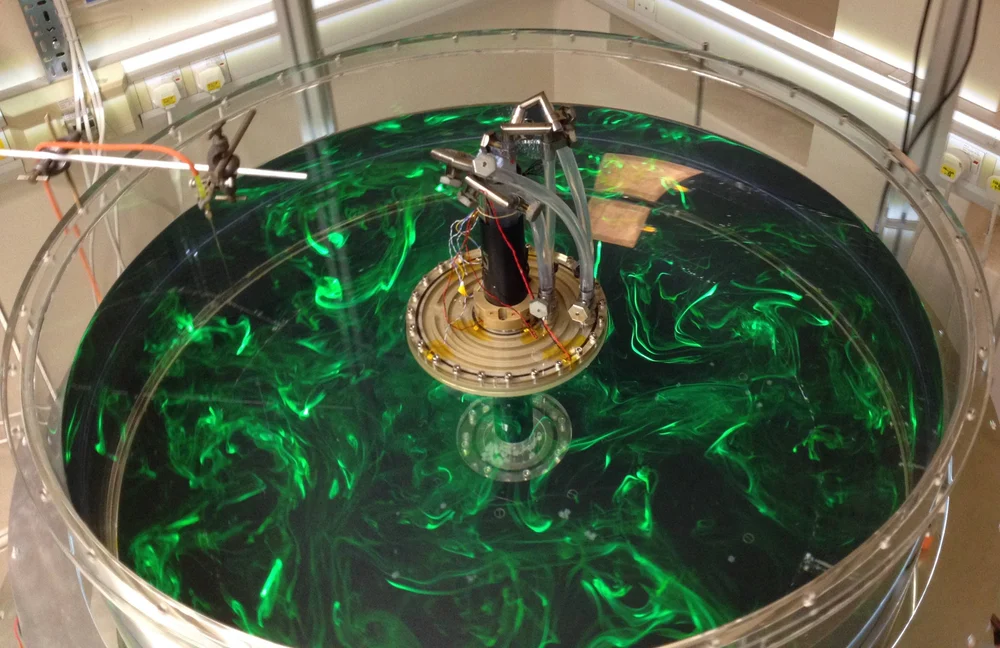
The research team built their “mini-atmosphere” inside a rotating cylindrical tank: an annular ring, like a round moat, with an inner wall and an outer wall. They filled the gap with a water-glycerol mixture roughly 24 centimetres deep and spun the whole apparatus to mimic Earth’s rotation and the deflecting force it exerts on moving air. To reproduce the temperature contrast between the equator and the poles, they heated a ring of fluid at the outer base of the tank (standing in for the sun-warmed tropics) and chilled a plate pressing down on the fluid’s inner surface from above (standing in for the radiative cooling high in the polar atmosphere). Tiny tracer particles seeded in the fluid let cameras track every swirl and eddy, revealing hidden flows across a vast range of scales.
This setup is no toy. It faithfully reproduces the kind of large-scale, rotation-dominated flow (known as geostrophic turbulence) that governs planetary atmospheres and oceans. On Earth, this balance between rotation and pressure keeps high-altitude winds sweeping along pressure contours rather than blowing straight from high to low pressure. The same physics shapes Jupiter’s colourful bands and persistent storm systems, and even the meandering currents in our own oceans.
What the team discovered is striking. In classical two-dimensional turbulence theory, energy tends to flow from small eddies up into giant vortices, while the intensity of rotation (a quantity called enstrophy) cascades in the opposite direction, from large to small, eventually dissipating as heat. The lab experiment confirms this picture but adds a crucial twist: everything depends on how strongly the fluid resists vertical mixing, that is, on how stably it is layered from top to bottom. The strength of this layering, measured by how quickly a parcel of fluid would oscillate if nudged upward and released, turns out to control the overall intensity of the turbulence.
The distribution of energy across different scales of motion follows a precise mathematical relationship, dropping steeply as flows get smaller — a pattern that has been measured directly in the real atmosphere by aircraft but that many models fail to reproduce accurately. The key finding is that the strength of this pattern scales with the square of the layering intensity. In other words, the more stably stratified the fluid, the more pronounced the drop-off at large scales, and the more tightly the energy organises itself into large coherent structures.
Even more intriguing is what the team found about the direction of energy flow. Rather than a single clean cascade in one direction, they observed something more subtle: around a characteristic length scale set by the balance between rotation and stratification, the direction of energy flow reverses. Below that scale, energy moves upward to larger structures; above it, energy moves downward to smaller ones. These two directions coexist simultaneously, driven by the same instability that generates mid-latitude weather systems, the tendency of a rotating, stably layered fluid to develop eddies that tilt against the temperature gradient. Crucially, the intensity of the enstrophy cascade itself is also governed by the stratification, meaning the whole system is ultimately controlled by the vertical temperature structure of the fluid.
Atmospheric models used for weather forecasts and climate projections have long shown discrepancies when compared with global observations. Aircraft sample only narrow slices; satellites see the big picture but miss fine-scale turbulence. By providing a controlled, three-dimensional view of exactly how layering shapes these flows, the experiment gives modellers a new and independent benchmark, one that does not inherit the biases built into the models themselves. The paper points out that while models broadly reproduce the energy distribution near the tropopause, the subtler question of how energy transfers across scales, and at what length scale that transfer changes direction, is far more sensitive to how small-scale processes are approximated. That is precisely where the laboratory results offer the clearest constraint.
The implications stretch to other worlds. The paper plots the relevant parameters for Jupiter, Saturn, Earth, Mars, Titan, and Venus side by side with the experimental data, showing that the same fundamental framework applies across a remarkable range of planetary atmospheres. For gas giants like Jupiter and Saturn, whose powerful jet streams and long-lived vortices persist for centuries, the dynamics fall into a somewhat different regime — one where the jets themselves dominate — and the authors flag this as the focus of future work.
Of course, no tank can capture every complexity of a full planetary atmosphere. Chemistry, radiation, moisture, and three-dimensional convection are all absent. Yet by isolating the pure fluid dynamics, the team has delivered a precise and controlled demonstration of how stratification organises atmospheric chaos. Their work reminds us that even the most familiar sky above us still holds surprises — and that sometimes the best way to understand a planet is to build a small one on a laboratory bench.
References
- Shan-Shan Ding, Hadrien Bobas, Hélène Scolan, Roland M. B. Young, and Peter L. Read (2026) Stratification-Dependent Enstrophy-Controlled Regime in Geostrophic Turbulence Phys. Rev. Lett. doi: 10.1103/n2nj-dg5r ↩