Hydrogen atoms and the hidden wormholes of entanglement
Hydrogen atoms and the hidden wormholes of entanglement
The idea sounds almost like science fiction: two tiny particles that are quantum mechanically linked might also be connected by microscopic shortcuts through spacetime itself, tiny wormholes. This possibility, known as the ER = EPR conjecture, has become a serious topic at the frontier where quantum mechanics meets gravity.
The entanglement-is-just-a-wormhole idea
The initials point back to two landmark ideas from 1935. “ER” refers to Einstein and Rosen’s proposal of bridges or wormholes, as they are known today, hypothetical tunnels linking distant regions of spacetime. “EPR” refers to the famous paper by Einstein, Podolsky, and Rosen on quantum entanglement, the puzzling phenomenon in which two particles can share a single quantum state, instantly correlated even when far apart.
For decades these concepts lived in separate worlds. Wormholes belonged to Einstein’s theory of gravity. Entanglement belonged to quantum mechanics. But in recent years, physicists exploring quantum gravity have found hints that spacetime geometry may itself emerge from quantum entanglement. In this view, the fabric of space and time is not fundamental but arises from deep quantum connections.
The ER = EPR conjecture takes this further. It proposes that whenever particles are entangled, they are connected not just by shared quantum information but by an actual, though quantum-scale, wormhole. These would not be tunnels you could travel through, but subtle geometric links in spacetime.
How to test the ER = EPR conjecture
Testing such an idea seems extraordinarily difficult. Yet two physicists, Irfan Javed and Edward Wilson-Ewing, have proposed a clever way 1 to look for its possible effects using the simplest atom in nature: hydrogen
Hydrogen consists of one proton and one electron. Because of its simplicity, physicists have measured its properties with breathtaking precision over many decades. Its energy levels and transitions have served as crucial testing grounds for quantum theory since the early 20th century.
According to ER = EPR, if the electron in a hydrogen atom is entangled, a quantum wormhole should exist. The researchers make a reasonable but unproven assumption: some of the electric field surrounding the electron might leak into this wormhole. To an outside observer who cannot access the wormhole, the electron would appear to have a slightly reduced electric influence, as if its effective charge were a tiny bit smaller.
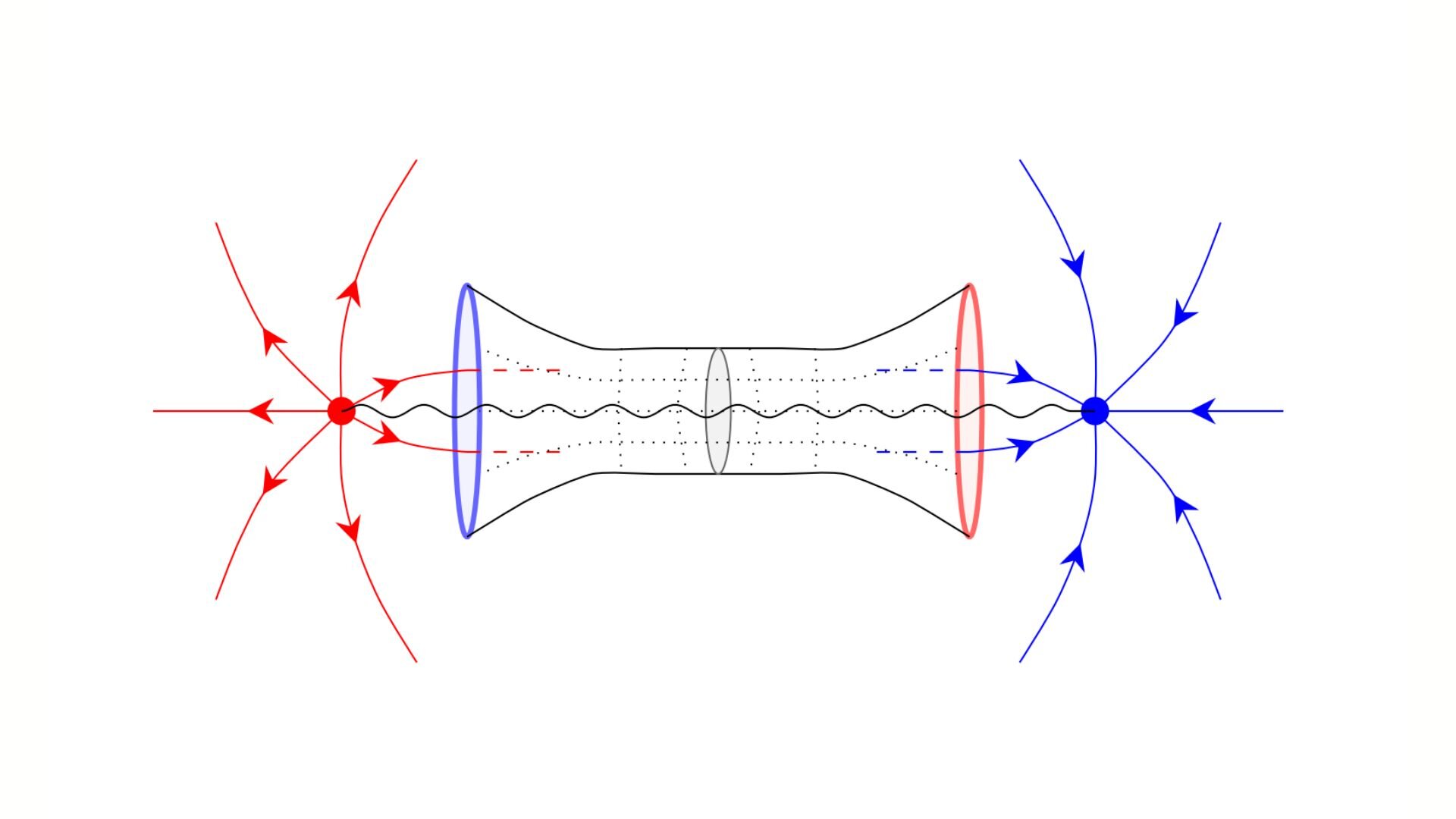
This small change would affect the attraction between the proton and electron. The atom would become ever so slightly larger. More importantly, it would alter the atom’s energy structure in measurable ways.
Hyperfine structure and net charge
The most sensitive test comes from the hyperfine structure of hydrogen—the tiny energy differences caused by the interaction between the spins of the proton and electron. One famous transition produces the 21-centimeter radio wave that astronomers use to map hydrogen clouds across the galaxy. This frequency has been measured to extraordinary accuracy, with no unexplained deviations.
If electric field leakage occurred, the hyperfine splitting would shift slightly. The fact that we see no such shift places strong limits on how large any such effect can be. The researchers also consider the electrical neutrality of the hydrogen atom. Experiments show that the positive charge of the proton and the negative charge of the electron cancel each other with remarkable precision. If some of the electron’s electric field disappeared into a non-traversable wormhole, the atom would carry a tiny net charge, something that has never been observed. This neutrality provides an even tighter constraint.
Assumptions are key
The paper concludes that, under their assumptions, any leakage effect must be extraordinarily suppressed. The wormhole connection, if it exists, has almost no noticeable impact on the everyday behavior of the hydrogen atom.
Importantly, the authors emphasize that their work relies on specific assumptions about how wormholes and entanglement might interact with electric fields. They assume the effect matters for point-like particles such as the electron but not for larger composite objects like the proton. They also focus on non-traversable wormholes, as originally suggested in the ER = EPR proposal, though they briefly discuss traversable cases in an appendix.
Unresolved
This research does not prove or disprove ER = EPR. No direct evidence for microscopic wormholes has been found. What it does show is how precision measurements in ordinary laboratory systems can begin to test ideas once thought to belong only to the most extreme environments, namely black holes or the early universe.
Hydrogen played a starring role a century ago in the birth of quantum mechanics, when its spectral lines helped physicists move beyond classical physics. Today, the same humble atom is helping scientists probe an even deeper question: whether the structure of spacetime itself is woven from quantum entanglement.
The work illustrates a hopeful trend in modern physics. Even the most exotic ideas about quantum gravity may eventually face the quiet judgment of high-precision experiments in a lab. Whether ER = EPR survives these tests or not, the conversation between theory and experiment continues.
References
- Irfan Javed and Edward Wilson-Ewing (2026) Testing Wormhole-Mediated Entanglement with Hydrogen Phys Rev. Lett. doi: 10.1103/78f4-2gxv ↩