Does dark energy evolve?
Does dark energy evolve?
For more than two decades, the standard picture of the Universe has rested on a surprisingly simple idea. Space is expanding, galaxies are moving farther apart, and a mysterious ingredient called dark energy is driving that expansion to accelerate. In the simplest model, dark energy is constant through time, an unchanging property of empty space itself. Yet recent observations from the Dark Energy Spectroscopic Instrument, or DESI, appeared to hint that dark energy may instead evolve as the Universe ages. If true, this would require new physics beyond the standard cosmological model.
Mutually consistent
A new study 1 takes a careful step back before accepting that conclusion. Instead of asking whether dark energy evolves, it asks whether the different astronomical datasets used to infer that evolution are mutually consistent in the first place.
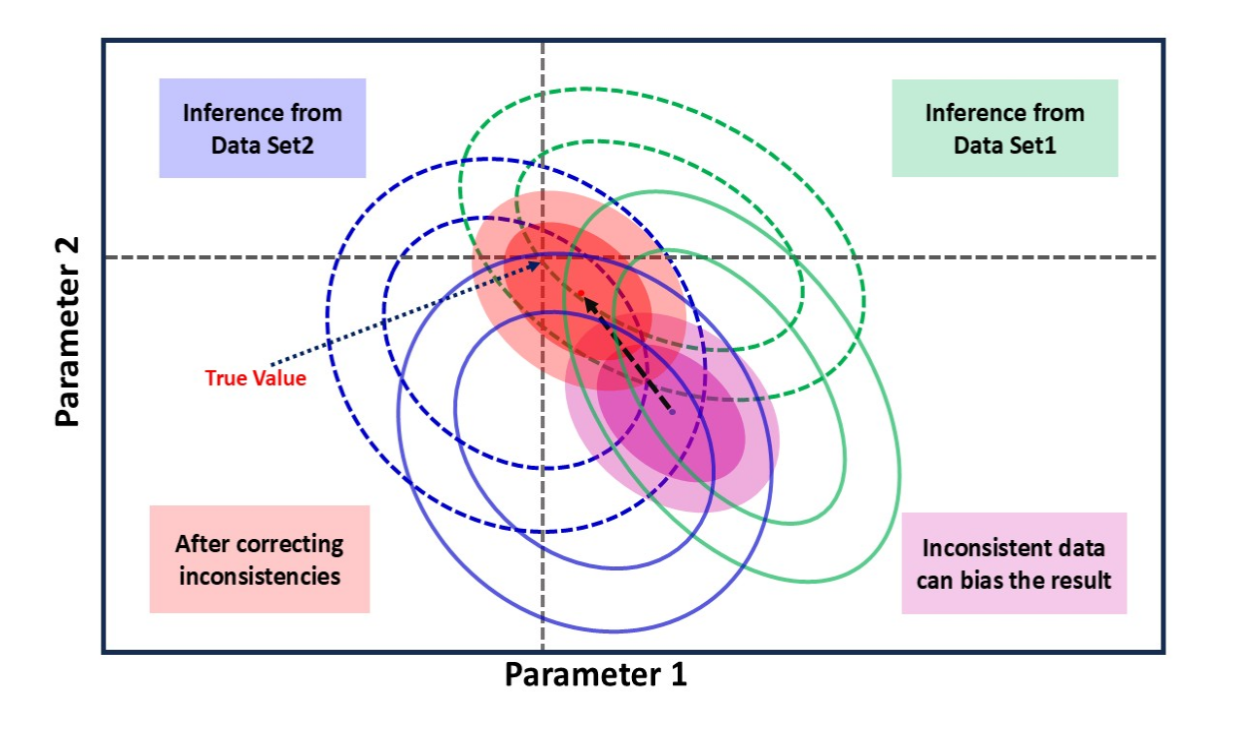
The study focuses on two major techniques for measuring the expansion history of the Universe. The first relies on Type Ia supernovae, exploding stars whose brightness varies but can be corrected using the shape of their light curves, making them precise enough to estimate distances. The second technique uses baryon acoustic oscillations, often abbreviated BAO: subtle patterns in the large-scale distribution of galaxies, frozen in place about 380,000 years after the Big Bang when the Universe cooled enough for atoms to form and sound waves could no longer travel through it. These frozen patterns serve as a kind of cosmic ruler. DESI recently combined its precise BAO measurements with the Pantheon+ supernova catalogue and found evidence that dark energy might differ from a simple cosmological constant. The new paper investigates whether that result could instead arise from hidden mismatches between the two kinds of measurements.
If light behaves
To test this, the researchers applied a fundamental principle called the cosmic distance duality relation. This relation follows from photon number conservation in any metric theory of gravity and holds regardless of what dark energy is doing, as long as light behaves normally in transit. It ties together the two different distances that supernovae and BAO each measure, providing a powerful, model-independent consistency check between the datasets.
Comparing the Pantheon+ supernova measurements with DESI’s BAO results, the researchers found hints that the two datasets do not perfectly satisfy the expected relation, and that the mismatch grows gradually with distance. That detail is crucial, because a redshift-dependent mismatch of this kind can masquerade as the signal of evolving dark energy. If one dataset drifts slightly relative to the other as observations reach further back in time, the combined analysis may falsely suggest that dark energy itself is changing.
When the researchers introduced correction terms to absorb this possible inconsistency, the evidence for evolving dark energy weakened substantially, and the preferred model shifted back toward a constant dark energy. Precision, in this view, does not guarantee correctness: combining two very precise but mutually inconsistent datasets can yield a sharp but misleading result.
The paper explores several possible origins for the discrepancy. Tiny calibration differences between supernova surveys could accumulate with distance. Supernovae properties may drift over cosmic history as stellar chemistry evolves. Intergalactic dust could dim distant supernovae more than expected. On the BAO side, uncertainties in the sound horizon — the cosmic length scale calibrated against the cosmic microwave background — can propagate into the inferred expansion history. More exotic possibilities, such as hypothetical particles that interact weakly with light over cosmological distances, are considered but judged less likely than conventional observational systematics.
An unsettled question
The broader message is methodological: as cosmological measurements become ever more precise, consistency checks between independent datasets become essential. The study demonstrates that the DESI DR2 evidence for evolving dark energy may reflect a precise but inaccurate inference driven by combining two imperfectly matched datasets.
This conclusion is not, however, universally accepted, and several independent research teams working on the same data at roughly the same time have reached different results. Das, More, and Alam 2 applied a closely related test to DESI DR2 combined with several supernova catalogues and found no statistically significant violation of the distance duality relation, concluding the datasets are mutually consistent. Teixeira and collaborators 3 found that certain specific forms of distance duality violation can reduce the hint for evolving dark energy while also helping address the separate Hubble tension, though other forms of the same violation leave the dark energy evidence largely intact. Wang and Mota 4 argued from a different angle that the joint combination of DESI BAO, supernova, and cosmic microwave background data is problematic, but concluded that when each dataset is analysed independently, dynamical dark energy is on average preferred over a cosmological constant.
Taken together, these studies show how genuinely unsettled the question remains. Whether dark energy evolves, and whether any apparent signal is real or an artefact of systematic effects, cannot yet be answered definitively. What is clear is that the extraordinary precision now achievable demands equally rigorous scrutiny of the data being combined. How that challenge is met will shape the next chapter of cosmology.
References
- Samsuzzaman Afroz and Suvodip Mukherjee (2026) Hint toward an inconsistency between BAO and supernovae datasets: The evidence of redshift evolving dark energy from DESI DR2 is absent Physical Review D doi: 10.1103/k59d-l795 ↩
- Sourav Das, Surhud More, Shadab Alam (2026) Cosmology-Independent Constraints on the Etherington Relation and SNeIa Absolute Magnitude Evolution from DESI-DR2 arXiv: 2604.02433 ↩
- Elsa M. Teixeira et al (2025) Implications of distance duality violation for the 𝐻0 tension and evolving dark energy Physical Review D doi: 10.1103/zzmp-rxrh ↩
- Wang, D., Mota, D. (2025) Did DESI DR2 truly reveal dynamical dark energy? Eur. Phys. J. C doi: 10.1140/epjc/s10052-025-15076-y ↩