Hydrogen-based steels gets boost from nickel oxide catalyst
Hydrogen-based steels gets boost from nickel oxide catalyst
Steel and metal production are among the largest contributors to global greenhouse gas emissions, accounting for approximately 10% of global CO2 emissions. At the same time, modern technology relies on tailored steels and metals for applications in fields such as mobility, energy, infrastructure, safety and medicine. Hydrogen-based metal production offers a promising CO2-free alternative and goes even further by integrating reduction, alloying and microstructure design into a single production step. However, hydrogen-based metal production still faces a number of challenges on its path to widespread adoption, one of which is the relatively slow reduction kinetics of metal ores at temperatures below 800°C (1,472°F). A team of researchers at the Max Planck Institute for Sustainable Materials (MPI-SusMat) has now made a significant breakthrough 1. They discovered that adding nickel oxides as catalytic precursors can double the reduction kinetics of hydrogen-based metal production compared with uncatalyzed processes and allow reduced energy use.
Nickel oxides: The most promising catalyst for stainless and maraging steels
Conventional alloy production is typically a three-step process: first, reducing ores to metals; then mixing liquefied elements to create an alloy; and finally applying thermomechanical treatments to achieve the desired properties. Each of these steps is energy-intensive and relies on carbon as both an energy carrier and a reducing agent, resulting in significant CO2 emissions and high energy consumption. The MPI-SusMat team showed previously that a hydrogen-based reduction process allows these three steps to be merged into a single step.
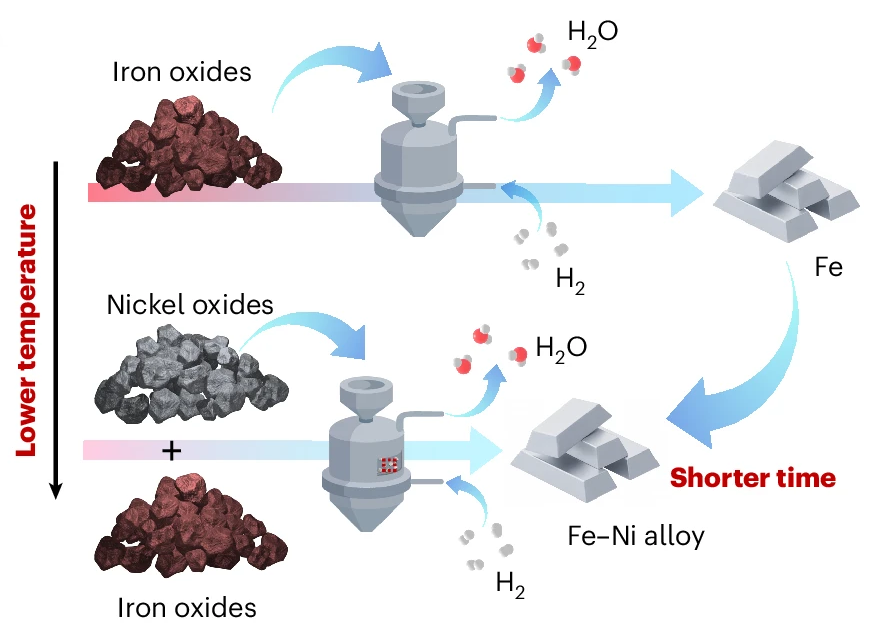
Xinren Chen, a postdoctoral researcher at MPI-SusMat and first author of the latest publication, and his colleagues now show that this approach not only reduces carbon emissions by using hydrogen as the reducing agent, but can also fundamentally accelerate the reaction kinetics.
The team demonstrates how this one-step metallurgical process can be enhanced by adding nickel oxide during the hydrogen-based reduction of iron ores to iron-nickel alloys. The additional nickel oxides are co-reduced and form nanoporous nickel as a transient phase. This nanoporous nickel acts as a highly active catalyst precursor for the reduction of iron oxides and enhances their reduction rate.
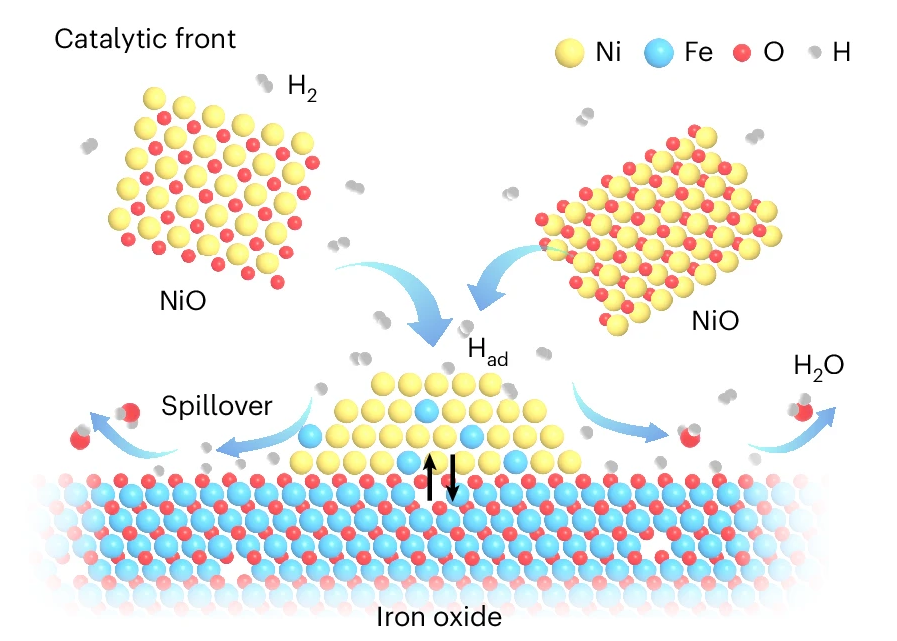
“Adding nickel oxides to an ongoing reduction process of iron oxides makes the overall reduction twice as fast. Atom probe tomography combined with transmission electron microscopy revealed that as the nickel oxides are rapidly reduced to porous metallic nickel, they bind with neighboring iron oxides and create an interface.
“When hydrogen, as the reducing agent, hits this interface, the nickel helps split the hydrogen molecules into highly reactive hydrogen atoms. These atoms then move across neighboring iron oxide surfaces, a process known as hydrogen spillover, enabling accelerated reduction reactions. Notably, the reduction can initiate at temperatures as low as 300°C (572°F), well below the ignition point of hydrogen,” Chen explains.
The resulting nickel-containing alloy is an important master alloy widely used in industrial steels, including stainless steel grades 304 and 316, as well as high-strength and cryogenic steels used for automotive, energy and medical applications.
Do other metal oxides have the same catalytic effect?
Using nickel oxides, the researchers successfully accelerated hydrogen-based iron ore reduction. Nickel is both thermodynamically and metallurgically compatible with iron, making it particularly effective in this process.
“While other transition metal oxides have not yet been systematically evaluated, elements with similar properties, such as cobalt, are expected to exhibit comparable catalytic behavior, offering promising directions for future investigation. In addition, oxides such as TiO2, although not readily reducible under these conditions, may also facilitate hydrogen spillover by providing active surface pathways for atomic hydrogen migration,” says Professor Dierk Raabe, managing director of MPI-SusMat and corresponding author of the publication.
References
- Chen, X., Bienvenu, B., Yang, T. et al. (2026) Solid–solid catalysis for sustainable alloy synthesis. Nat. Synth doi: 10.1038/s44160-026-01086-5 ↩