The hidden role of the immune system in female Alzheimer’s
The hidden role of the immune system in female Alzheimer’s
Author: José R. Pineda got his Ph.D. from University of Barcelona in 2006. Since 2007 he has worked for Institut Curie and The French Alternative Energies and Atomic Energy Commission. Currently he is a researcher of the EHU. He investigates the role of stem cells in physiologic and pathologic conditions.
For decades, Alzheimer’s research has been dominated by a seemingly intuitive idea: the disease is largely explained by the accumulation of abnormal proteins in the brain, primarily beta-amyloid and tau. However, while this view has been useful, it has fallen short in explaining certain fundamental aspects. One of the most striking is that Alzheimer’s affects women far more than men. This is not a minor difference: roughly two-thirds of cases occur in women, and the clinical progression tends to be faster and more severe. The work by López-López and colleagues addresses this imbalance from a different angle. Instead of focusing exclusively on protein accumulation, it shifts attention to the brain’s immune system—specifically to a molecular pathway known as interferon signaling. What the study proposes is that the brain’s immune response, far from being a mere bystander, could be a central driver of the disease, and one that operates differently in men and women 1.
To understand the importance of this idea, it helps to briefly consider what interferons are. They are molecules that form part of the body’s first line of defense against infections, especially viruses. They activate genetic programs that help cells detect and neutralize threats. Under normal conditions, this system is essential for survival. The problem arises when it becomes chronically or inappropriately activated, as is the case in several inflammatory diseases 2. So, the study begins with an analysis of human brain tissue from Alzheimer’s patients. Using transcriptomics (techniques that measure the activity of thousands of genes at once) the authors identified a clear pattern: in the brains of women with Alzheimer’s, genes associated with the interferon response were much more strongly activated than in men (Figure 1). This pattern was not explained by differences in disease severity, since both groups showed comparable levels of neuropathological damage. Instead, it points to an intrinsic difference in how the brain responds to the disease. This finding is significant because it suggests that women not only develop Alzheimer’s more often, but may do so through a partially distinct biological pathway. In other words, the same clinical diagnosis may conceal different underlying mechanisms depending on sex.
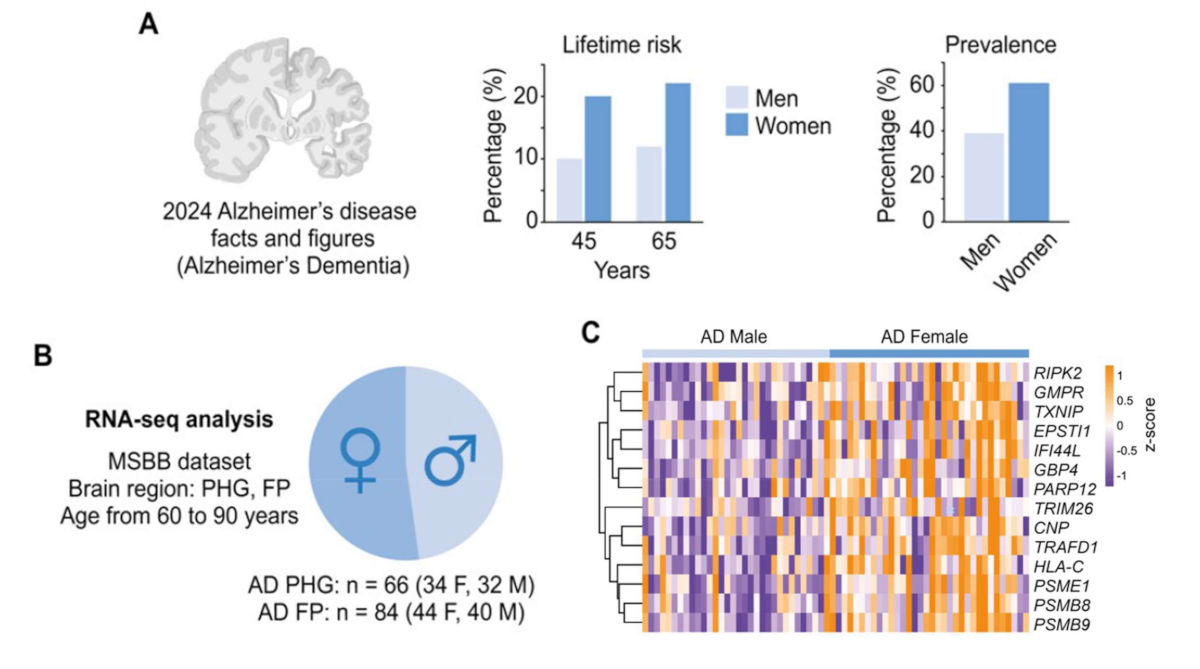
To move beyond correlation and explore causality, the researchers turned to animal models. They used genetically modified mice (APP/PS1), widely employed in Alzheimer’s research because they develop amyloid plaques similar to those seen in patients. Once again, the same pattern emerged: female mice showed much stronger activation of the interferon pathway, along with increased brain inflammation, neuronal damage, and functional impairment. An especially interesting point is that these differences were not limited to amyloid plaque levels. Indeed, female mice did have more plaques, but the study shows that neuronal damage and inflammation cannot be explained solely by amyloid accumulation. This supports a growing idea in the field: that Alzheimer’s toxicity depends not only on protein buildup, but also on how the brain responds to it. In this context, microglia (the brain’s resident immune cells) become key players. Cell-level analyses revealed that these cells are the main drivers of interferon activation. In essence, microglia detect signals of damage or stress and launch an inflammatory response which, if sustained over time, can ultimately harm neuronal tissue. To test whether this pathway is not only associated with disease but actually contributes to it, the authors performed direct manipulation experiments acutely activating interferon signaling in healthy animals using an immune stimulus. To do that, they did intraperitoneal administration of polyinosinic:polycytidylic acid (poly(I:C)) to induce inflammation, but also they performed crossings between the APP/PS1 mice and a microglia-specific Rela conditional knockout line (AD hiIFN). The result was striking: within hours to days, the brains of these animals began to show changes resembling Alzheimer’s pathology, including altered neuronal activity, synaptic disruption, and markers of axonal damage. This results suggest that activation of this pathway is not a secondary phenomenon, but may be sufficient to induce key features of the disease. In parallel, the researchers performed the inverse experiment: they chronically enhanced interferon signaling in microglia within APP/PS1 mice (an Alzheimer’s disease model). This led to a worsening of neurodegenerative features, even though, paradoxically, amyloid plaque levels did not increase—and in some cases even decreased. This last finding is particularly revealing because it challenges a widespread assumption: that fewer plaques necessarily means a healthier brain. Here, the opposite happens!! The animals had less amyloid burden, yet more neuronal damage and worse function. This points to inflammation, and specifically interferon signaling, as an independent driver of degeneration.
Next, the key question is whether this pathway can be targeted therapeutically. To address this, the study explores a pharmacological intervention aimed at the cGAS–STING pathway (a molecular system that senses cellular damage and triggers interferon production). Using a specific inhibitor (STING inhibitor C-176), the researchers demonstrated by RNA-seq and immunohistochemistry that the treatment was able to reduce interferon signaling in the brain. The results were consistent: inflammation decreased, neuronal integrity was better preserved, and cognitive performance improved in memory tests (very important from the therapeutic and functional perspective). More importantly, these effects were far more pronounced in females, which aligns with the idea that this pathway is more active in them and therefore more impactful when blocked. Notably, these improvements occurred without significant changes in amyloid plaque levels. Once again, the conclusion is clear: modulating the immune response may be as important as, or even more important than, targeting protein aggregates. Taken together, this work proposes a shift in how Alzheimer’s is understood. Rather than viewing it solely as a disease of protein accumulation, it suggests it is also—critically—a disorder of immune dysregulation. More specifically, one in which excessive interferon signaling plays a central role, particularly in women.
The practical implications are twofold. First, it opens the door to therapies that modulate immune pathways in the brain, something already feasible in other diseases using drugs that target similar mechanisms. Second, it highlights the importance of incorporating sex as a biological variable in both research and treatment design. What works in men may not work the same way in women, and vice versa. As with any preclinical study conducted in mice we must be cautious when extrapolating to humans: results in animal models do not always translate directly, and manipulating the immune system carries inherent risks, given its essential role in protecting against infections. However, the value of this work lies not only in its potential clinical applications, but in the conceptual framework it offers.
By identifying interferon signaling as a key factor in sex-specific vulnerability to Alzheimer’s, the study provides a mechanistic explanation for a long-observed but poorly understood phenomenon. Perhaps more importantly, it suggests that intervening in this pathway could alter disease progression even without changing classical amyloid pathology. In a field where many clinical trials have failed by focusing solely on plaque removal, this perspective is not just novel, it may be necessary to explore it in the future.
References
- López-López, V., Iniesta, G., Galán-Ganga, M. et al. (2026) Sex-dependent interferon signaling contributes to female-biased vulnerability in Alzheimer’s disease. J Neuroinflammation doi: 10.1186/s12974-026-03840-0 ↩
- Boehmer D., Zanoni I. (2025) Interferons in health and disease Cell doi: 10.1016/j.cell.2025.06.044. ↩