Single-electron Bremsstrahlung in a synchrotron storage ring for quantum experiments
Single-electron Bremsstrahlung in a synchrotron storage ring for quantum experiments
Author: Victor Etxebarria, professor, Dept. Electricidad y Electrónica. Fac. Ciencia y Tecnología, Universidad del País Vasco-EHU
DELTA is a 1.5-GeV synchrotron radiation source operated by the TU Dortmund University. This singular university-based facility with emphasis on research and education, offers high degree of flexibility both for user experiments and accelerator physics and technology.
Most of the world’s synchrotrons are designed to provide a continuous supply of radiation to users in a variety of scientific and industrial fields. Even though Bremsstrahlung 1 is an inherently quantum process, synchrotron radiation of electron beams in a storage ring can be well-described as an electromagnetic wave in the frame of classical electrodynamics. In ordinary electron synchrotrons the radiated power can be calculated using the Larmor formula and its relativistic generalizations describing charged particle radiation under acceleration.
The classical electrodynamics approach for synchrotrons is based on the assumption that radiation is a continuous process, which is well modelled up to very high energies which are not attainable even in the most powerful modern accelerators. However, the discrete nature of radiation includes the recoil of an electron when it emits a photon. Also, the resulting radiation polarization depends on the electron spin. Thus, the statistical properties of photons provide additional information beyond the classical treatment to explain the stochastic emission of quanta by individual electrons.
Single-electron experiments in a storage ring allow us to study in detail the quantum nature of synchrotron light as well as to develop new technology for beam diagnostics in accelerators. To produce a single-electron beam in DELTA, a low single bunch of electron current is first injected in the storage ring and a beam scraper is used to detect and remove the beam halo. Photons emitted by electrons in a dipole magnet or an undulator can be easily detected using a photomultiplier or an avalanche photodiode. At beamline BL 4 in DELTA the single-electron beam is prepared and measured 2. The main non-invasive measurement set-up is shown in Figure 1.
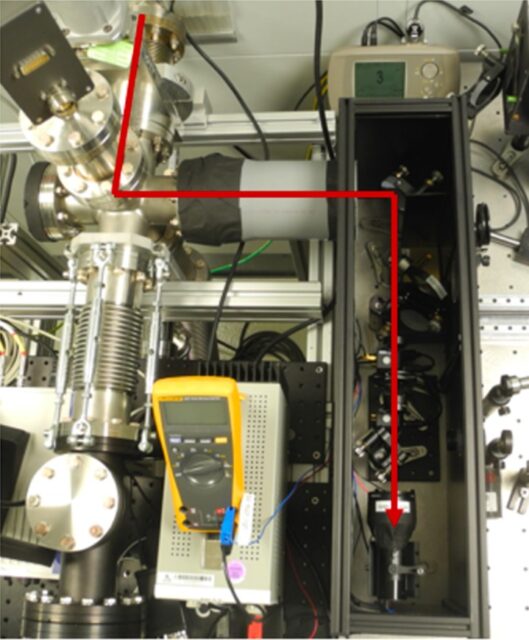
The setup was first tested with a moderate single-bunch electron current and a strongly attenuated beam of synchrotron radiation. The scraper is moved close to the electron beam, considering the electron period of 384ns in the ring, to drastically increase the loss rate. In Figure 2 it is shown the radiated photons per second measured in the storage ring by eliminating the last 22 electrons in the injected bunch. Each step marked in red corresponds to the loss of one electron.
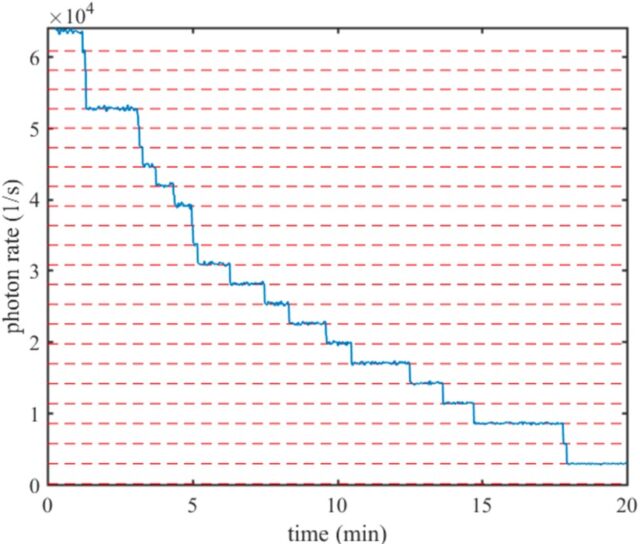
The emission of a photon by a single electron at approximately every 100th passage through an undulator is completely different from the classical description. It is remarkable that, unlike typical objects to study quantum mechanical phenomena, an undulator usually extends over several meters. This may allow us to use standard accelerator techniques like radiofrequency and magnetic fields to manipulate non-classical properties.
Note for instance that the recoil gives momentum to the excitation of radial degrees of freedom of an electron when it radiates a photon. Thus, the trajectory of the electron experiments a quantum widening. The electromagnetic radiation by a charged fermion moving in an external magnetic field depends on the spin of the fermion. This effect was first proposed and computed by Sokolov and Ternov, and measurement on a storage ring to develop further QED testing and new quantum diagnostics technology for particle beams are areas of significant current interest.
References
- A. Sommerfeld (1909) Über die Verteilung der Intensität bei der Emission von Röntgenstrahlen, Physikalische Zeitschrift, 10, 969–976. ↩
- S. Khan, B. Büsing et al. (2024) Single-electron experiments at the DELTA storage ring, IPAC 1358-1360 doi: 10.18429/JACoW-IPAC2024-TUPG51 ↩