Reading the cosmic web in its smallest scales
Reading the cosmic web in its smallest scales
One of the most powerful ways to study the Universe is to map where galaxies are located. Galaxies are not scattered randomly through space; they gather into groups, clusters, filaments and other structures that trace the underlying distribution of dark matter. The pattern of this cosmic web carries information about the basic ingredients and history of the Universe.
Pushing into a small-scale regime
A new analysis 1 pushes this idea into an unusually small-scale regime. It focuses on emission-line galaxies, a population of relatively young, actively star-forming galaxies. These objects are especially useful for surveys such as the Dark Energy Spectroscopic Instrument, or DESI, because their strong spectral emission lines make it comparatively easy to measure how far away they are, and therefore how far back in cosmic time they are being seen. The data used here come from DESI’s first public data release, covering galaxies seen when the Universe was between roughly 30 and 50 percent of its current age, some seven to ten billion years ago.
The difficulty is that galaxies do not trace matter in a simple, one-to-one way. Most of the matter in the Universe is dark matter, and galaxies form and live inside concentrations of it called halos. How a galaxy relates to its halo depends on messy astrophysical processes, such as how efficiently it forms stars, and what happens when it falls into a larger halo, loses gas, and gradually shuts down its star formation. These complications become especially important for galaxies separated by only a few million light-years or less, distances comparable to the size of a single halo.
For this reason, cosmological analyses have traditionally focused on larger separations, where the growth of cosmic structure can be described with simpler mathematics. But this throws away information. The smallest scales contain far more detail about how matter is arranged inside halos, and in principle they can provide much tighter constraints on cosmological parameters. The challenge lies in separating that detail from the astrophysics of galaxy formation itself.
A model that links galaxies to the dark-matter structures
The new analysis tackles this problem with a model (SHAMe-SF, Subhalo Abundance Matching extended – Star Forming) that links galaxies to the dark-matter structures found in computer simulations. Rather than assuming every halo hosts galaxies in exactly the same way, the model lets several properties vary. It can, for instance, distinguish central galaxies from smaller satellite galaxies orbiting within the same halo, and it can capture the gradual suppression, or quenching, of star formation in some environments. The calculations rely on large cosmological simulations, sped up with a machine-learning shortcut, so millions of parameter combinations can be explored efficiently.
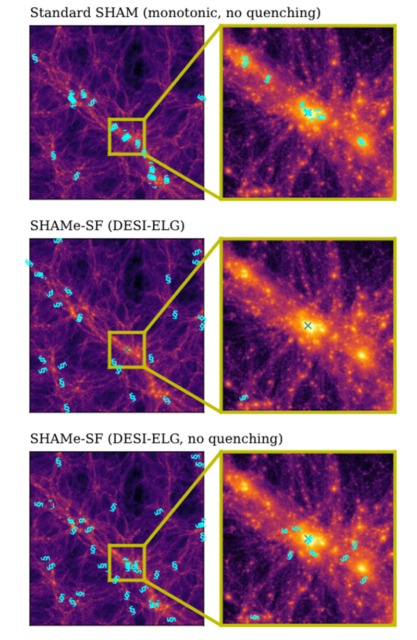
Before turning to real observations, the method was tested on artificial galaxy catalogues built from a large hydrodynamical simulation, in which the true underlying cosmology is known in advance. Two different mock populations of emission-line galaxies were constructed from this simulation. In both cases, the method recovered the correct cosmological parameters without significant bias, using clustering information down to separations of only about one and a half million light-years, deep inside individual dark-matter halos.
Smallest scales are not just extra data points
These tests revealed something particularly interesting: the smallest scales are not just extra data points. They can be essential for getting the cosmology right. The clustering signal inside individual halos carries information about satellite galaxies, and if those scales are discarded, the properties describing satellites become tangled up with σ8, the parameter that measures how strongly matter clusters throughout the Universe. In the simulations, excluding separations below roughly three to four million light-years produced looser, and in one case biased, estimates of that parameter.
The method was then applied to real data: the lower-redshift half of the DESI emission-line-galaxy sample. Three complementary measures of galaxy clustering were combined, capturing both how galaxies are separated across the sky and how their apparent positions are stretched or compressed by their own motions along the line of sight. The smallest separations included were again about one and a half million light-years.
Striking agreement
The result is σ8 = 0.81, accurate to roughly six percent. This number describes how strongly matter is clumped together: higher values mean matter is bunched more tightly into structures, lower values a smoother distribution. Alongside it, the analysis measures Ωm h² = 0.146, also accurate to about six percent. This quantity combines the fraction of the Universe made of matter with its expansion rate, giving an absolute measure of how much matter it contains, independent of that rate. Both values agree with measurements of the cosmic microwave background made by the Planck satellite, and with other DESI analyses. For comparison, an independent DESI study that combined the clustering of several galaxy types across the survey’s full volume, with added information about the density of ordinary matter and the shape of the primordial density fluctuations, found σ8 = 0.842, with an uncertainty of about four percent.
What is striking is not simply this agreement. The measurement described here comes from only one percent of the DESI survey’s eventual volume, and it relies on scales usually considered too complicated to model reliably. Yet its precision rivals that of analyses built on the full, much larger dataset.
There is an important qualification. The study does not prove that the completed DESI survey will automatically deliver ten times better precision, even though a simple statistical extrapolation suggests such a gain might be possible. Systematic effects could well become the limiting factor. The galaxy-halo model needs testing against a wider range of simulations, effects such as which galaxies actually get their light measured need to be better understood at small scales, and the computational shortcuts need to become even more precise.
The broader lesson is that the nonlinear Universe, the tangled, complicated regime close to individual galaxies, is not merely a mess to be avoided. If its astrophysical complexity can be modelled reliably, the intricate distribution of galaxies inside dark-matter halos becomes a genuine source of cosmological information. What was once treated mainly as a complication may turn out to be one of the most valuable parts of the cosmic map.
Author: César Tomé López is a science writer and the editor of Mapping Ignorance
Disclaimer: Parts of this article may have been copied verbatim or almost verbatim from the referenced research paper/s.
References
- S. Ortega-Martinez, R. E. Angulo, S. Contreras, J. Chaves-Montero, M. Zennaro, S. Bose, B. Hadzhiyska, C. Hernandez-Aguayo, L. Hernquist, and V. Springel (2026) Cosmological constraints from the small scale clustering of emission line galaxies Astron. Astrophys. doi: 10.1051/0004-6361/202660526 ↩