When dark matter comes in more than one wave
When dark matter comes in more than one wave
Galaxies rotate faster than the matter we can see should allow. Evidence for an unseen, gravitating substance began to build in the 1930s with Fritz Zwicky’s studies of galaxy clusters, and strengthened in the 1970s as Vera Rubin measured how stars orbit within spiral galaxies. Nearly a century later, dark matter is still known almost entirely through its gravity. It holds galaxies together and shaped the web of cosmic structure, yet its nature remains unknown.
Axions, plural
One candidate has an unusual origin. In the late 1970s, physicists proposed a new particle to solve a puzzle in the theory of the strong nuclear force. Frank Wilczek named it the axion, after a laundry detergent, because it promised to clean up the problem. By 1983 theorists had shown that axions about a millionth of an electronvolt in mass could make up cold dark matter, the slow-moving kind. Later, string theory, an attempt to unify gravity with quantum physics, suggested that nature may contain not one axion but many, with masses spread across a vast range. Some of these particles could be extraordinarily light: around 10⁻²² electronvolts, more than 10²⁷ times lighter than an electron.
Such lightness has a striking consequence. The quantum wavelength of a particle grows as its mass shrinks, and for these axions it stretches to astronomical size, comparable to the roughly half-kiloparsec cores of small dwarf galaxies, about 1,600 light-years. Dark matter would then behave less like a swarm of tiny grains and more like a vast wave, often called wave or fuzzy dark matter. Simulations from 2014 showed that every galaxy halo would have a dense central core with a flat density profile, surrounded by a shimmering pattern of interfering waves. The flat core contrasts with the steep central spike predicted by the simplest cold dark matter models. The same wave nature also prevents very small clumps from forming, which may help explain why fewer small satellite galaxies are seen around our Galaxy than those models predict.
There is, however, a serious difficulty. Light from distant quasars passes through clouds of hydrogen that imprint absorption lines on it, the Lyman-alpha forest, which records how matter was clumped on small scales in the early Universe. If a single ultralight species made up all dark matter, these data demand a considerably larger mass. One influential analysis set a lower limit of about 2×10⁻²⁰ electronvolts, some two hundred times heavier than the favoured value. Separately, deep surveys show no clear drop in the number of faint galaxies, which argues against single axions lighter than about 2.5×10⁻²² electronvolts. Both conclusions assume one kind of axion.
A new analysis 1 asks what changes if dark matter is a mixture. On large scales, it finds, all species feel the same gravitational field, so they respond together and behave much like one effective axion. The mass of that stand-in depends on each species’ mass and on its share of the total dark matter, with lighter species weighing more heavily. The recipe was tested against a detailed calculation for two species, 30% at 10⁻²² electronvolts and 70% at five times that mass. It reproduced the overall suppression of structure well, missing only some fine oscillations, and the resulting difference in predicted mass fluctuations was below 0.1%. If this holds, a multi-axion universe could build large-scale structure much like a single-axion one, with the cut-off in faint galaxies set by the effective mass. The method extends to any number of species and could seed future simulations.
Inside galaxies the picture changes. On these smaller scales the species act independently, and each weaves its own interference pattern with its own grain size. Projected along the line of sight, these produce density fluctuations of only a few percent, yet they bend light enough to blur the lines of greatest magnification in a gravitational lens, called critical curves, into corrugated bands.
The Dragon test
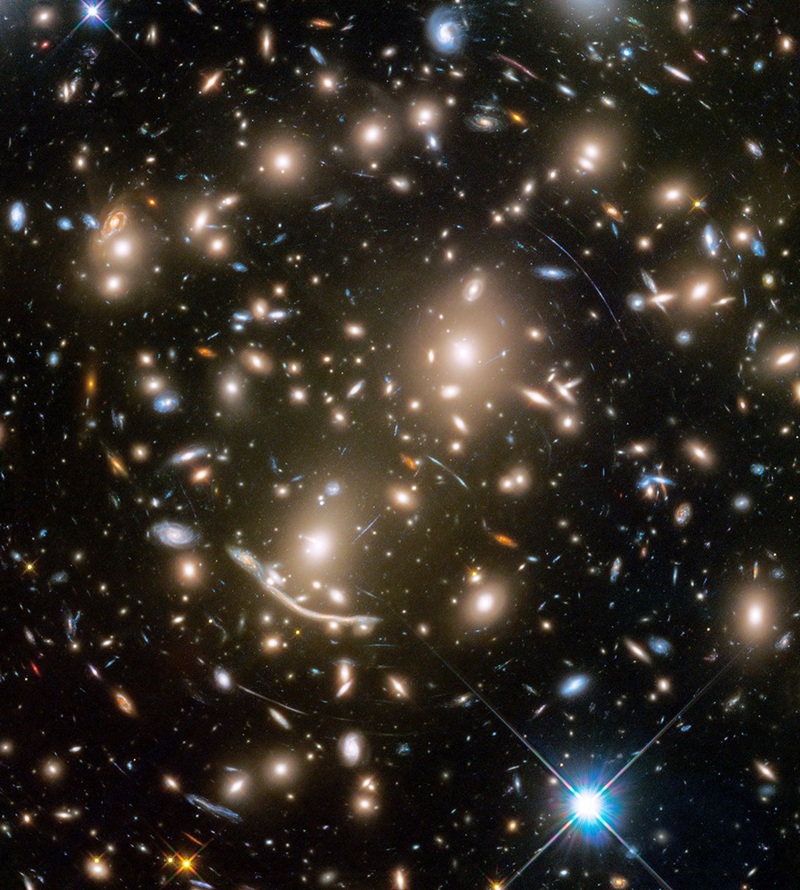
The Dragon Arc offers a test. This is a spiral galaxy, seen when the Universe was half its present age, stretched and magnified by the galaxy cluster Abell 370. In 2025, observations with the James Webb Space Telescope revealed more than forty individual stars in it, each appearing as a brief flicker when magnified by intervening stars in the cluster. Their positions scatter broadly around the critical curve, and an earlier analysis found this matches wave interference. Cold dark matter clumps would instead confine them to a narrower band skewed in the opposite direction. Reading the scatter as a wavelength of about ten parsecs gives a lensing effective mass of roughly 2.4×10⁻²² electronvolts, assuming about 2.4×10¹⁴ solar masses lie inside the critical curve. This differs from the large-scale effective mass, because lensing depends on each species’ share of the projected density. It is not a detection of axions but a model-dependent interpretation. If the two species suggested by dwarf galaxies, about 1.9×10⁻²² and 2.3×10⁻²¹ electronvolts, made up the halo, the lighter would supply roughly 89% of the projected density near the arc.
The most distinctive prediction concerns position. Heavier axions are expected to gather near the centre of a halo and lighter ones to dominate farther out, so the lensing effective mass should change from place to place. A single species cannot do this. The Cosmic Horseshoe, a lensed galaxy where the telescope may find around sixty flickering stars per pointing, could test it by comparing two positions about five arcseconds apart. A mismatch would hint at several species.
This work shows how a mixture of ultralight particles could look like a single one across the cosmos while revealing its true complexity inside galaxies, perhaps reconciling cosmic constraints with galactic evidence. Proving it will require better simulations, more realistic models of multi-species haloes, and further lensing observations.
Author: César Tomé López is a science writer and the editor of Mapping Ignorance
Disclaimer: Parts of this article may have been copied verbatim or almost verbatim from the referenced research paper/s.
References
- J. Zhang, T. Broadhurst, J. Lim, P. Morilla, and S. K. Li (2026) Multi-copy axion transfer function and observational implications of effective de Broglie scales Astron. Astrophys. doi: 10.1051/0004-6361/202558735 ↩