MI weekly selection #236
MI weekly selection #236
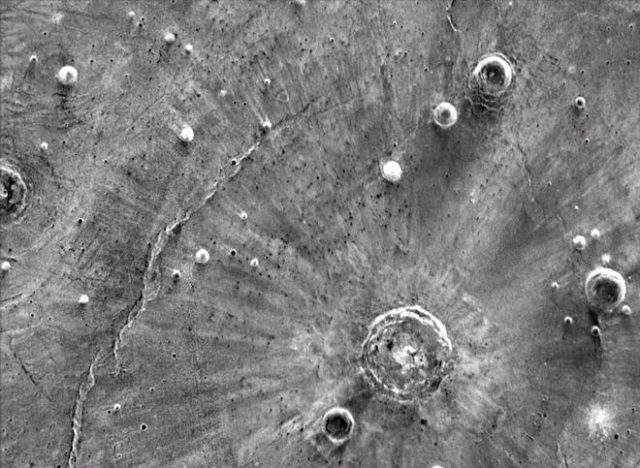
Streaks shooting out from Mars impact craters likely caused by high-speed winds
Some impact craters on Mars show evidence of wind streaks likely caused by high-speed sideways vortices rolling away following the impacts. “These have tornado-like speeds but do not go straight up; instead, they are horizontal, like a tornado on Earth turned on its side,” said Peter Schultz, the study’s lead author.
Microbiome affects drug metabolism
A study showed that the microbiome affects how the body processes drugs, sometimes metabolizing drugs into ineffective or toxic compounds. If future research verifies the findings, prescriptions may eventually be based on personal microbiomes, or clinicians could prescribe helpful enzymes or diets to alter a patient’s microbiome.
Noninvasive deep-brain stimulation technique developed
A new technique may stimulate cells deep in the brain without having to surgically place electrodes there. Temporal interference stimulation utilizes electrodes placed on the head that target the deep brain with high-frequency electrical signals, and it could one day help treat epilepsy, Parkinson’s disease and depression, among other conditions.
Comet 67P may hold clues to Earth’s atmospheric xenon
The xenon in Earth’s atmosphere likely came from comets, according to findings gathered by the Rosetta spacecraft during its orbit of comet 67P/Churyumov-Gerasimenko. Samples of 67P’s xenon closely resemble the heavy isotopes of Earth’s atmospheric xenon, a study published in Science suggests.
Cuttlefish trick prey, predators by behaving like hermit crabs
Pharaoh cuttlefish sometimes act like hermit crabs, possibly to deceive prey or deter predators. Researchers observed the behaviour when the cuttlefish were placed in large open areas and when they were in a tank with small fish. The surprising behaviour has scientists asking new questions.