Moiré patterns at the interface of topology and magnetism
Moiré patterns at the interface of topology and magnetism
Most of the electronic devices we use every day, from smartphones to solar panels, depend on electrons moving smoothly through crystal structures. In recent years, however, researchers have discovered that stacking extremely thin materials in carefully chosen ways can produce completely new types of behavior that never appear in ordinary bulk materials. One of the most intriguing of these new phenomena comes from moiré patterns.
When two atomically thin crystals with slightly different lattice spacings are placed on top of each other, their small mismatch generates a much larger periodic pattern. This new pattern (moiré) acts like an artificial super-lattice that completely changes the landscape in which electrons move.
Dirac fermions in a moiré superlattice
Now, a team of researchers has created 1 a moiré pattern right at the boundary between a topological insulator and a two-dimensional magnetic insulator. Their experiments provide the first clear evidence that electrons in this combined system can form Dirac fermions (fascinating quantum entities that behave like tiny particles moving at relativistic speeds inside solid materials) organized by the moiré superlattice, opening exciting possibilities for future quantum technologies.
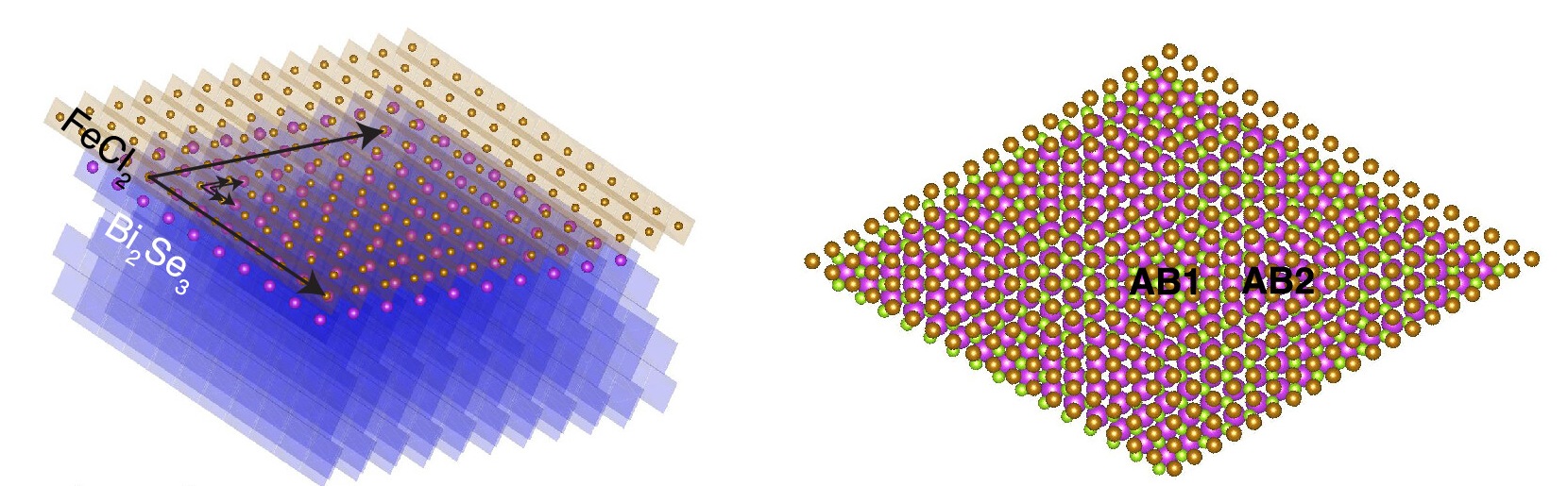
Bismuth selenide (Bi₂Se₃), the topological insulator chosen for this work, behaves in a very unusual way. It blocks electric current in its interior while allowing electrons to flow freely along its surfaces. These surface states are topologically protected, which means they remain robust even when the material contains impurities or defects. A particularly valuable feature of these surface electrons is that their spin is tightly locked to their direction of motion, a property that could be very useful for developing spin-based electronics.
On top of this topological insulator, the researchers placed an atomically thin layer of a magnetic insulator such as iron dichloride (FeCl₂) or iron dibromide (FeBr₂). These two-dimensional magnetic materials do not conduct electricity, but they do carry an ordered magnetic arrangement. When brought into close contact with the topological surface, the magnetism can influence the moving electrons and potentially break time-reversal symmetry, one of the key rules that normally govern quantum electron behavior.
Because the atomic lattices of the two materials do not match perfectly, a moiré superstructure naturally forms at their interface. This superstructure has a repeating scale much larger than the atomic spacing of either material, so it creates a new effective environment for the surface electrons.
Dirac cones and energy gaps
The team used two powerful experimental techniques to study this interface in detail. Scanning tunneling microscopy gave them direct images of the moiré pattern itself, revealing its beautiful periodic modulation. Angle-resolved photoemission spectroscopy allowed them to map how the energy and momentum of the electrons change under the influence of this pattern.
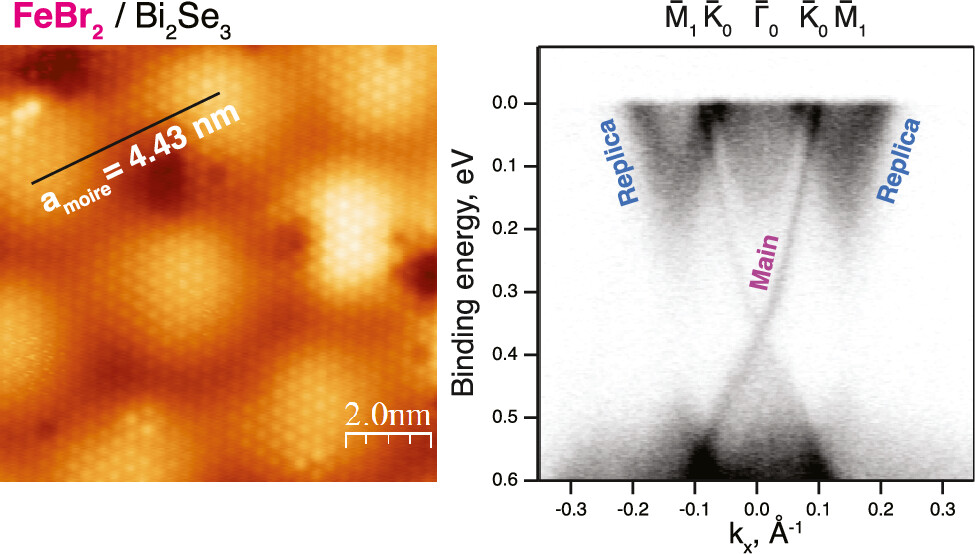
Importantly, instead of the single, simple linear band that characterizes an isolated topological surface, the data showed multiple replicated Dirac cones. These repeated cones are clear evidence that the moiré superlattice has imprinted its own larger periodicity onto the electronic structure. The effect resembles what happens in twisted bilayer graphene, where moiré patterns have already led to the discovery of remarkable correlated states including unconventional superconductivity.
The experiments also detected small energy gaps opening at specific points in the electronic spectrum. These gaps are important clues suggesting that the moiré potential interacts with the magnetic character of the top layer in a meaningful way. Together, these observations indicate that the moiré pattern not only reorganizes the electron bands but can also control symmetry breaking in a tunable manner, potentially giving rise to entirely new correlated topological phases that cannot exist in the individual materials.
A role in quantum computing?
This work demonstrates, for the first time, that the protected surface states of a topological insulator can be engineered and modified using moiré techniques when combined with atomically thin magnetic layers. By choosing the right materials, adjusting the twist angle, or modifying the interface chemistry, researchers may be able to create custom quantum phases with stronger electronic correlations or even topological superconductivity, a state that could host exotic quasiparticles suitable for fault-tolerant quantum computing.
Author: César Tomé López is a science writer and the editor of Mapping Ignorance
Disclaimer: Parts of this article may have been copied verbatim or almost verbatim from the referenced research paper/s.
References
- I. I. Klimovskikh, S. E. Hadjadj, A. Thakur, A. Saunot, C. Rogero, M. Tallarida, J. Dai, V. M. Trontl, A. P. Weber, G. D. Gu, J. Lobo-Checa, M. Ilyn, and T. Valla (2025) Emergence of Moire Dirac Fermions at the Interface of Topological and 2D Magnetic Insulators ACS Nano doi: 10.1021/acsnano.5c10193 ↩