Understanding the risks of environmental pollutants in the human brain
Understanding the risks of environmental pollutants in the human brain
Author: Itziar Polanco Garriz, researcher – PhD candidate at GAIKER Technology Centre
The world’s population is growing, people are living longer, and industry continues to expand. These changes bring many benefits, but they can also increase risks to human health. Over time, people are exposed to many substances in the environment, some of which may be harmful. At the same time, greater industrial activity means more chemicals are produced, used, and released, which can lead to higher levels of environmental contamination and greater human exposure.
It was during the 1980s that the field of neurotoxicology began to emerge, with early studies focusing on understanding how environmental contaminants and toxic substances affect the nervous system. At that time, researchers relied mainly on animal models such as frogs and mice, as well as embryonic tissues and neuronal cultures derived from these species.
Today, however, the limitations of these models are well recognized. They often fail to accurately reproduce the complex biological processes that occur in the human body. In addition, they can require significant time and resources, raise ethical concerns related to animal use, and present challenges when trying to translate results to humans due to fundamental physiological differences between species.
There is therefore a clear need to develop more realistic experimental models that better represent the human body and help us understand more accurately how toxic substances can affect the nervous system. Some of these contaminants are especially concerning because they are extremely small. Their tiny size means they can enter the body through the air we breathe, travel to the central nervous system, and in some cases even cross the blood–brain barrier to reach the brain directly. When this happens, brain tissue may be exposed to potentially harmful effects.
Researchers at GAIKER Technology Centre have focused their efforts on studying the neurotoxic effects of these contaminants on the central nervous system (CNS) 1. To achieve this, they have developed an in vitro model of the human blood–brain barrier, as well as a model that mimics brain tissue using cell lines of human origin. Thanks to these advances, it is possible to significantly reduce the gap between experimental models and human physiology, providing a more accurate representation of human anatomy without the need to use animals in research, thereby avoiding ethical concerns.
Human cell lines are very useful in toxicology because they help researchers create models that are closer to real human tissues. By combining different types of cells, it is possible to build more advanced systems that better represent organs such as the brain. For example, neurons can be studied together with microglial cells, which are involved in the brain’s defense system. This allows researchers to better understand how contaminants may affect brain tissue.
In addition, researchers can recreate the human blood–brain barrier in the laboratory by combining endothelial cells and astrocytes. This barrier is one of the body’s most important defense systems, as it helps protect the brain by controlling which substances can pass from the bloodstream into nervous tissue. Reproducing it in the lab gives scientists a valuable tool to study what happens when contaminants encounter this protective layer. It allows them to explore whether harmful substances can alter the barrier, weaken its protective function, or even cross it and reach the brain. This kind of model is especially useful for understanding potential risks to human health and for identifying which contaminants may pose a greater threat to the nervous system.
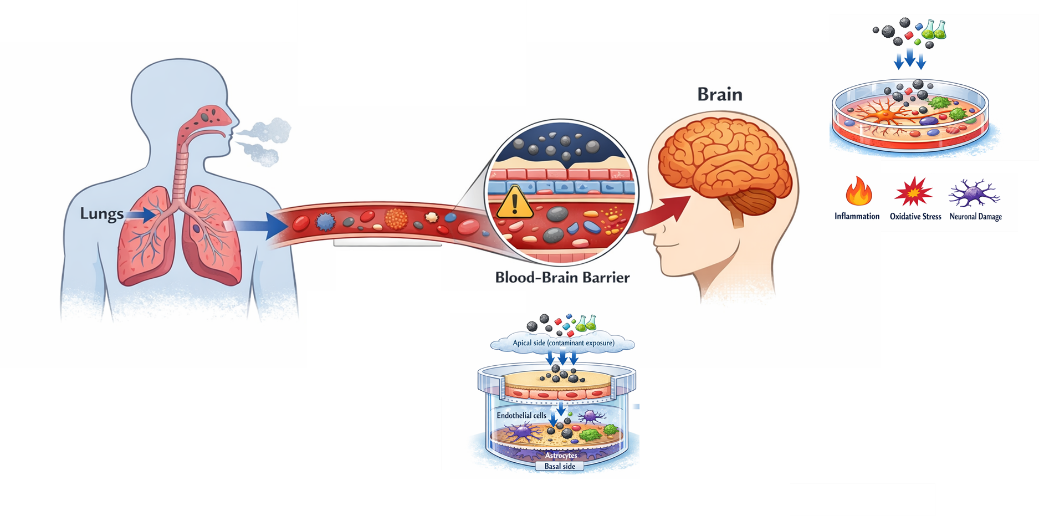
To explore how useful these models are, the researchers tested them with different contaminants that people may come into contact within everyday life or through industrial activity. They then observed how the cells responded, paying special attention to signs of damage and inflammation. This approach helps provide a clearer picture of how harmful substances may affect the brain and supports the development of better tools to study potential risks to human health.
Overall, this work shows the value of developing human-based experimental models to better understand how environmental contaminants may affect the brain. These tools not only provide more realistic information about potential risks to human health, but also open the door to safer, more effective and more ethical ways of studying neurotoxicity in the future.
The BRTA is a consortium that remains a step ahead of future socio-economic challenges worldwide and in the Basque Autonomous Community; it addresses them through research and technological development, thus projecting itself internationally. The BRTA centres collaborate to generate knowledge and transfer it to Basque society and industry so as to make them more innovative and competitive. The BRTA is an alliance of 17 R&D centres and cooperative research centres with the support of the Basque Government, the SPRI and the Chartered Provincial Councils of Araba, Bizkaia and Gipuzkoa.
References
- Polanco-Garriz, I; de la Iglesia Menchaca, E; Goñi de Cerio, F; Katsumiti, A. (2025) Development of human-based in vitro models to evaluate the neurotoxic effects of advanced materials Toxicology Letters doi: https://doi.org/10.1016/j.toxlet.2025.07.544 ↩