Moiré patterns on topological insulators, a new route toward topological superconductivity
Moiré patterns on topological insulators, a new route toward topological superconductivity
In recent years, “twistronics” has shown that simply changing how two crystal layers sit on top of each other can completely transform their electronic behavior. When two lattices are slightly mismatched in size or rotated by a small angle, they create a larger repeating interference pattern called a moiré superlattice. This long-wavelength pattern acts like a new artificial crystal for electrons. In graphene, moiré superlattices have already produced remarkable effects such as correlated insulating states and superconductivity.
A thin layer of xenon on the surface of a topological insulator can do something surprising: it can create a moiré pattern that reshapes how electrons move. In a new study 1, that idea was tested on two well-known topological insulators, Bi2Se3 and Bi2Te3, using a technique called angle-resolved photoemission spectroscopy, which maps the energy and momentum of electrons.
The key feature of a topological insulator is that its interior behaves like an insulator, while its surface supports special conducting states. These surface states form a Dirac cone, meaning their energy changes almost linearly with momentum. In a topological material, these states are protected by symmetry, so they cannot be altered in just any way. That is why the effect of a moiré pattern on them is especially interesting.
The xenon layer does not match the crystal underneath perfectly. That mismatch creates a long-wavelength pattern on the surface, like a repeating ripple. When the electronic structure is measured, the original topological surface band is copied into additional replicas shifted in momentum space. This is clear evidence that the moiré potential is affecting the surface electrons directly.
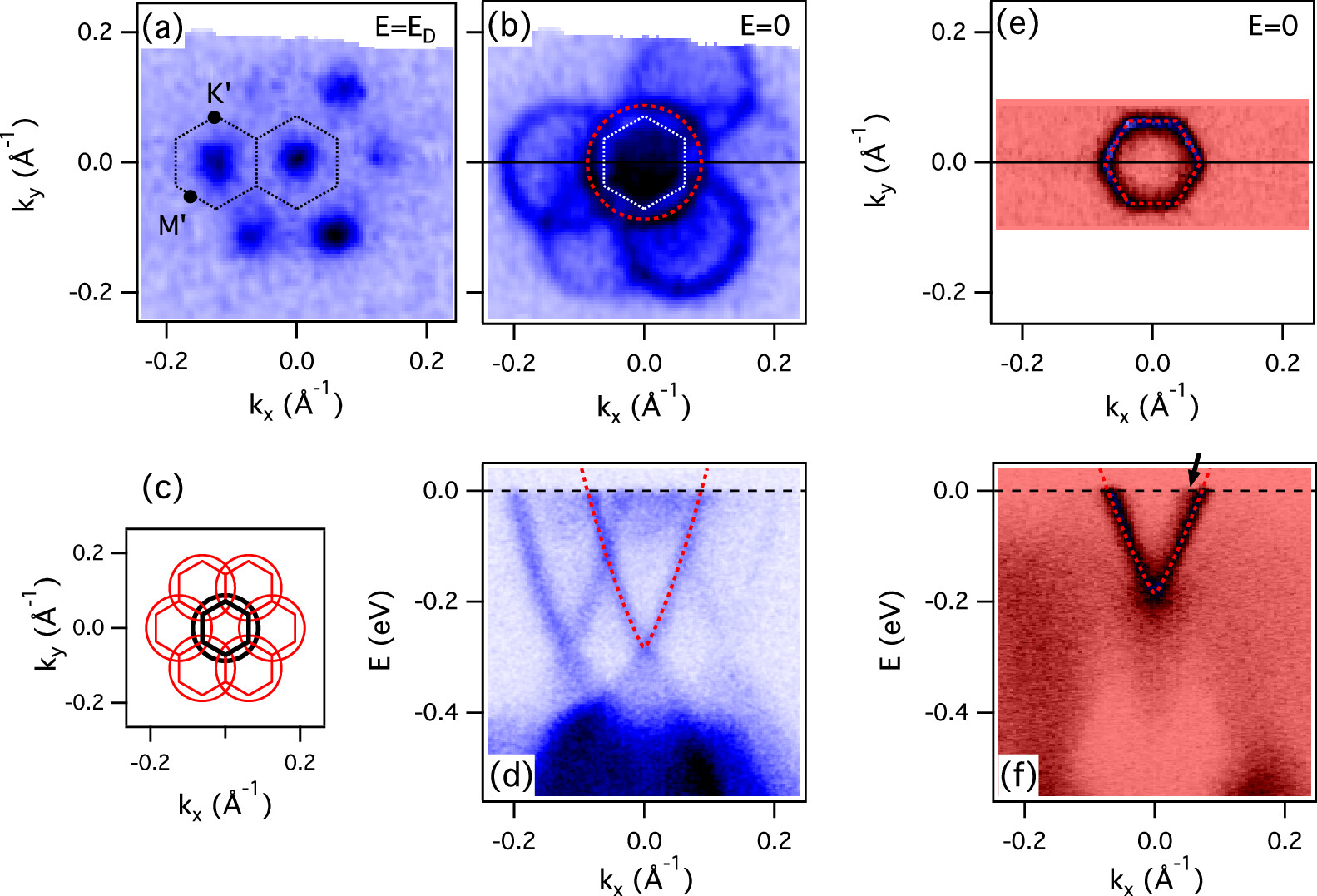
What makes this system unusual is that the copied bands do not behave the same way everywhere. At some crossings, the bands avoid each other and open small gaps. But at special symmetry points, the crossings remain gapless. That difference is exactly what topological protection predicts. In the Xe/ Bi2Se3 system, the largest observed gap is about 27 meV, and it appears near the K points of the moiré Brillouin zone.
These gaps matter because they create van Hove singularities, points where many electronic states crowd into a narrow energy range. When that happens, the density of states rises, and electronic interactions become stronger. One important interaction is electron-phonon coupling, the interaction between electrons and vibrations of the crystal lattice. Stronger coupling can help electrons form pairs, which is the basic ingredient of superconductivity.
The study finds that the electron-phonon coupling on the xenon-covered Bi2Se3 surface is stronger than on clean Bi2Se3. That does not mean superconductivity has been observed here. It means the surface has moved closer to conditions where superconductivity could become possible if the system is tuned further, for example by changing the carrier density or the moiré period.
This result shows that a simple, chemically inert layer of xenon can be used to engineer the electronic structure of a topological insulator surface in a controlled way. Instead of twisting two fragile crystals, the moiré pattern forms naturally through adsorption. That makes the approach cleaner and potentially easier to scale.
The broader significance is that moiré engineering is no longer limited to graphene-like systems. It can also be applied to topological insulators, where symmetry and topology add new rules to the physics. In this case, those rules produce protected crossings, gapped intersections, enhanced electronic interactions, and a possible route toward topological superconductivity in the future.
Author: César Tomé López is a science writer and the editor of Mapping Ignorance
Disclaimer: Parts of this article may have been copied verbatim or almost verbatim from the referenced research paper/s.
References
- A. K. Kundu, I. I. Klimovskikh, A. V. Fedorov, E. Vescovo, G. D. Gu, and T. Valla (2026) Symmetry-protected moire band engineering and enhanced electron-phonon coupling in Xe/Bi2Se3 superlattices: Path to topological superconductivity ACS Nano doi: 10.1021/acsnano.5c20111 ↩