A new route to photon upconversion
A new route to photon upconversion
Turning low-energy light into higher-energy light seems to break the usual rules of physics, since energy is supposed to run downhill, not uphill. Yet a process called photon upconversion achieves exactly this, without breaking any laws of thermodynamics. Instead of absorbing one photon and releasing a single photon of lower energy, as most light-absorbing molecules do, an upconversion system absorbs two lower-energy photons and combines their energy to release one higher-energy photon. Because it takes two photons to make one, the total energy is still conserved; the trick is repackaging it into a more useful form. The phenomenon was first observed in the 1960s in simple organic mixtures cooled to very low temperatures, but it only became practical decades later, once chemists identified metal-containing dyes able to hold their excited states at room temperature. Since then, scientists have pursued upconversion as a way to make better use of sunlight, to power light-driven chemical reactions, to improve imaging inside living tissue, and to build new kinds of optoelectronic devices.
Triplet-triplet annihilation
The most developed route to upconversion relies on a process called triplet-triplet annihilation. A light-absorbing molecule known as a sensitizer first captures a low-energy photon and passes that energy to a second type of molecule, the annihilator. The annihilator settles into a triplet excited state, an unusually long-lived condition that allows it to persist until it meets a second annihilator molecule in the same state. When two such molecules collide, one drops back to its ground state while the other is pushed up into a higher-energy singlet state, from which it emits a photon of higher energy than either of the photons that started the process.
A long-standing problem with this scheme is that ordinary sensitizer molecules lose a portion of the absorbed energy internally, as the initially excited state converts into the lower-energy triplet state that gets passed along. This loss caps how large an energy jump the whole system can ultimately achieve. One promising way around the problem is to replace the conventional sensitizer with an organic radical, a molecule carrying a single unpaired electron. That unpaired electron gives radicals unusual electronic and magnetic behavior and can make the conversion from absorbed light into a usable excited state considerably more efficient, since it opens transitions that are otherwise very weak in conventional molecules.
A single hydrogen to control it all
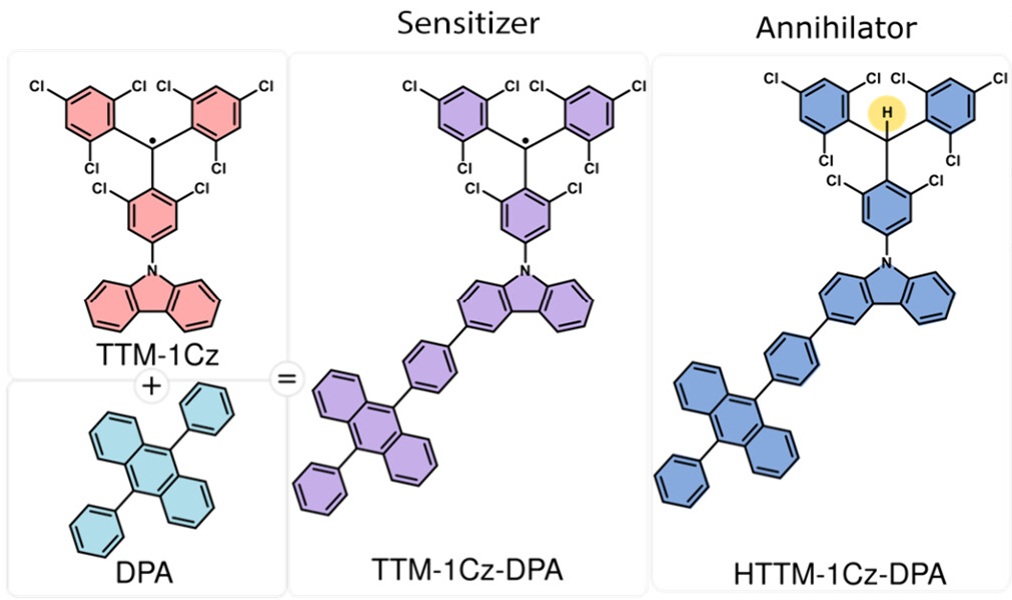
To work out why, the investigation combined light-based spectroscopy, electron spin resonance (a technique that detects unpaired electrons), and quantum chemical calculations. After the radical absorbs red light, its excitation transfers within about ten picoseconds (ten trillionths of a second) to the attached anthracene unit, creating a long-lived excited state that still carries some radical character. This internal handoff stretches the effective excited-state lifetime to more than 250 nanoseconds, roughly ten times longer than the 27 nanoseconds measured for the radical unit on its own. A longer-lived excited state gives the sensitizer far more opportunity to encounter another molecule and hand off its energy before simply decaying back to the ground state. The calculations independently pointed to the same conclusion, showing that energy transfer to a nearby annihilator proceeds far more readily through this long-lived triplet-like state than directly from the radical’s first excited state.
A mix needed
The work also tested an idea proposed in earlier research, that a single radical-containing molecule of this kind might act as both sensitizer and annihilator on its own, a so-called single-component upconversion system. The new experiments argue against this. Solutions containing only the radical molecule, across a range of concentrations, showed no detectable upconverted light, consistent with the radical’s higher excited states relaxing away too quickly for the necessary emission to compete.
Efficient upconversion instead required mixing the radical sensitizer with its hydrogen-added counterpart, or with the well-established annihilator 9,10-diphenylanthracene. Because the two molecules share nearly the same molecular framework, this two-molecule mixture is described as a “pseudo-single-component” system. Shining red light at 658 nanometres onto the radical paired with its hydrogenated twin produced blue emission at 450 nanometres, an apparent energy gain of about 0.9 electronvolts, with 7 percent of absorbed photon pairs converted into upconverted light. Pairing the same radical sensitizer with 9,10-diphenylanthracene instead produced blue emission at 437 nanometres, a slightly larger energy gain of about 1.0 electronvolt, with 12 percent efficiency. Both figures mark a large improvement over earlier all-organic radical sensitizers, which had reached efficiencies of only a few tenths of a percent, and the upconverted emission remained stable over hours of continuous illumination.
A practical strategy for photon upconversion
Beyond these specific molecules, the study illustrates how a minimal change in molecular structure, adding or removing a single hydrogen atom, can completely redirect a molecule’s photochemical role, switching it from an energy donor to an energy acceptor. Combining optical measurements, spin resonance, and computation made it possible to trace exactly why this switch occurs at the level of electronic structure, rather than simply observing that it happens.
The findings offer a clearer picture of how organic radicals can be harnessed for photon upconversion and point toward a practical strategy for building more efficient materials from radicals and their closed-shell relatives together. Such materials could eventually help capture more of the solar spectrum, drive light-powered chemical synthesis, or improve the efficiency of light-emitting technologies, by putting to use photons that would otherwise be wasted.
Author: César Tomé López is a science writer and the editor of Mapping Ignorance
Disclaimer: Parts of this article may have been copied verbatim or almost verbatim from the referenced research paper/s.
References
- Kieran D. Richards, Wenzhao Wang, Philipp Thielert, James D. Green, John M. Hudson, Claire Tonnelé, David Casanova, Yoann Olivier, Timothy J. H. Hele, Sabine Richert, Feng Li, and Emrys W. Evans (2026) Open- and Closed-Shell Roles of Sensitizer and Annihilator in Pseudo-Single Component Mixtures for Upconversion Journal of the American Chemical Society doi: 10.1021/jacs.6c04090 ↩