Magnetic edges in graphene islands survive on a metal
Magnetic edges in graphene islands survive on a metal
Graphene, a honeycomb sheet of carbon atoms just one atom thick, was first isolated in 2004 with adhesive tape and a lump of graphite, work that earned a Nobel Prize in 2010. Large sheets of graphene conduct electricity superbly, but they are not magnetic. Shrink a piece to a few nanometres, however, and its boundary begins to matter. Along one particular kind of edge, theory has long predicted a surprise: carbon, an element not normally associated with magnets, can become magnetic.
A new study shows 1 that this magnetism-like behaviour can survive in tiny graphene islands sitting on a metal, which had been the main obstacle to studying it.
Why edges matter
Cut graphene across its honeycomb and the edge can take different shapes. In the “zigzag” edge, the outermost atoms form a row of teeth like a saw blade. In the mid-1990s, theorists predicted that electrons crowd into special states hugging such an edge. Every electron also carries spin, a quantum property that makes it behave like a tiny compass needle with two possible orientations. Because electrons repel one another, calculations indicate that those at a zigzag edge can arrange their spins in an orderly pattern, producing magnetism from carbon alone. A mathematical theorem from 1989 adds that triangular flakes with zigzag edges should carry a net magnetic moment. For a small triangle, calculations give a strength equal to six unpaired electron spins.
The difficulty is that edges are fragile. Graphene islands built from molecules on gold surfaces show edge magnetism that is weakened or erased by the metal’s electrons. In one earlier experiment it returned only after a single graphene ribbon was dragged onto an insulating film with a microscope tip, one ribbon at a time. Growing islands by chemical vapour deposition requires a more reactive metal than gold, like nickel, to grip graphene tightly, reshaping its electronic structure and altering its edges.
Growing islands, then cushioning them
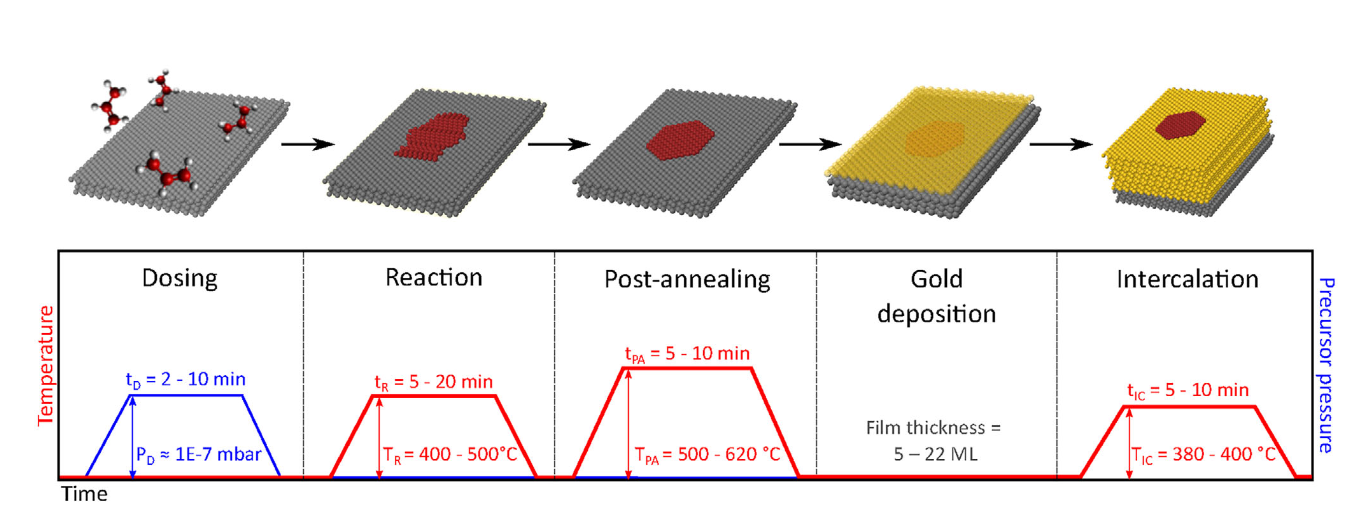
The solution the team has found has two stages. First, propylene or ethylene gas is dosed onto a clean nickel crystal in vacuum and heated. The gas molecules break apart, and the carbon atoms assemble into graphene islands. Heating to 500–550 °C yields triangles with zigzag edges, while 600–620 °C gives hexagons. Next, gold is evaporated onto the surface and warmed to about 380–400 °C. Gold atoms slip beneath the islands, a process called intercalation, forming a cushion that separates the graphene from the nickel. Most islands end up sunk into the top layer of gold like tiles set in a floor, while 10–25 percent rest on top.
Two observations indicate that the islands are indeed decoupled. The electrons confined to the gold surface behave almost as they do on bare gold, and the characteristic electrons of graphene itself reappear.
Listening to the edge
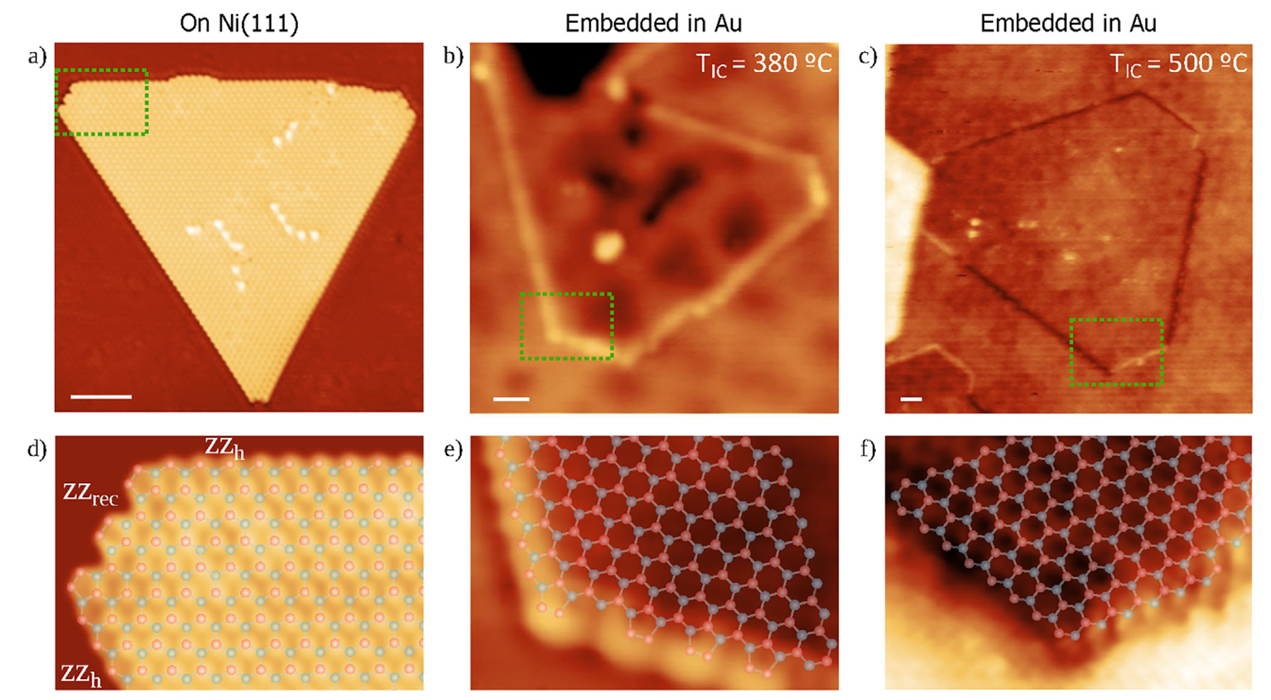
The islands were examined with a scanning tunnelling microscope. Its atomically sharp metal tip hovers a fraction of a nanometre above the surface without touching it. Electrons cross the gap through a quantum effect called tunnelling, and the resulting current depends on distance and on which energy levels are available beneath the tip. Invented in 1981 and recognised with a Nobel Prize in 1986, the technique can image individual atoms and, by varying the voltage, reveal where electrons can sit in energy.
At the island edges, the measurements revealed two sharp peaks, one from occupied states and one from empty states, separated by about 1.2 electronvolts. The two peaks were absent in the island interior and on bare gold. Both were squeezed into roughly 0.4 nanometres from the edge, and the signal repeated every 0.246 nanometres, exactly the spacing of the zigzag teeth. The separation stayed close to 1.2 electronvolts for edges between four and nine nanometres long, and across edge types ranged only from 1.10 to 1.42.
Such a pair is what is expected when interactions push electrons of opposite spin to different energies. The gap is the largest reported for graphene edges on a metal and approaches the 1.5 electronvolts measured for ribbons on an insulating salt film.
Magnetism is delicate
Quantum-mechanical simulations reproduced a pair of edge states with spin concentrated on the outermost carbon atoms. Basic versions of the calculation underestimate the gap, but a refined treatment that includes screening by the metal predicts about 1.4 electronvolts, close to the measurement.
The simulations also show why the magnetism is delicate. It depends on how far the edge carbons sit from the gold. Islands embedded in the top gold layer, where the carbon is about 3.4 ångströms away, keep a larger magnetic moment than islands on top, at about 3.1 ångströms. Pushing the atoms closer destroys the moment. Real islands are slightly warped: their corners cling to the metal while the middle of each edge lifts away and stays magnetic. A repeating pattern in the gold, left over from its interface with nickel, adds a gentle ripple of about 70 millielectronvolts to the gap along the edge.
A magnetic interpretation
The experiment recorded energies and positions of electronic states, not the direction of the spins themselves, so the magnetic interpretation rests on theory and on comparison with earlier work. The edge carbon atoms are also thought to carry hydrogen atoms. This is inferred from indirect evidence rather than imaged, but it matters, because calculations for bare edges show the magnetism quenched and no matching pair of peaks.
Chemical vapour deposition is already used to make large graphene sheets, so the method could be scaled up in ways that molecule-by-molecule assembly cannot easily match. The gold layer may also allow the islands to be lifted onto other surfaces. The study shows that, at the nanoscale, behaviour depends not only on which atoms are present but also on exactly how the boundary sits on its surroundings.
Author: César Tomé López is a science writer and the editor of Mapping Ignorance
Disclaimer: Parts of this article may have been copied verbatim or almost verbatim from the referenced research paper/s.
References
- M. Gastaldo, M. Mansouri, C. Garcia-Fernandez, D. Sanchez-Portal, A. Garcia-Lekue, G. Ceballos, and A. Mugarza (2026) Spin-split edge states in metal-supported graphene nanoislands obtained by CVD Adv. Mater. doi: 10.1002/adma.202512943 ↩