Gaston Bachelard and the making of a scientific mind
Gaston Bachelard and the making of a scientific mind
Author: José Luis Granados Mateo is a postdoctoral researcher in the Department of Philosophy at the University of the Basque Country (EHU) and a member of the Integrated History and Philosophy of Science (iHPS) research group. His work focuses on history and philosophy of science, science and values, and the epistemology of scientific practices.
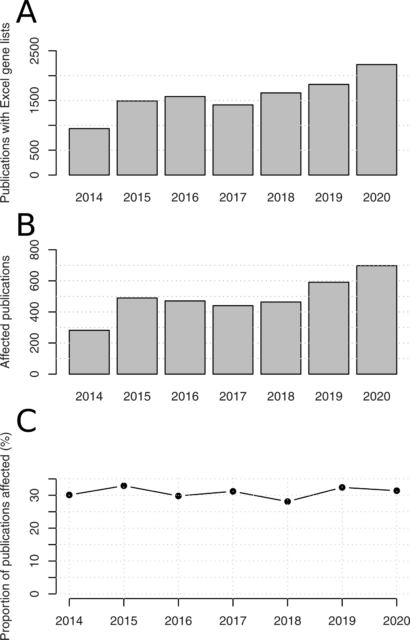
A gene identifier enters a spreadsheet and emerges as a date. The transformation can look like a clerical nuisance, remote from the serious business of scientific reasoning. Yet a 2021 study of PubMed Central articles from 2014–2020 found gene name errors in the supplementary Excel files of 3,436 of the 11,117 publications containing such gene lists: 30.9% of that sample (Abeysooriya et al., 2021; Figure 1). The finding does not mean that a third of the scientific conclusions were false. It shows how an operation treated as routine can alter the material on which later reasoning depends. The scientific question begins with the damaged identifiers, but it need not end there. Why was a familiar way of handling data trusted to preserve their meaning? Gaston Bachelard helps us to pursue that question beyond the recommendation to be more careful. His account of scientific education asks how competent researchers learn to recognise the assumptions embedded in what they already know how to do. That is a problem for the laboratory, the field station and the research group working through a shared dataset today.
Gaston Bachelard and epistemological obstacles
Bachelard (1884–1962) taught physics and chemistry before becoming a university philosopher, first at Dijon and then at the Sorbonne. This trajectory matters because the classroom remains a place of philosophical discovery throughout his work: understanding a scientific claim involves changing how one thinks, and the resistance to that change deserves investigation. His 1938 book, La formation de l’esprit scientifique, usually rendered in English as The Formation of the Scientific Mind, makes this resistance its subject. The word formation carries considerable weight. A scientific mind is formed through work on concepts, problems and evidence; possession of information alone does not secure it. Nor should mind suggest a mysterious faculty owned by a special class of people. What interests Bachelard is the activity through which thinking becomes capable of correcting itself. His account is exacting because that activity cannot simply be completed during training and then taken for granted throughout a career.
He calls the difficulties arising within knowing itself epistemological obstacles. The expression can initially sound like an elaborate name for ignorance, but its point is almost the reverse. Ignorance leaves something unknown; an obstacle can provide an answer that prevents us from recognising what remains unknown. The obstacle may be a persuasive image, a habitual classification, or an explanatory principle whose earlier usefulness encourages us to extend it too far. In the opening chapter of The Formation of the Scientific Mind, Bachelard locates the problem with unusual precision:
It is not a matter of considering external obstacles, such as the complexity or fleeting character of phenomena, nor of blaming the weakness of the senses or of the human mind: it is within the very act of knowing that, through a kind of functional necessity, impediments and confusions arise. It is there that we shall identify causes of stagnation and even regression; there that we shall discern causes of inertia which we shall call epistemological obstacles. (Bachelard, 2000, p. 15)
This distinction concerns the source of a difficulty. A software conversion is not, simply by occurring, a Bachelardian epistemological obstacle. The philosophical problem arises when a habit of understanding makes the conversion difficult to recognise: for example, treating a spreadsheet as a transparent container rather than a system that interprets entries. This is my extension of Bachelard’s argument, not a claim about a technology he discussed. Supported versions of Excel now provide controls over automatic data conversions (Microsoft, n.d.); a means of preventing an error does not establish that a particular dataset escaped it. For researchers, the useful response is to determine which transformations occurred and how the identifiers can be checked against their source. The wider lesson concerns expertise. Only knowledge of what the identifiers mean makes this particular damage intelligible, yet expertise must also examine the habits that make its everyday work possible. An obstacle can operate before there is a conclusion to favour, shaping what enters the investigation as an apparently settled fact.
A question
The place to begin is therefore the question. ‘For a scientific mind, all knowledge is an answer to a question. If there has been no question, there can be no scientific knowledge,’ Bachelard writes (2000, p. 16). Consider an ecologist asked whether a population is doing better. The apparent simplicity of the question conceals decisions about what improvement would mean, over which interval it should be assessed, and what evidence could distinguish a durable change from a temporary fluctuation. Specifying these decisions does more than tidy up language. It changes what must be observed and what an answer could legitimately establish. Bachelard’s claim should not be turned into a prohibition on exploratory work, as though every discovery required a hypothesis written in advance. An unexpected observation can force the invention of a question. The point is that the observation acquires a determinate role in knowledge when we can articulate what it bears upon. A collection of results cannot do that intellectual work on our behalf.
This emphasis helps explain his abrasive treatment of opinion. On the same page, he declares that opinion ‘translates needs into knowledge’ (Bachelard, 2000, p. 16). The target is a form of conviction in which what matters to us supplies the apparent reason for believing something. His argument does not require the absurd claim that an everyday judgement can never happen to be correct. He explicitly allows that science may vindicate an opinion, while insisting that its justification will differ from the grounds on which the opinion was held. Nor does the argument authorise scientists to dismiss a patient’s experience, a farmer’s observation or a technician’s practical judgement. Those may disclose phenomena that an established procedure has missed. What requires examination is the passage from experience to an explanatory claim: which distinctions make the claim assessable, and what could establish its scope? Read this way, Bachelard’s severity concerns the grounds of assent rather than the social standing of the person speaking.
Teaching as overcoming obstacles
Teaching makes the stakes especially clear. Bachelard criticises the assumption that explaining the same demonstration again will necessarily produce understanding. His objection is that learners already inhabit a world of explanations. Of teachers who overlook this, he writes:
They have not reflected on the fact that the adolescent comes to the physics classroom with empirical knowledge already constituted; the task, then, is not to acquire an experimental culture, but to change an experimental culture, to overturn the obstacles accumulated by everyday life. A single example: the equilibrium of floating bodies is the object of a familiar intuition that is a tangle of errors. (Bachelard, 2000, p. 21)
His example is a piece of wood pressed beneath the water. The hand encounters resistance, and it is tempting to attribute an upward activity to the wood itself. Archimedes’ principle requires a different account, in which the surrounding fluid and the volume displaced become essential to explaining the buoyant force. A floating body and a fully submerged body obey the same principle, although the volume of fluid displaced need not be the same. The educational difficulty lies in reorganising the explanation, rather than merely attaching a formula to the familiar sensation. Bachelard is diagnosing a relation between an intelligible everyday experience and a more exact conceptual account of it (2000, p. 21). Applied to advanced training, the lesson is equally demanding. A doctoral researcher may reproduce a procedure accurately while interpreting its output through an unsuitable model. A useful discussion then has to uncover that model. Asking the researcher to predict what would change under altered conditions may reveal more than another demonstration of the correct calculation.
Language and numbers
Language can make such obstacles remarkably durable. Bachelard devotes a chapter to the sponge, tracing how a familiar image could appear to explain quite different phenomena simply by making them recognisable. Naming an effect in terms of a sponge can leave the actual process of absorption, compression or penetration unexamined (2000, pp. 87–88). His example invites an uncomfortable inspection of our own vocabulary. A contemporary researcher might say that a system stores information or that an organism follows a programme. Such expressions can be productive, provided the proposed correspondence is made explicit and its limits remain available for examination. The difficulty begins when familiarity with the word is mistaken for knowledge of the mechanism. These contemporary examples are extensions of Bachelard’s diagnosis, not examples from his book. I would take his warning as a reason to put metaphors to work under supervision: ask what they enable us to distinguish, what relations they specify, and where they cease to help. A metaphor that generates a discriminating experiment has a different status from one that merely makes an explanation feel complete.
Numbers offer no automatic escape from this problem. ‘Magnitude is not automatically objective,’ Bachelard cautions in his discussion of quantitative knowledge (2000, p. 248). The warning concerns the relationship between a numerical determination and the object it is meant to describe. A highly repeatable index of environmental quality, for example, may still leave unresolved why those components were selected, why they were combined in that way and which changes the index cannot register. More decimal places will not settle those questions. Bachelard also insists that the precision of a measurement must be related to the sensitivity of the measuring method and to the conditions under which the object remains stable (2000, p. 250). His terminology should not be treated as a substitute for a modern account of measurement uncertainty. The enduring point is that the warrant for a number belongs to a method, an object and specified conditions. Reproducible calculation, suitable measurement and a justified interpretation require connected but distinguishable arguments. A scientific education that attends only to the first leaves considerable room for numerical confidence without understanding.
Predictive modelling supplies a contemporary instance. Kapoor and Narayanan’s 2023 survey of earlier reviews identified data leakage affecting 294 papers across 17 fields. Those documented cases do not provide a representative failure rate for all research using machine learning. One form of leakage occurs when information from the data reserved for testing influences the construction of a model, making its performance look better than it would on genuinely new observations. Selecting predictive variables using the whole dataset before separating training and test data is one route to the problem. In the authors’ reanalysis of civil war prediction studies, correcting the errors removed the claimed substantial advantage of complex models over logistic regression (Kapoor and Narayanan, 2023). This finding is specific to the comparisons investigated; it does not establish the general superiority of simpler models. What interests me philosophically is the change in the question. A performance score becomes evidence only when the conditions of its production support the inference being made. Bachelard’s concern with the formation of a problem is therefore quite practical: what, exactly, has the model been given the opportunity to predict?
The constructive burden of a scientific ‘no’
These examples can give Bachelard an undeserved reputation as a philosopher of permanent demolition. If knowledge repeatedly becomes an obstacle, must the scientific mind always oppose what is accepted? His La philosophie du non, first published in 1940, addresses precisely that misunderstanding. The title can sound like a celebration of refusal, yet his description of the activity is carefully bounded:
The philosophy of no is not a will to negate. It does not proceed from a spirit of contradiction that contradicts without proof and raises empty objections. It does not systematically evade every rule. On the contrary, it is faithful to rules within a system of rules. It does not accept internal contradiction. This philosophy does not deny just anything, at any time and in any manner. Only at certain well-defined junctures does it initiate the inductive movement that characterises it and bring about a reorganisation of knowledge on a broader basis. (Bachelard, 2003, p. 112)
The constructive burden of a scientific ‘no’ is considerable. One must identify what requires revision, give reasons for revising it and determine what follows from the change. Mere dissent contributes none of this. Bachelard’s examples include the movement beyond Euclidean geometry and Newtonian mechanics, understood as enlargements that also reassess the status of earlier knowledge (2003, p. 114). Their philosophical interest lies in the possibility that a previously unrestricted claim becomes intelligible within specified conditions. Recognising the validity of a theorem under particular axioms differs from treating those axioms as the only conceivable organisation of space. Likewise, identifying the domain in which an approximation works can preserve its usefulness while changing our understanding of what it establishes. This is why rectification deserves a richer meaning than the replacement of a wrong answer with a right one. It can alter the relations among concepts and the conditions of their use. There is no reason to assume that every scientific advance follows this pattern, but it offers a valuable standard for criticism: an objection should make the problem more intelligible, not merely display the independence of its author.
Reason itself is implicated in this work. In Le rationalisme appliqué, published in 1949, Bachelard develops an account of rational activity answerable to particular investigations. His applied rationalism is best approached through the interaction between a theoretical requirement and an experimental operation. A theory helps determine what an instrument must distinguish; the instrument’s behaviour, once understood and checked, may require the theory’s claims to be reformulated. Bachelard locates scientific work in this reciprocal activity, where rational organisation becomes effective through technical application and remains open to new determinations from experience (1986, pp. 3–4). This differs from imagining reason as a finished set of instructions that the sciences merely execute. It also gives experimental work an intellectual status that disappears when it is described as the passive collection of facts. Designing a control, establishing a calibration or finding the appropriate variable can change the content of the question under investigation.
The role of instruments
His term phenomenotechnique brings the role of instruments into focus. In the physical sciences on which he concentrates, investigation often involves technically producing the conditions under which a phenomenon becomes accessible to precise study (Bachelard, 1986, pp. 2–4). The James Webb Space Telescope offers a useful contemporary comparison, provided we keep an important distinction in view: a telescope does not produce the nebula it observes. It produces records through a particular arrangement of optics, filters and detectors. The two views of the Pillars of Creation in Figure 2, released in 2022, make the consequences visible. NIRCam, operating in the near infrared, reveals many stars; the MIRI view at longer infrared wavelengths gives a markedly different prominence to the dusty structures (ESA/Webb, 2022a, 2022b). The difference is evidence about how the region appears in those wavelength bands, not a disappearance of the stars between pictures. Their visible colours represent infrared measurements: they are assigned during image processing rather than recorded as the colours a human observer would see (ESA/Webb, n.d.).
The relevance of Bachelard here is deeper than the familiar reminder that images are processed. An observational arrangement determines which differences can become available for scientific interpretation. Its construction does not make the evidence arbitrary; it specifies some of the conditions under which an interpretation can be challenged. For a scientist examining a microscopy image, a spectrum or a remotely sensed map, the corresponding question is what the visible contrast allows one to infer. Which differences in the object would produce it, and which features of the measurement could produce something similar? Those questions belong inside the scientific account of the image. They require knowledge of the instrument and of the object together. I would read the Webb comparison as an invitation to recover that joint reasoning, rather than as an excuse to distrust pictures. A beautiful image can be entirely faithful to its measurements while still needing an exact explanation of what has been made visible.

Left: NASA, ESA, CSA, STScI; J. DePasquale, A. Koekemoer, A. Pagan (STScI) Right: NASA, ESA, CSA, STScI, J. DePasquale (STScI), A. Pagan (STScI). CC BY 4.0. Images resized without recolouring or cropping.
Methods
There is a practical consequence that deserves a place in every research training programme. Checking that a method has been followed correctly is different from checking the method. Bachelard develops this distinction through levels of intellectual vigilance in Le rationalisme appliqué. At one level we attend to an identifiable event; at another we examine the rigorous application of a method. A further level begins ‘when one scrutinises not merely the application of the method, but the method itself’ (Bachelard, 1986, p. 80; see also pp. 78–79 and Figure 3). Return to the prediction study. Rerunning shared code and obtaining the same score can establish that a calculation is reproducible; it does not establish that the evaluation answers the scientific question. That requires examining what was available during training and why the test represents the situation about which the claim is made. Bachelard did not formulate the technical rules for this evaluation. His distinction helps explain why inspecting those rules is an intellectual task in its own right. A dependable procedure can become especially difficult to question because its execution no longer causes trouble.
Vigilance of this kind also changes the role of other people. The phrase ‘scientific mind’ can suggest a drama taking place inside an isolated head, but Bachelard’s texts resist that reading. Near the end of The Formation of the Scientific Mind, he explicitly turns to the scrutiny of others as a condition for escaping the authority of one’s first impressions (2000, p. 283). In Le rationalisme appliqué, he writes: ‘Scientific thought needs a social reality, the assent of a community of physicists and mathematicians’ (1986, p. 6). The language of assent requires care: agreement is not an instrument that converts a false statement into a true one. The epistemic value lies in the work through which a claim is made understandable, examinable and answerable to people other than its originator. Someone else can reveal that what appeared to be an observation already contained an unacknowledged interpretation. They may also expose a limitation that an entire group has learned to overlook. The social character of objectivity therefore raises questions about how criticism is organised, not merely about how many researchers agree.
An ethical demand
For a working scientist, this introduces an ethical demand into an apparently technical discussion. An error that threatens a valued result may be difficult to encounter with emotional indifference. Bachelard’s vocabulary of a ‘psychoanalysis’ of objective knowledge registers his concern with the attachments that accompany our explanations, including the satisfaction of finding the world familiar or manageable (2000, pp. 21, 282–283). We need not accept that vocabulary as a clinical diagnosis in order to recognise the problem. The scientific issue is what happens to the objection once it becomes uncomfortable. Does it receive an appropriate test? Can a junior colleague state it without having to turn the discussion into a contest of rank? The questions I am drawing from Bachelard concern the conditions under which rectification can occur. They do not make error admirable in itself. Errors become instructive through the work that identifies their grounds and limits, and a research culture deserves credit for making that work possible rather than for displaying a general enthusiasm for failure.
There are limits to the reach of this philosophy, and scientists should insist on them. Bachelard’s strongest examples arise from mathematics, physics and chemistry; their forms of abstraction and experimental control should not be imposed indiscriminately on every discipline. A historical reconstruction of an ecosystem, an observational study and a mathematical proof establish their claims through different kinds of reasoning. Bachelard himself acknowledges that other sciences would require different philosophical analyses, even while according the physical sciences an especially extensive range (1986, p. 7). His sweeping opposition between immediate experience and scientific knowledge also leaves room for argument about the value of trained perception, field familiarity and practical judgement. I would resist turning that opposition into a licence to devalue knowledge acquired outside formal scientific institutions. What travels productively across disciplines is the demand to examine how a claim acquires its warrant, what its methods make visible and where its concepts require revision. The answer must remain specific to the inquiry. A philosophy that foreclosed those differences would reproduce the rigidity Bachelard asks us to overcome.
That demand also motivates the contemporary extension I proposed in ‘Del espíritu científico al espíritu tecnocientífico: Una filosofía del no para el tercer entorno’ (Granados Mateo, 2026). There I ask how Bachelard’s account of formation and vigilance changes when consequential cognitive operations are distributed across simulations, computational procedures and institutions. The question is no longer exhausted by what an individual investigator understands. It also concerns whether a chain of operations can be traced, whether its outputs can be subjected to meaningful comparison, and who has the capacity to initiate a correction. This is a proposed reconstruction of Bachelard’s problem under contemporary conditions, rather than an account of technologies he supposedly anticipated. It extends a difficulty already present in his work: the scientific mind has to be formed in relation to the actual means through which knowledge is produced and assessed.
The open-minded scientist
The familiar image of an open-minded scientist is consequently too undemanding if it refers only to personal willingness. A researcher may welcome criticism while depending on procedures that no member of the immediate team can inspect adequately. What matters then is how the relevant expertise, records and opportunities for independent checking are brought into the inquiry. Responsibility for understanding cannot mean that every participant must know every operation in equal detail; it requires an arrangement in which consequential questions can reach someone capable of investigating them. A useful research meeting might therefore follow one figure backwards: from the claim it supports, through the transformations of the data, to the measurement or observation. This is a proposal for organising criticism, not a method guaranteed to discover every error. Its educational value lies in making colleagues explain the transitions they usually perform without discussion. We form people, but we also construct the situations in which their judgement can be exercised.
To read Bachelard well is to feel the pressure of this distinction in an ordinary piece of research. Before asking whether a result confirms what we expected, we may need to ask whether our way of posing the problem has given a genuine alternative room to appear. Before congratulating ourselves on the reliability of a procedure, we may need to establish what that reliability entitles us to infer. These questions do not suspend investigation in endless philosophical hesitation. Answered with sufficient precision, they help determine the next useful observation, calculation or discussion. The formation of a scientific mind takes place in that movement from an apparently settled understanding towards a better articulated problem. Its most persuasive evidence may be a modest event: a researcher recognises why a familiar explanation has ceased to be adequate, changes the inquiry accordingly, and makes the reasons for that change available to others.
Note on quotations and editions
All English quotations from Bachelard have been translated for this essay. Those from The Formation of the Scientific Mind and The Philosophy of No are translated from the Spanish editions by José Babini and Noemí Fiorito de Labrune respectively; those from Le rationalisme appliqué are translated directly from French. The wording is therefore not attributed to a published English translation. Page references identify the printed pages of the editions listed below, not the page counter of a PDF viewer. Original publication dates are distinguished from the dates of the editions consulted. The empirical cases have their own sources; their connections with Bachelard are interpretations developed in this essay. Hypothetical teaching examples are distinguished from those documented cases.
References
Abeysooriya, Mandhri, Soria, Megan, Kasu, Mary Sravya, and Ziemann, Mark (2021). ‘Gene name errors: Lessons not learned’. PLOS Computational Biology, 17(7), e1008984. https://doi.org/10.1371/journal.pcbi.1008984.
Bachelard, Gaston (1986). Le rationalisme appliqué. 6th edition. Presses Universitaires de France. First published in 1949.
Bachelard, Gaston (2000). La formación del espíritu científico: Contribución a un psicoanálisis del conocimiento objetivo. Translated by José Babini. 23rd Spanish edition. Siglo XXI Editores. Original French work published in 1938.
Bachelard, Gaston (2003). La filosofía del no: Ensayo de una filosofía del nuevo espíritu científico. Translated by Noemí Fiorito de Labrune. First Spanish edition, fourth reprint. Amorrortu. Original French work published in 1940.
Bibliothèque nationale de France (n.d.). ‘Bachelard, Gaston (1884–1962)’. Authority record, Catalogue général. https://catalogue.bnf.fr/ark:/12148/cb11889795z. Source for the biographical dates and teaching appointments; accessed 11 October 2026.
ESA/Webb (2022a). ‘Webb’s Instruments Showcase the Pillars of Creation (NIRCam)’. Image weic2218d, 28 October. https://esawebb.org/images/weic2218d/.
ESA/Webb (2022b). ‘Webb’s Instruments Showcase the Pillars of Creation (MIRI)’. Image weic2218c, 28 October. https://esawebb.org/images/weic2218c/.
ESA/Webb (n.d.). ‘Image Processing’. https://esawebb.org/about/general/image-processing/. Accessed 11 October 2026.
Granados Mateo, J. L. (2026). ‘Del espíritu científico al espíritu tecnocientífico: Una filosofía del no para el tercer entorno’. Revista Iberoamericana de Ciencia, Tecnología y Sociedad – CTS. Advance online publication. https://ojs.revistacts.net/index.php/CTS/article/view/1215.
Kapoor, Sayash, and Narayanan, Arvind (2023). ‘Leakage and the reproducibility crisis in machine-learning-based science’. Patterns, 4(9), 100804. https://doi.org/10.1016/j.patter.2023.100804.
Microsoft (n.d.). ‘Data import and analysis options in Excel’. https://support.microsoft.com/en-us/excel/data-import-and-analysis-options-in-excel. Accessed 11 October 2026.