Electron interactions in rhombohedral stacked graphene as number of layers varies
Electron interactions in rhombohedral stacked graphene as number of layers varies
Graphene, a single sheet of carbon atoms arranged in a honeycomb, was first isolated in 2004, and for years its electrons were treated as nearly independent travellers. That changed in 2018, when two sheets twisted by a “magic” angle produced almost flat energy bands, in which an electron’s energy hardly depends on its motion, together with insulating and superconducting states. A twist is not the only route. Stacking several sheets in a rhombohedral pattern, each one shifted slightly relative to the one below, also gives nearly flat bands, especially under a perpendicular electric field. Since 2021 such stacks have shown magnetic order and superconductivity, and in 2025 four-layer devices gave signs of an exotic “chiral” superconductivity.
Flat bands matter because electrons in them gain little by moving, so their mutual repulsion takes charge and can organise them into collective states. Recent calculations 1 explore what this repulsion does as the number of layers grows from two to twenty, while the electric field and the density of charge carriers are varied. Gates can add electrons or remove them, leaving mobile vacancies called holes. The method, called Hartree–Fock, lets each electron feel the average push of all the others, plus a quantum correction arising because identical electrons avoid one another. The calculation is repeated until the answer stops changing, and it is carried out at zero temperature.
Each electron has a spin, up or down, and belongs to one of two families of states called valleys. Together these give four possible “flavours”. In an ordinary metal all four are equally populated. The calculations show that repulsion often favours imbalance, much as interactions line up spins in a magnet. Electrons may gather in one flavour (a quarter-metal), two (a half-metal) or three (a three-quarter-metal). Despite the names, these states are still metals that conduct electricity. As the density rises, the favoured state typically steps through these polarised metals and ends as the balanced one. Between the steps appear intermediate states in which some flavours are full while another is only partly filled. Each flavour then has its own Fermi surface, the boundary in momentum between occupied and empty electron states.
The honeycomb lattice, and the bands built on it, look identical after a rotation of 120 degrees. In some calculated states the electrons spontaneously give up this symmetry, and the Fermi surface becomes lopsided. Physicists call this nematic, a word borrowed from liquid crystals, whose rod-like molecules line up along a chosen direction. Nematic states appear at low densities and moderate to strong fields, mainly in the quarter-metal and in one partially polarised state. Some are only partly nematic: one flavour is distorted while another stays symmetric. The atoms are held fixed in the model, so the symmetry breaking lies purely in how the electrons arrange themselves.
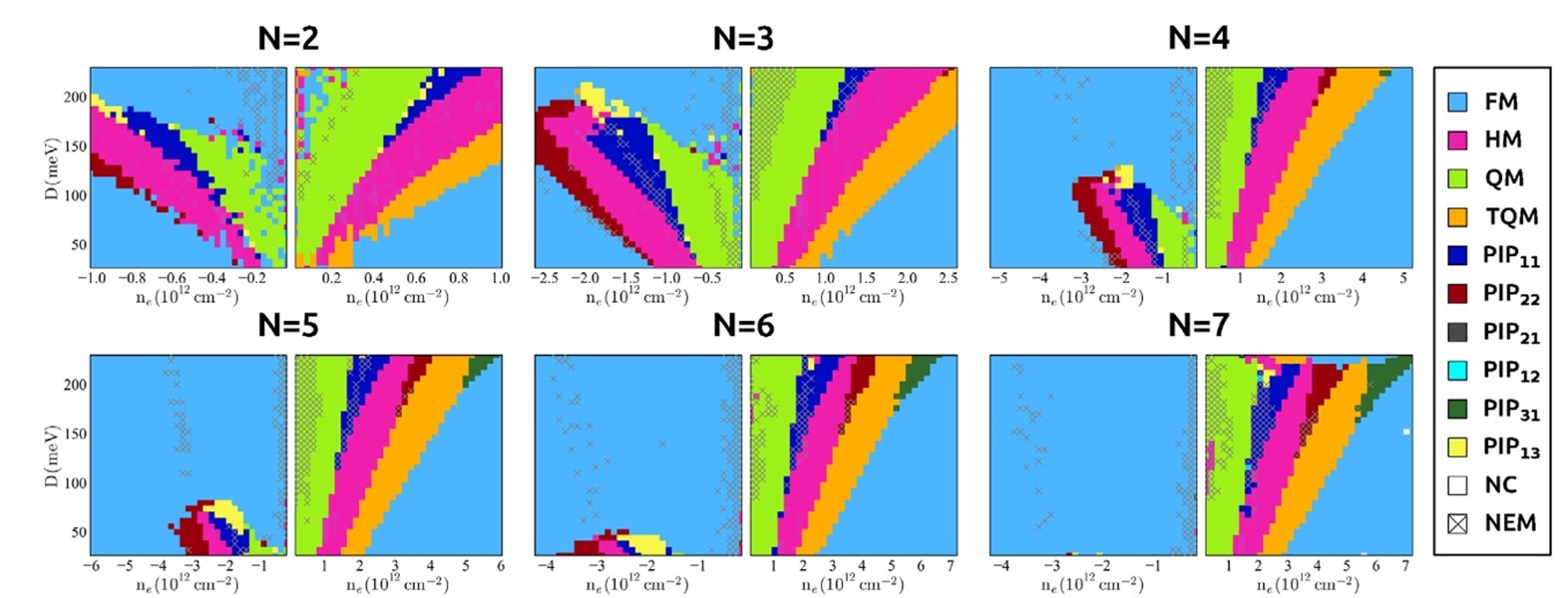
Thickness changes the picture. With added electrons, polarised states appear at every thickness examined, up to twenty layers, although the thickest stack was checked only at selected conditions. As layers are added, these states move to higher densities and weaker fields and occupy less of the map, while the ordinary metal gradually takes over. By fifteen layers it dominates at strong fields. With holes the effect is harsher: in the baseline setting, by seven layers the ordinary metal covers nearly the whole map. The surroundings matter too. Lowering the dielectric constant, a measure of how strongly the environment screens repulsion, from 10 to 4 strengthens interactions and widens the polarised regions. A dome of correlated states then survives on the hole side up to seven layers, the most examined for that setting.
Placing graphene on a material such as tungsten diselenide can induce spin–orbit coupling, a relativistic effect linking an electron’s spin to its motion. In the calculations, this stabilises a new partially polarised state and a three-quarter-metal on the hole side. Experiments point the same way: three-layer graphene beside tungsten-based compounds showed a three-quarter-metal and a strengthened superconducting state nearby, whereas earlier experiments on bare trilayers had already revealed half- and quarter-metals.
These are predictions, not observations of every calculated phase. Hartree–Fock averages over electron interactions, compares only a chosen set of candidate states, and does not describe superconductivity itself. The nematic states and the exact boundaries still await experimental tests. Even so, the work portrays rhombohedral graphene as a tunable material, where thickness, gates and surroundings select among many distinct states of interacting electrons.
Author: César Tomé López is a science writer and the editor of Mapping Ignorance
Disclaimer: Parts of this article may have been copied verbatim or almost verbatim from the referenced research paper/s.
References
- G. Parra-Martinez, A. Jimeno-Pozo, J. A. Silva-Guillen, and F. Guinea (2026) Nematic and partially polarized phases in rhombohedral graphene with varying number of layers: An extensive Hartree-Fock study Adv. Mater. doi: 10.1002/adma.202514008 ↩