Author archives: DIPC

Image of DIPC

Donostia International Physics Center (DIPC) is a singular research center born in 2000 devoted to research at the cutting edge in the fields of Condensed Matter Physics and Materials Science. Since its conception DIPC has stood for the promotion of excellence in research, which demands a flexible space where creativity is stimulated by diversity of perspectives. Its dynamic research community integrates local host scientists and a constant flow of international visiting researchers.

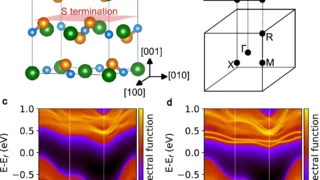
The intertwined nature of electronic waves in 2D TiSe<sub>2</sub>​ crystals

The intertwined nature of electronic waves in 2D TiSe2​ crystals

Condensed matterDIPC Advanced materialsMaterials

By DIPC

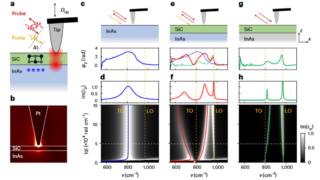
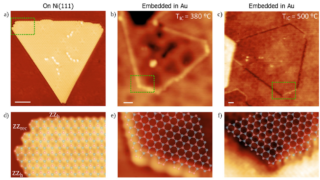
When we peel a crystal down to its very last layer, the physics governing its behavior undergoes a radical shift. This transition from the bulk (three-dimensional) to the two-dimensional limit is where some of the most exotic phenomena in condensed matter physics emerge. Among these, Titanium Diselenide, or TiSe₂, has long fascinated researchers because of […]

Challenging Bredt’s rule

Challenging Bredt’s rule

ChemistryDIPC Biochemistry

By DIPC

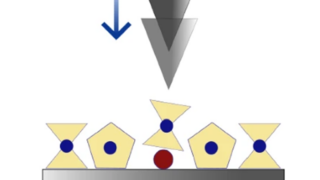
In the world of organic chemistry, some rules are taught as absolute boundaries. One of the most famous is Bredt’s rule, a guideline that has dictated the limits of molecular architecture for nearly a century. This rule essentially places a “keep off the grass” sign on certain parts of a molecule, specifically forbidding the formation […]

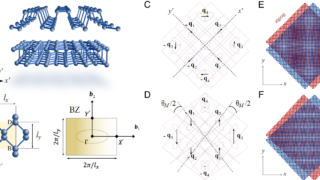
Real space geometry of aperiodic tilings as control knob for quantum physics

Real space geometry of aperiodic tilings as control knob for quantum physics

Condensed matterDIPC Advanced materialsMaterialsQuantum physics

By DIPC

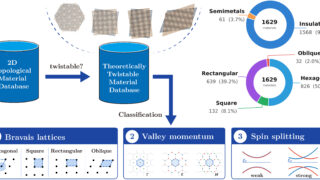
When we study solid-state physics, we usually begin with crystals. In a crystal, atoms repeat in a strict and regular pattern, much like tiles on a bathroom floor. Because every small region looks the same as every other, electrons move through a predictable landscape. This repeating order is the reason we can explain electricity, magnetism […]

Moiré patterns at the interface of topology and magnetism

Moiré patterns at the interface of topology and magnetism

DIPC Advanced materialsMaterialsNanotechnology

By DIPC

Most of the electronic devices we use every day, from smartphones to solar panels, depend on electrons moving smoothly through crystal structures. In recent years, however, researchers have discovered that stacking extremely thin materials in carefully chosen ways can produce completely new types of behavior that never appear in ordinary bulk materials. One of the […]

The filament era of the early universe

The filament era of the early universe

AstronomyAstrophysicsCosmologyDIPC Astrophysics

By DIPC

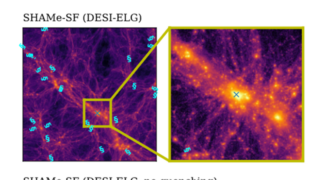
One of the most striking discoveries made by the James Webb Space Telescope, together with earlier observations from the Hubble Space Telescope, is that many galaxies in the young universe look very different from those we see around us today. Instead of graceful spiral disks or rounded ellipses, a large fraction of galaxies observed when […]

A new two-dimensional carbon allotrope combining graphene and nanoporous design

A new two-dimensional carbon allotrope combining graphene and nanoporous design

ChemistryDIPC Advanced materialsDIPC Electronic PropertiesMaterials

By DIPC

Carbon is one of the most versatile elements in the periodic table. Beyond the familiar forms of graphite and diamond lies a rich family of carbon structures with surprising and useful properties. Among these, graphene, a single two-dimensional (2D) allotrope consisting in a layer of carbon atoms arranged in a perfect hexagonal lattice, has captivated […]

Antimicrobial peptides let ions through membranes without boring holes

Antimicrobial peptides let ions through membranes without boring holes

BiochemistryChemistryDIPC PolymersPharmacy

By DIPC

Antimicrobial peptides (AMPs) are highly potent and broad-spectrum antibiotics, found as components of the innate immune system in almost all forms of life. AMPs are short proteins, tiny compared with conventional antibiotics but extraordinarily effective: they bind to and disrupt bacterial membranes, which quickly incapacitates or kills a cell. For decades, the picture many scientists […]