STRAWBERRY fields, where dark matter haloes truly end
STRAWBERRY fields, where dark matter haloes truly end
Dark matter is a mysterious, invisible substance that makes up about 27% of the Universe’s total energy content. We cannot see it directly, only infer its presence through the gravity it exerts. For decades, cosmologists have described dark matter haloes as the invisible scaffolding within which galaxies form and live. Every galaxy, including our own Milky Way, resides inside one. Yet there has always been a surprisingly awkward question hiding underneath that simple picture: where does a halo actually end?
STRAWBERRY fields
A new study 1, charmingly named STRAWBERRY, offers a fresh answer. Instead of defining a halo by drawing an arbitrary boundary around where the matter density becomes “high enough,” the researchers ask a more physical question: which dark matter particles are truly trapped by the halo’s gravity, and which are only passing through? This may sound like a technical distinction, but it changes the way we think about cosmic structure.
Imagine a mountain valley in fog. Some hikers are clearly inside the valley, unable to leave without climbing over the ridge. Others are simply crossing nearby slopes and will soon move on. Previous methods often counted both groups together because they only looked at how crowded the area was. STRAWBERRY instead studies the shape of the gravitational “landscape” itself, identifying the valleys, the ridges between them, and the particles whose energy is too low to escape.
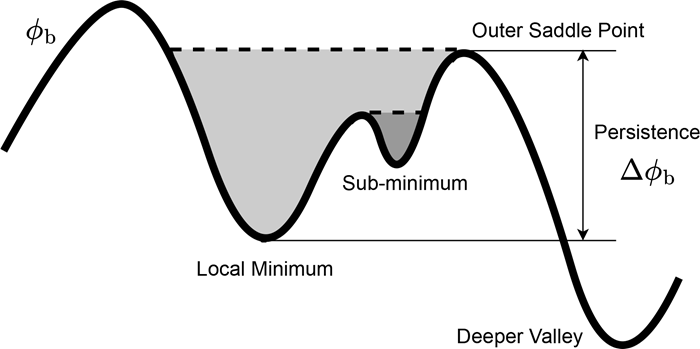
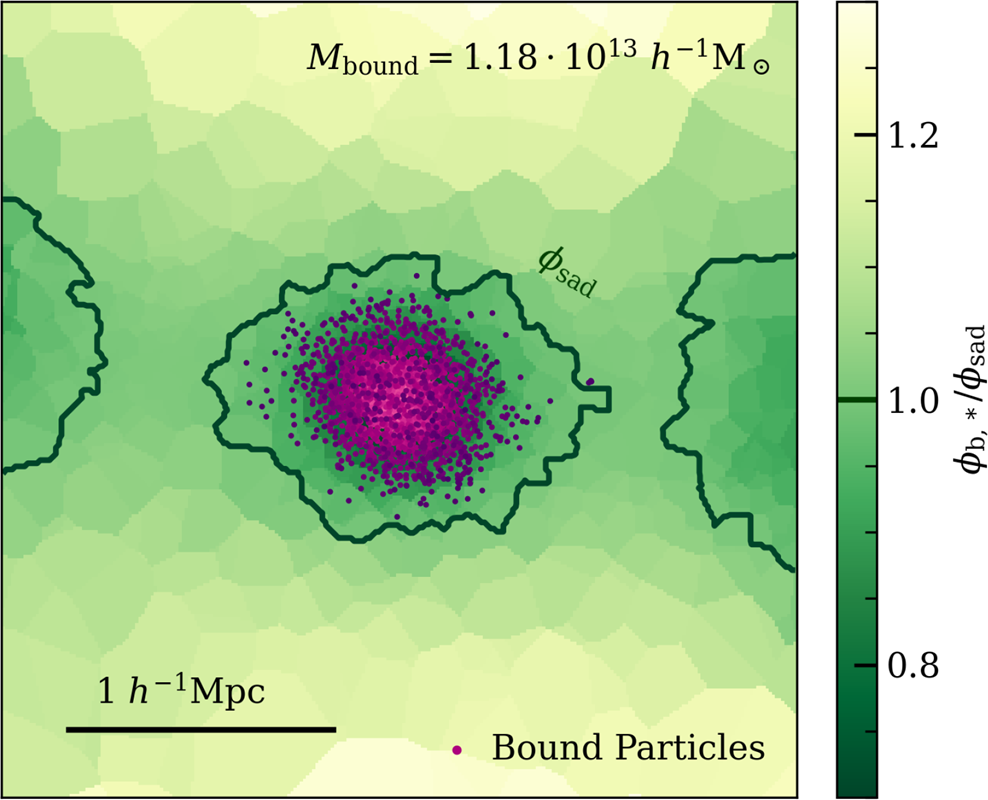
In practice, the team uses what they call the gravitational potential: a map of “gravitational altitude” that assigns a single number to every point in space, telling you how tightly gravity holds a particle there. A particle belongs to a halo if it does not have enough energy to cross the nearest gravitational pass that leads into a deeper neighbouring valley. This makes the halo boundary a true dynamical edge, defined by motion and energy, not by a human-chosen threshold.
Layered haloes
The most important result is conceptually beautiful. Dark matter haloes appear to be made of two distinct layers.
The inner layer is genuinely bound. These particles orbit the halo for long times, settle into a near equilibrium state, and create a structure with a real finite size. In the simulations, this bound core shows a sharp outer cutoff, meaning the halo mass naturally converges instead of fading ambiguously into space forever.
Outside it lies a second population, particles that are not truly captive. Some are falling in for the first time; others have swung around once and are splashing back outward — cosmologists call these the “splashback” population. They still contribute to the familiar extended halo profile, but physically they are part of the surrounding cosmic traffic rather than the stable heart of the halo.
A dark ecosystem
Thus, a dark matter halo is not just a fuzzy blob. It is more like a living ecosystem with a stable core and a constantly changing environment. After all, almost every major prediction in modern cosmology depends on haloes. We use them to estimate galaxy masses, model galaxy clustering, infer how structure grew after the Big Bang, and compare dark matter theories with observations. If we misunderstand what belongs to a halo, we can bias those results.
This work moves us away from bookkeeping definitions and toward a definition rooted in dynamics, energy, and fate. Instead of asking where matter happens to be dense today, it asks what matter is right now energetically bound to the structure. When astronomers compare theoretical haloes to galaxy surveys, they may now be able to separate the long-lived gravitational skeleton from the transient inflow around it. This new framework may therefore sharpen the bridge between simulations and real observations.
Author: César Tomé López is a science writer and the editor of Mapping Ignorance
Disclaimer: Parts of this article may have been copied verbatim or almost verbatim from the referenced research paper/s.
References
- T. R. G. Richardson, J. Stucker, and R. E. Angulo (2026) STRAWBERRY: Finding haloes in the gravitational potential Astron. Astrophys. doi: 10.1051/0004-6361/202556846 ↩