Switchable chirality in layered materials
Switchable chirality in layered materials
Chirality is one of the most familiar ideas in science. Human hands are chiral because the left and right hand are mirror images that cannot be perfectly aligned on top of one another. The same idea appears in chemistry, where molecules with opposite handedness can behave very differently. In recent years, physicists have discovered that chirality can also emerge inside crystals, where it may strongly influence electricity, magnetism, light, and even quantum topology.
A recent study 1 examined this phenomenon in a family of layered crystals called NbOX₂, where X can be chlorine, bromine, or iodine. These materials already attracted attention because they combine several unusual properties: they are ferroelectric, meaning they possess an electrically switchable internal polarization, and they interact strongly with light in ways useful for photonic devices. The new work shows that they may also provide a controllable platform for chiral quantum matter.
The central question is how a crystal that initially has no handedness can spontaneously become left-handed or right-handed. The answer lies in the way atoms arrange themselves inside the material.
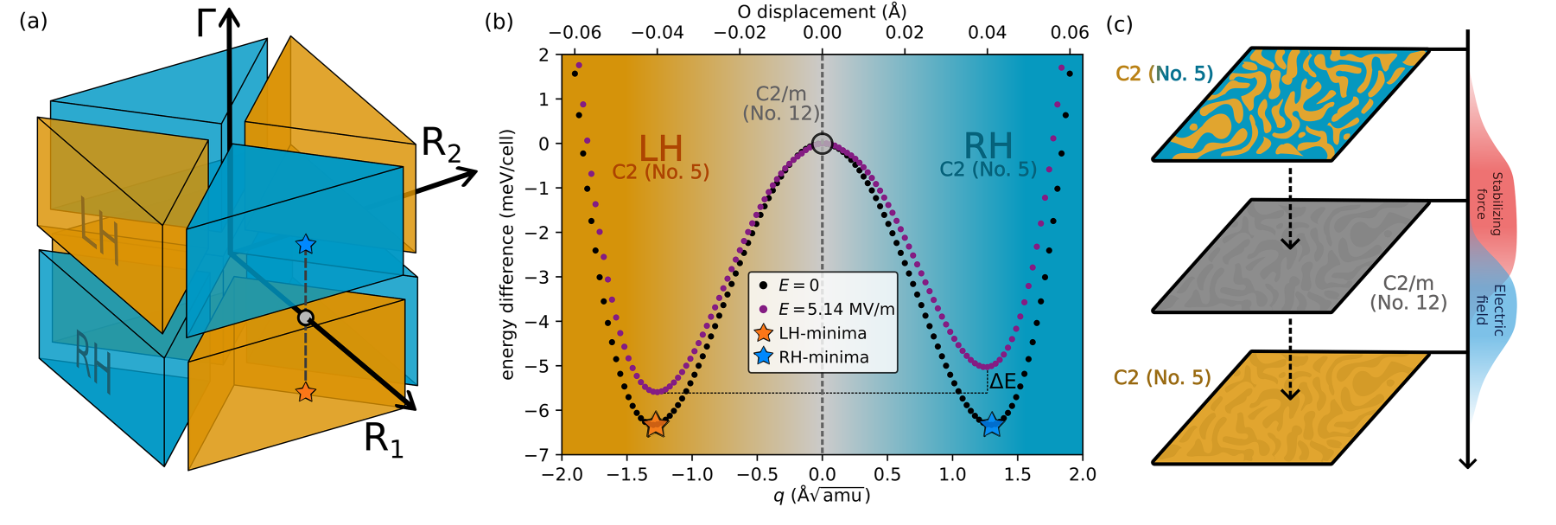
An achiral intermediate structure
At high symmetry, the crystal structure is achiral. In this state, the arrangement of atoms looks identical to its mirror image. However, calculations show that this structure is unstable. Tiny atomic vibrations naturally push the system toward a lower-energy arrangement. Instead of remaining perfectly symmetric, the atoms shift slightly and reorganize into a chiral structure with a definite handedness.
This process resembles balancing a pencil vertically on its tip. The upright position is symmetric but unstable. A tiny disturbance causes the pencil to fall in one direction or the other. In the crystal, the “falling direction” determines whether the material becomes left-handed or right-handed.
The study identifies an important intermediate stage between the symmetric and chiral phases. This intermediate structure is still achiral, but it has a very shallow energy well, making it susceptible to stabilization by external perturbations such as pressure (predicted around 81 kbar for NbOCl₂), thermal or quantum anharmonic fluctuations, or optical excitation. That makes the material unusually tunable.
The researchers mapped the crystal’s energy landscape using first-principles quantum calculations. The resulting landscape resembles a “Mexican hat” shape often encountered in symmetry-breaking physics. At the center sits the unstable symmetric state. Around the rim lie several low-energy states corresponding to different distortions of the crystal. Some distortions remain achiral, while others produce chirality.
Switchable chirality
An especially important result is that the energy barrier separating left-handed and right-handed structures is extremely small. This means the crystal could potentially switch handedness relatively easily. The study proposes a mechanism for controlling this process with an external electric field.
The electric field slightly favors one chiral arrangement over the other by breaking the mirror symmetry between them. Temperature or pressure, through anharmonic atomic fluctuations, effectively lower the energy barrier between the two enantiomers, facilitating the transition toward the preferred one. Once the field is removed, the selected chiral state can remain stable. In effect, the crystal behaves somewhat like a compass needle aligning with a magnetic field, except the field controls chirality instead of direction.
An obstructed atomic limit
Beyond chirality itself, the work also connects these materials to topological physics. In condensed matter physics, topology describes properties that remain robust even when a material is deformed or disturbed. Topological materials often host special electronic states on their surfaces or edges that are protected against defects.
The calculations reveal that the chiral phase of NbOX₂ contains an unusual electronic structure called an obstructed atomic limit. The electrons behave as though their charge is concentrated in regions that do not coincide directly with the atomic positions. This hidden organization can generate topological surface states under certain crystal cleavages; though notably not along the surface most easily exposed in the laboratory, which does not intersect the relevant charge centers.
Flat bands
The material also develops very flat electronic bands just below the Fermi level, the threshold energy separating occupied from unoccupied electron states. Flat bands are important because electrons in them have nearly zero kinetic energy, allowing their mutual repulsion to dominate and drive collective quantum behavior. Strong interactions can produce exotic quantum phenomena such as correlated insulating states or unconventional superconductivity. Similar ideas have become central in research on twisted graphene and other engineered quantum materials.
The study therefore connects several modern themes in condensed matter physics at once: spontaneous symmetry breaking, ferroelectricity, chirality, topology, and strongly interacting electrons. What makes these crystals particularly interesting is that all these effects appear in a single material family that may be experimentally controllable through electric fields, temperature, and pressure.
More broadly, the work demonstrates how chirality can emerge not merely as a static geometric feature, but as a dynamic property that can potentially be switched and manipulated. If such control becomes practical, chiral layered materials could eventually contribute to optical technologies, spin-based electronics, and future quantum devices where topology and chirality work together.
Author: César Tomé López is a science writer and the editor of Mapping Ignorance
Disclaimer: Parts of this article may have been copied verbatim or almost verbatim from the referenced research paper/s.
References
- Martin Gutierrez-Amigo, Claudia Felser, Ion Errea, and Maia G. Vergniory (2026) Emergent Chirality and Enantiomeric Selectivity in Layered NbOX2 Crystals Phys. Rev. Lett. doi: DOI: 10.1103/kb6r-zxwq ↩