Listening for the Universe’s rarest whisper
Listening for the Universe’s rarest whisper
Deep beneath the Pyrenees, in a mountain laboratory carved out of rock near the Spanish village of Canfranc, physicists have switched on a machine built to listen for one of the rarest whispers in nature. The detector is called NEXT-100, and it began taking data in May 2024. Its story is not simply one of engineering, but of a carefully designed attempt to answer a profound question about why matter exists at all.
Neutrinoless
The mystery begins with the neutrino, one of the strangest particles in physics. Neutrinos are everywhere, streaming through your body by the trillions every second, yet they barely interact with anything. One of the biggest open questions in the field is whether the neutrino is its own antiparticle. If it is, a very rare kind of radioactive decay, called neutrinoless double beta decay, should exist. In ordinary double beta decay, two neutrons inside a nucleus transform simultaneously and release two electrons together with two neutrinos. In the neutrinoless version, the neutrinos would somehow cancel each other out internally, leaving only the two electrons. Detecting this would show that a fundamental conservation law of particle physics can be broken, and it might help explain why the universe ended up filled with matter rather than equal parts matter and antimatter.
NEXT-100
NEXT-100 is built 1 to search for exactly this process in a specific form of xenon gas known as xenon-136. The detector holds about 70.5 kilograms of this isotope, compressed to high pressure inside a large vessel made from a radiopure titanium-steel alloy. The choice of gas is central to the whole design. When particles pass through pressurized xenon, they leave behind two simultaneous signatures: a flash of ultraviolet light and a trail of freed electrons. NEXT-100 reads both with unusual precision.
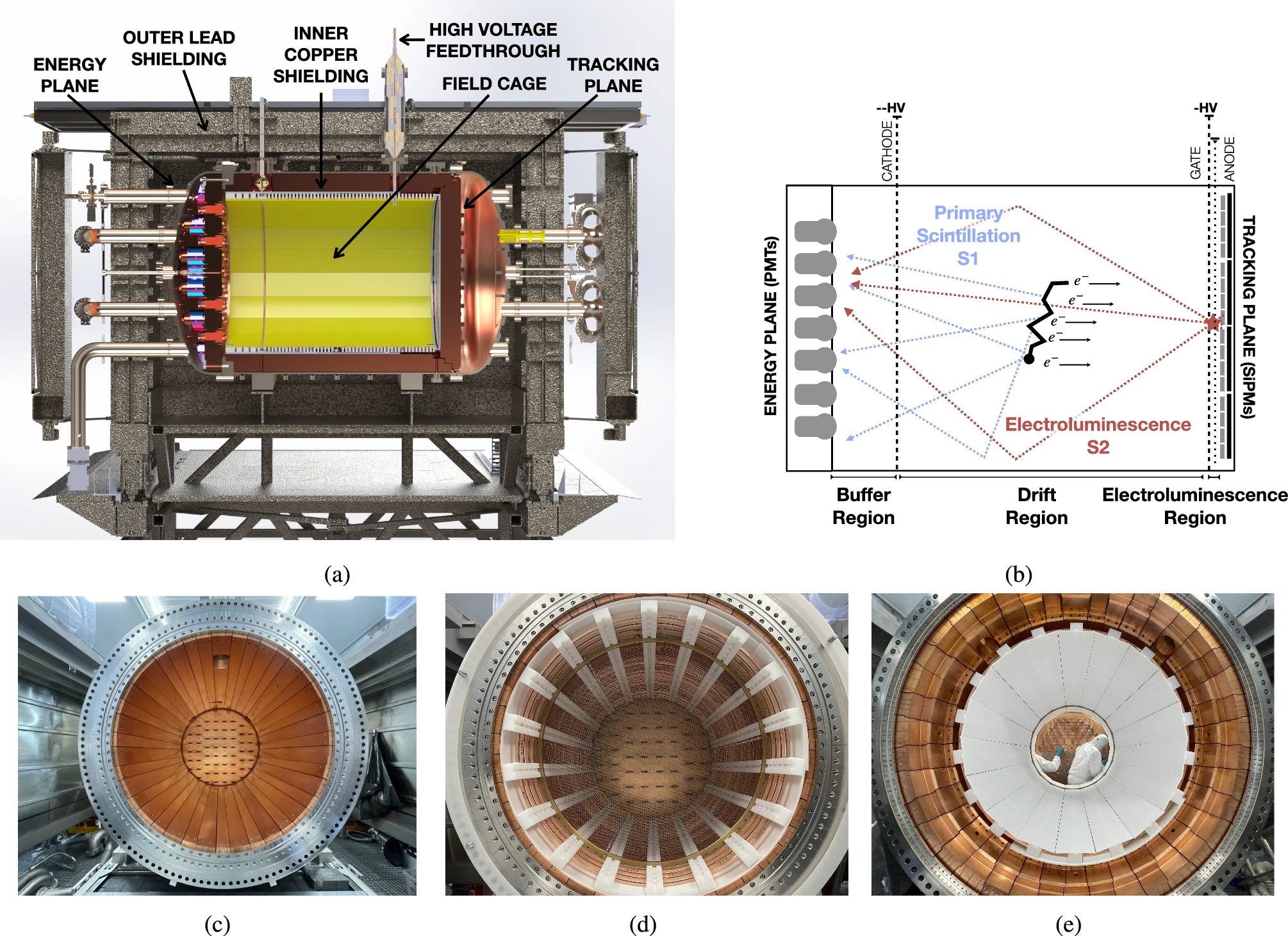
The heart of the experiment is a time projection chamber, which you can think of as a three-dimensional camera for invisible particle tracks. When a decay happens in the gas, the xenon atoms briefly light up, producing a first faint flash that marks the precise start time of the event. The freed electrons then drift slowly through the chamber under the influence of an electric field. Near one end of the vessel, they enter a narrow region where the field is strong enough to accelerate them into producing a second, much brighter burst of light, but not so strong that it triggers a chaotic avalanche. This gentle, controlled amplification, known as electroluminescence, is the key innovation of the NEXT program, because it preserves an extremely accurate measurement of the total energy deposited in the gas.
A fixed number…
That energy precision matters enormously. If neutrinoless double beta decay exists in xenon-136, it would always deposit energy at one exact value: about 2.46 million electron volts, a fixed number set by the physics of the nucleus. NEXT-100 is designed to measure energy to better than one percent precision, which allows it to pick out a genuine signal from the much broader fog of ordinary radioactive contamination that would otherwise swamp it.
…and a shape
But energy alone is not enough. The detector also records the shape of the electron tracks, and this is where things get particularly elegant. A true neutrinoless double beta decay produces two electrons that fly apart from the same point, each depositing a distinctive blob of energy at the end of its track. Most background events look quite different, typically resembling a single electron with only one such bright endpoint. By checking both the energy and the track shape simultaneously, the detector acts as a kind of double filter, rejecting far more background than either measurement could alone.
Health checks by radon
The collaboration reports that NEXT-100 has already been operating stably during its commissioning phase, first with argon and then with xenon gas. One particularly striking part of the story is how the team uses naturally occurring radioactive decays from radon, a gas that inevitably seeps into the detector in tiny amounts, as an internal health check. By tracking those decays over time, the physicists can confirm that electrons are drifting cleanly across the entire gas volume without being absorbed, a crucial requirement for the detector to work as intended.
Materials science
Another thread running through the whole project is one that might surprise you: much of particle physics turns out to be materials science. Every component of the detector, from the lead bricks forming the outer shield to the ultra-pure copper blocks lining the inside, from the plastic structural supports to the resistors shaping the electric field, has been selected or tested for extremely low levels of natural radioactivity. Even the red paint on the lead shielding had to be stripped away after it was found to contain too many radioactive contaminants during an earlier phase of the experiment. In this kind of search, a carelessly chosen bolt can generate as much unwanted background as hours of real data.
Something much bigger
What makes this experiment particularly exciting is that it is explicitly designed as a proof of concept for something much bigger. NEXT-100 aims to probe neutrinoless double beta decay half-lives on the order of ten thousand trillion trillion years, a number so large it dwarfs the age of the universe by a factor of about a trillion. If it reaches that sensitivity, and if the technology scales as the team expects, it would strengthen the case for a future ton-scale detector that could decisively test whether neutrinos are truly their own antiparticles.
So this detector is a bridge between engineering and cosmology. By watching a carefully purified volume of xenon gas deep underground, physicists are hunting for an event so rare it may happen less than once in ten thousand trillion trillion years per atom. Yet if they ever see it, the consequences would ripple through our understanding of mass, symmetry, and the cosmic origin of matter itself.
Author: César Tomé López is a science writer and the editor of Mapping Ignorance
Disclaimer: Parts of this article may have been copied verbatim or almost verbatim from the referenced research paper/s.
References
- NEXT Collaboration (2026) The NEXT-100 Detector. Eur. Phys. J. C doi: 10.1140/epjc/s10052-025-14951-y ↩