Tuning a crystal until light and sound fuse
Tuning a crystal until light and sound fuse
At the smallest scales, materials are never entirely still. Atoms in a crystal continuously vibrate around their resting positions, and some of these vibrations, called phonons, have well-defined energies that can interact with light. Normally, light and a material vibration can be treated as separate things. But when their interaction becomes strong enough, they can no longer be described independently: they merge into new hybrid states known as polaritons, which carry properties of both light and matter. When the strength of this interaction becomes comparable to the energy of the excitations themselves, the system enters what physicists call the ultrastrong-coupling regime, a demanding condition achieved in only a handful of platforms.
A team of researchers explores now 1 an unusual version of that phenomenon using two materials: a very thin layer of silicon carbide sitting on a semiconductor called indium arsenide. Silicon carbide has a characteristic vibration, called a phonon, in which neighbouring atoms move against each other. Indium arsenide, when it contains enough mobile electric charges, supports a surface electromagnetic wave called a surface plasmon polariton, which travels along its surface. The goal was to bring the energy of these two excitations into the same range so that they would interact strongly, and even ultrastrongly.
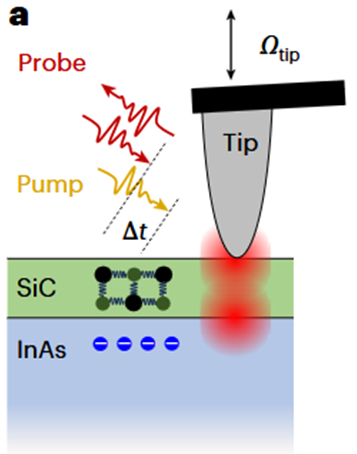
To do this, the researchers used a clever trick to tune the semiconductor on demand. A very short pulse of near-infrared light strikes the indium arsenide and temporarily knocks loose additional mobile electrons, briefly raising their concentration to roughly 10¹⁸ to 10¹⁹ per cubic centimetre. This shift changes the frequency of the surface plasmon polariton. By adjusting the delay between this pulse and a second, infrared probe pulse, the surface wave could be tuned until its frequency approached that of the silicon-carbide vibration.
The interaction itself was observed with a nanoscale infrared microscope. A metal-coated atomic-force-microscope tip, its very apex only tens of nanometres across, concentrates the infrared electric field into a spot far smaller than the wavelength of the light itself. This trick lets the instrument detect surface waves that are far more tightly confined than ordinary infrared measurements can reach, overcoming a long-standing barrier: free-space light and tightly confined surface waves normally cannot exchange energy efficiently, so ordinary spectroscopy cannot probe such confined waves directly. The scattered infrared light is analysed for both its strength and its phase, revealing how the excitations behave across both frequency and space.
Ultrastrong-coupling regime
The clearest sign of strong coupling is that a single resonance does not simply shift when two excitations meet; it splits into two new resonances, one above and one below the original frequency. Here, the measured splitting reached about 180 wavenumbers, more than 20 percent of the silicon-carbide vibration frequency, placing the system solidly in the ultrastrong-coupling regime. Calculations reproduced the observed splitting and confirmed that the new states are indeed a genuine mixture of the semiconductor surface wave and the silicon-carbide vibration.
The most surprising result appeared when the coupling was examined not just as a function of frequency but of the wave’s momentum, a quantity related to how tightly a wave is confined in space: the more confined the wave, the higher its momentum. In ordinary strong or ultrastrong coupling, two excitations mix substantially only over a narrow range near the point where their energies coincide. Here, however, the surface plasmon polariton’s frequency barely changes across a wide range of momenta once it becomes tightly confined against the surface, essentially flattening out. Because of this “flat” behaviour, the wave stays close enough in energy to the silicon-carbide vibration to remain strongly mixed across an unusually broad range of momenta, rather than only at a single, sharply defined point. The resulting hybrid states are described as having a flat band.
This spatial behaviour was confirmed directly by scanning the nanoscale probe across the edge of the silicon-carbide layer. Hybrid surface waves launched at the tip travel outward, reflect off the edge, and interfere with the incoming field, creating a pattern of intensity maxima and minima. Analysing this interference pattern reveals both the wavelength and the direction of travel of the hybrid waves. The resulting dispersion, that is, how the frequency of the wave changes with its momentum, closely matched theoretical predictions, providing independent confirmation of the unusually broad coupling.
There is a trade-off. A flat dispersion means these hybrid excitations travel with a very small group velocity, so they cannot efficiently carry energy over long distances. Even so, because many more momentum states can now participate in the coupling than in conventional systems, a much larger family of hybrid states becomes accessible.
The study also predicts, though does not yet demonstrate, that a similar flat-band effect could occur when molecular vibrations couple to low-loss surface phonon polaritons: electromagnetic surface waves that ride along vibrations in a polar crystal, related to silicon carbide’s own phonon but propagating along the surface rather than confined within a thin layer. Coupling light strongly to molecular vibrations, known as vibrational strong coupling, has attracted attention for its potential to influence chemical reactivity, although exactly how and why this happens is still being worked out. The significance of this work is therefore not a ready-made chemical technology, but a demonstrated way to generate and observe a much larger family of strongly hybridized light-matter states, extending the reach of strong coupling into a regime where the usual boundary between light and matter begins to blur.
Author: César Tomé López is a science writer and the editor of Mapping Ignorance
Disclaimer: Parts of this article may have been copied verbatim or almost verbatim from the referenced research paper/s.
References
- E. Vicentini, X. Arrieta, M. Schnell, N. Pajusco, F. Begemann, M. B. Burillo, M. Ramos, A. Bylinkin, R. Esteban, J. Aizpurua, and R. Hillenbrand (2026) Real-space observation of flat-band ultrastrong coupling between opticalphonons and surface plasmon polaritons Nat. Mater. doi: 10.1038/s41563-025-02412-6 ↩