How a magnetic molecular junction shapes the current between two superconductors
How a magnetic molecular junction shapes the current between two superconductors
In 1911, Heike Kamerlingh Onnes cooled mercury to a few degrees above absolute zero and watched its electrical resistance vanish. Lead soon joined the list of superconductors, losing its resistance below about 7.2 kelvin. A full explanation arrived in 1957: electrons bind into Cooper pairs that move together as one collective state below a critical temperature. Breaking a pair costs a minimum amount of energy, called the energy gap, so inside the gap a superconductor offers no states for single electrons.
Yu–Shiba–Rusinov states
Magnetism is an old enemy of this order. Magnetic impurities were known to suppress superconductivity, and in the 1960s Yu, Shiba and Rusinov showed theoretically that a magnetic atom disturbs the pairs around it and traps a localized state with an energy inside the gap. These Yu–Shiba–Rusinov (YSR) states were first seen atom by atom in 1997, using a scanning tunneling microscope (STM): a needle-sharp metal tip that measures the tiny current of electrons tunneling across a vacuum gap to a surface.
A different story concerns two superconductors joined by a very weak link. In 1962, Brian Josephson predicted that Cooper pairs can tunnel through such a link with no voltage at all, an effect confirmed in 1963. When a voltage is applied, another process takes over: multiple Andreev reflection. An electron whose energy lies inside the gap cannot enter a superconductor alone. Instead it is sent back as a hole, the absence of an electron, while a Cooper pair slips in, as Andreev described in 1964. Between two superconductors under a voltage V, a particle can bounce back and forth, gaining energy eV with each crossing, until it can finally escape above the gap. When n crossings are needed, the conductance shows a peak at a voltage equal to the sum of the two gaps divided by n. This pattern, explained in the early 1980s, is called subharmonic gap structure. For lead on lead the sum is 2.7 millivolts, so peaks are expected near 2.7, 1.35 and 0.9 millivolts.
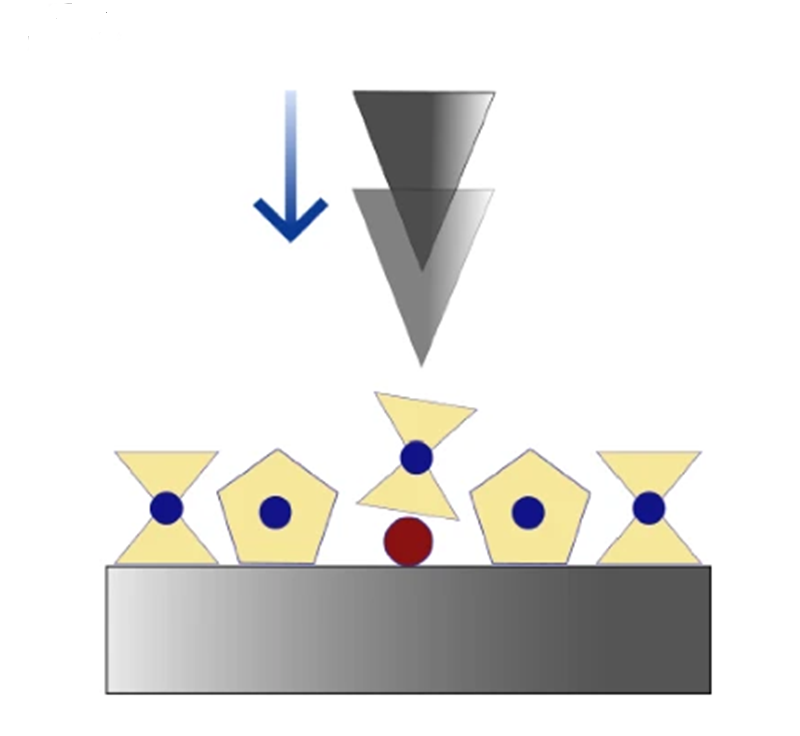
Impurity states and Andreev reflections have usually been treated as separate subjects. A recent experiment 1 places them in the same device. A nickelocene molecule, a nickel atom sandwiched between two five-carbon rings, sits on a lead surface above a single iron atom trapped between the molecule and the lead. On its own, the molecule carries a spin that appears as characteristic steps in the measured spectra. Above the iron, those steps vanish and YSR states appear instead. Density-functional calculations explain why: the magnetic moments of molecule and iron point in opposite directions and almost cancel, leaving a leftover spin of one half on the iron. That spin couples to the lead and produces a single pair of YSR states.
The second superconductor is a lead-coated STM tip, lowered toward the molecule at 2.4 kelvin. Far away, electrons tunnel through a wide vacuum barrier and the tip merely reads out the YSR states, which appear as lopsided peaks near the edge of the gap. As the tip approaches, the junction becomes more transparent, meaning electrons cross it more easily, and the setup becomes a weak link between two superconductors. At moderate conductance, new peaks appear at half the sum of the gaps, the signature of second-order Andreev reflection. At the highest conductances, a sharp peak develops at zero voltage: the Josephson contribution. Thermal fluctuations of the superconducting phase broaden this peak, as is typical of STM junctions.
These stages do not simply stack. As the tip approaches, the YSR peak moves to lower energy and mingles with the Andreev peaks. The interpretation is that the bound state becomes a stopping point along the Andreev path. Peaks then appear at the tip’s gap plus the bound-state energy, divided by n, rather than at the ordinary positions. This is called YSR-assisted multiple Andreev reflection.
Odd and even orders
A simple argument explains why odd and even orders differ. Each reflection carries the particle to the opposite electrode, and only the lead surface contains the magnetic atom; the tip has none. After an odd number of crossings the particle ends on the surface, where it can land in the bound state. The peak shifts and acquires the lopsided shape typical of tunneling into a single level. After an even number it ends in the tip, among ordinary states, and those peaks stay closer to their usual positions, although the second-order peak still turns lopsided at higher conductance as a YSR-assisted component splits off. Simulations reproduce this pattern. In the measurements, thermal broadening blurs finer details such as the third-order peak, and small features near zero voltage seem to reflect a mixture of both processes.
Reproducing the evolution of the spectra required two changes together: higher transparency and a stronger exchange coupling between the iron spin and the lead. Raising transparency alone gives a growth of the key peak that the measurements do not show. A likely reason is that the approaching tip slightly squeezes the molecule and strengthens the coupling, though this is an inference. The model treats the spin as classical and its two parameters as effective ones, so it is a phenomenological decomposition rather than a unique microscopic extraction. It also cannot capture the zero-voltage peak.
Even so, the result shows that YSR states and Andreev reflections are two limits of one problem, tuned continuously within a single molecular junction. Under suitable conditions, such spin-active links might also host a Josephson diode, in which supercurrent flows more easily in one direction, or a π-junction, in which the two superconductors prefer opposite phases. These remain possibilities, not demonstrated effects.
Author: César Tomé López is a science writer and the editor of Mapping Ignorance
Disclaimer: Parts of this article may have been copied verbatim or almost verbatim from the referenced research paper/s.
References
- C. Mier, A. Fetida, R. Robles, P. Boronat, D. Jyoti, N. Lorente, L. Limot, and D. -J. Choi (2026) Yu-Shiba-Rusinov-assisted Andreev transport in a molecular junction between superconductors Nat. Commun. doi: 10.1038/s41467-026-76478-4 ↩