Phonon anomalies and magnetic order in chromium antimonide (CrSb)
Phonon anomalies and magnetic order in chromium antimonide (CrSb)
In a solid, atoms are never completely still. Even close to absolute zero they jiggle around their equilibrium positions, and this motion travels through the crystal as collective waves called phonons. Meanwhile, electrons carry electric charge and an intrinsic property called spin, which is the origin of magnetism. These ingredients are usually studied separately, yet they can strongly influence one another. Chromium antimonide (CrSb), a compound of chromium and antimony, now offers one of the most striking examples 1.
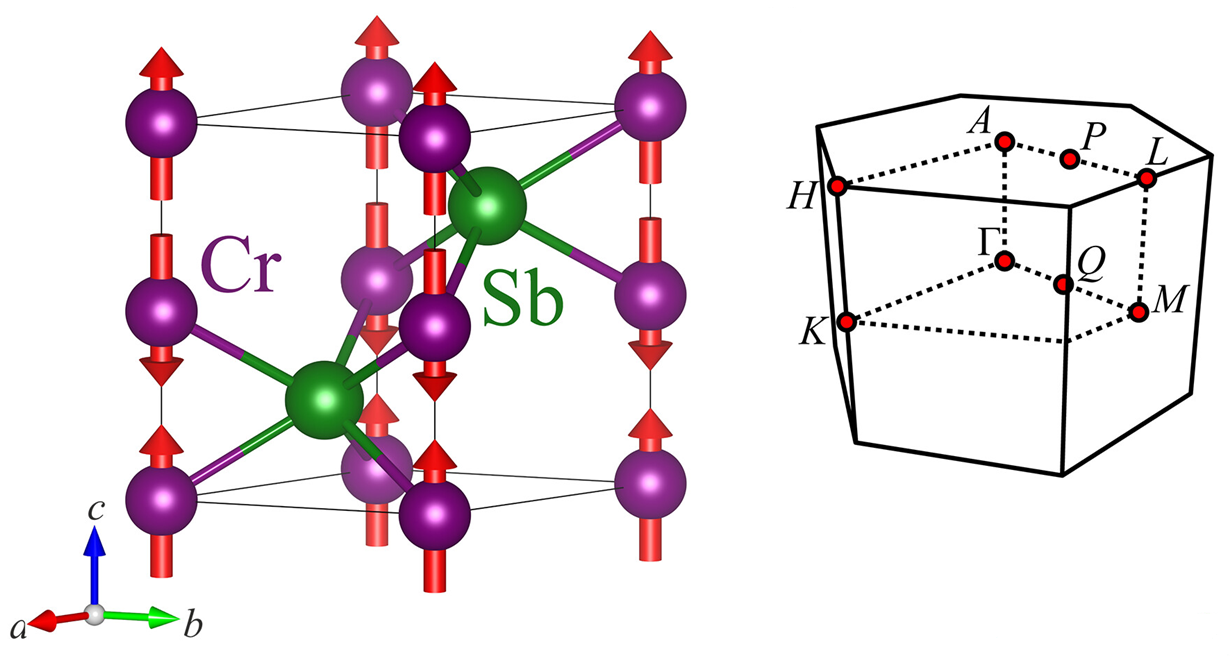
CrSb has a hexagonal crystal structure in which layers of chromium atoms alternate with layers of antimony atoms. Each chromium atom acts as a tiny magnet. Within a layer all the magnets point the same way, while neighboring layers point in opposite directions, so the magnetism cancels overall. This arrangement is called antiferromagnetism. Louis Néel proposed it in the 1930s, neutron-scattering experiments on manganese oxide confirmed it in 1949, and Néel received the 1970 Nobel Prize in Physics. In CrSb the order appears below about 712 kelvin (roughly 440 °C), the Néel temperature, which is unusually high for such a material.
CrSb also belongs to the altermagnets, a family of magnets recognized only recently. Theorists singled them out between 2019 and 2022, and the first direct experimental evidence came in 2024 in manganese telluride. Like antiferromagnets, altermagnets have no net magnetization. But because their two sets of opposite magnets are related by a rotation or reflection of the crystal, electrons with opposite spins have different energies when moving in certain directions. This combination makes them attractive for future spin-based electronics.
Crossing the Néel temperature reshapes the crystal. X-ray diffraction shows that the distance between layers shrinks sharply as the crystal cools through the transition, the layers expand slightly in their plane, and the volume of the unit cell changes in an abrupt step of about 0.2 percent. No new crystal structure appears; the change is magnetic in origin. The mechanism is called exchange striction: the strength of the magnetic interaction between neighboring atoms depends on their separation, so once magnetic order sets in, the atoms shift to lower the total energy.
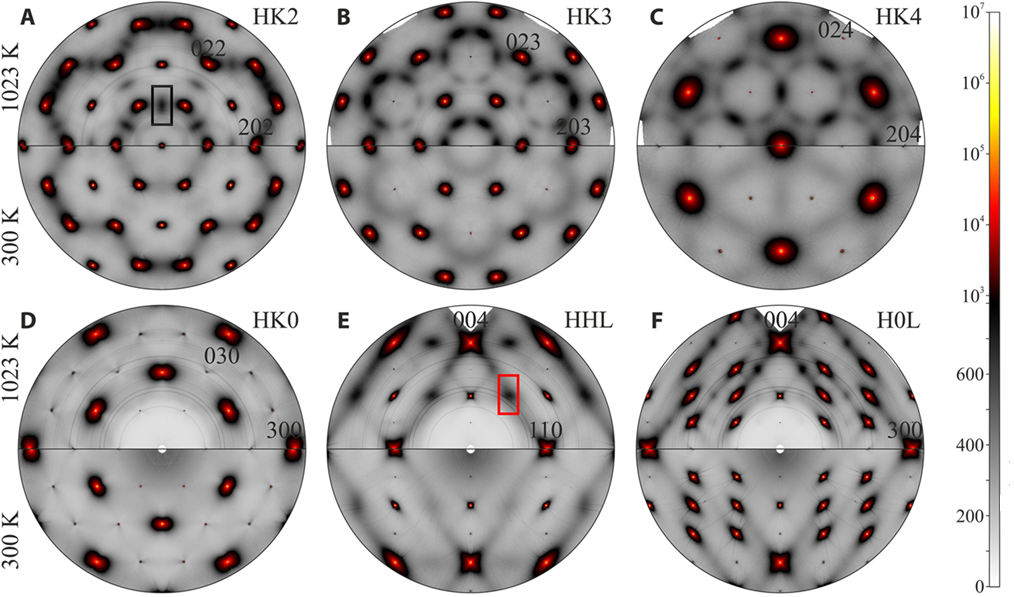
Above the Néel temperature, something else is developing. A perfect crystal scatters X-rays into sharp spots, whereas faint, spread-out “diffuse” scattering reveals local departures from perfect order. In CrSb this diffuse signal is strongest for a pattern that repeats every two unit cells in one direction within the layers, a location known as the M point of reciprocal space (a mathematical map of the repeating patterns in a crystal). It persists up to the highest temperature measured, about 1,020 kelvin, and collapses once magnetic order sets in. The patterns are tiny, extending only about 2.5 nanometers within the layers and 1.5 nanometers between them. Had they spread throughout the crystal, they would have formed a charge-density wave, a regular modulation of electronic charge accompanied by shifted atoms, as found in other metals. In CrSb that wave never forms; the patterns remain short-range fluctuations that magnetism suppresses.
Atomic vibrations reveal why. In 1959 Walter Kohn showed that conduction electrons can lower the energy of vibrations with particular wavelengths, producing a dip in the phonon spectrum now called a Kohn anomaly. Inelastic X-ray scattering, which measures the energy X-rays gain or lose in the crystal, detects a Kohn-like anomaly at the M point. The lowest-energy vibration there, a mixture of in-plane chromium motion and out-of-plane antimony motion, has an energy of about 10 millielectronvolts at room temperature but only about 4 near and above the Néel temperature. This softening of roughly 6 millielectronvolts is among the largest effects of magnetism on lattice vibrations ever reported.
Calculations explain the electronic side. For the nonmagnetic state, which mimics the crystal above the Néel temperature, they predict two nearly flat electronic bands right at the Fermi level, the energy below which electron states are filled at absolute zero. Flat bands pack many electron states at almost the same energy, so electrons respond strongly to atomic motion. If atoms are treated as perfect springs, the same vibration comes out unstable, meaning the atoms should spontaneously rearrange. Real crystals do not collapse, because at high temperature the forces between atoms deviate from perfect springs. Including this anharmonicity stabilizes the vibration at an energy consistent with the measurements.
Magnetic order changes the picture. In the antiferromagnetic calculation, the flat bands are pushed 1.5 to 2 electronvolts below the Fermi level, removing the electron states that drive the instability. Coupling between electrons and vibrations at the M point weakens, the charge correlations fade, and exchange striction between neighboring chromium atoms stabilizes the vibration, which is why its energy changes so much at the transition. In effect, a charge-density wave tries to form and magnetism wins.
CrSb therefore shows that magnetic, electronic and lattice properties cannot be understood in isolation. Its simple structure and high ordering temperature make it a clean testing ground for such competition in altermagnets, and similar rivalries between ordered states shape other quantum materials, including high-temperature superconductors.
Author: César Tomé López is a science writer and the editor of Mapping Ignorance
Disclaimer: Parts of this article may have been copied verbatim or almost verbatim from the referenced research paper/s.
References
- A. Korshunov, M. Alkorta, C. -Y. Lim, F. Ballester, C. Li, Z. Li, D. Chernyshov, A. Bosak, M. G. Vergniory, I. Errea, and S. Blanco-Canosa (2026) Competing charge and spin instabilities and giant magnetoelastic coupling in CrSb Sci. Adv. doi: 10.1126/sciadv.aei0921 ↩